| Major Groups > Boletes > Tylopilus > Tylopilus sordidus |

|
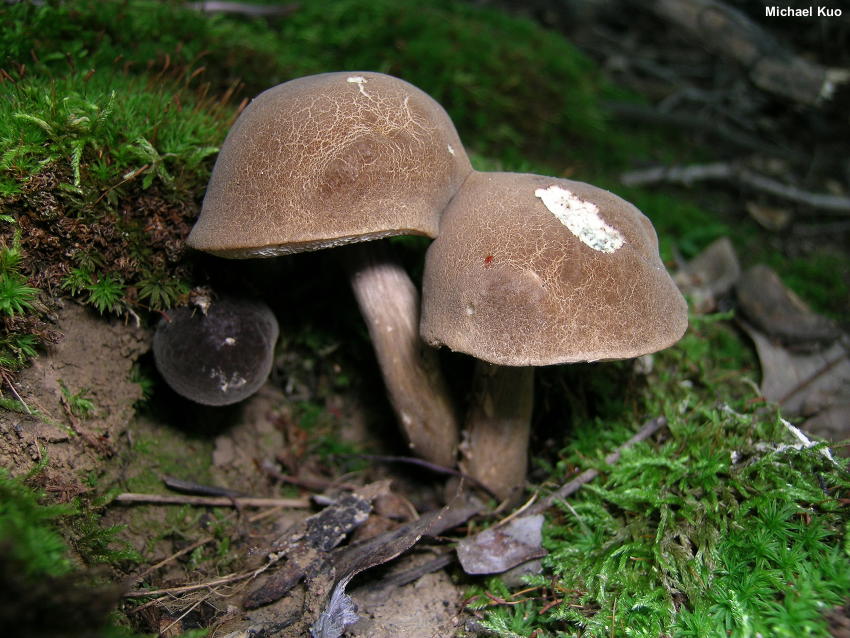
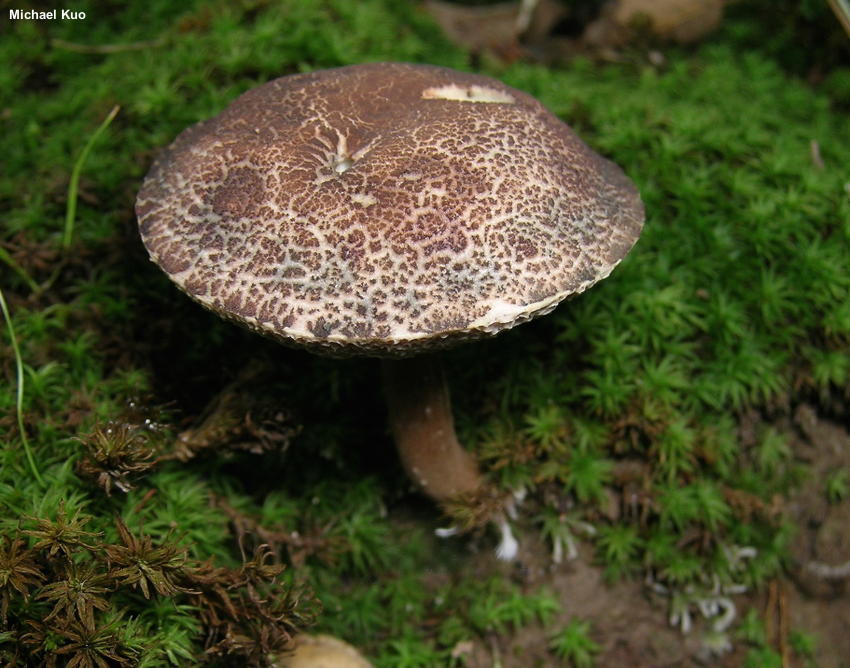
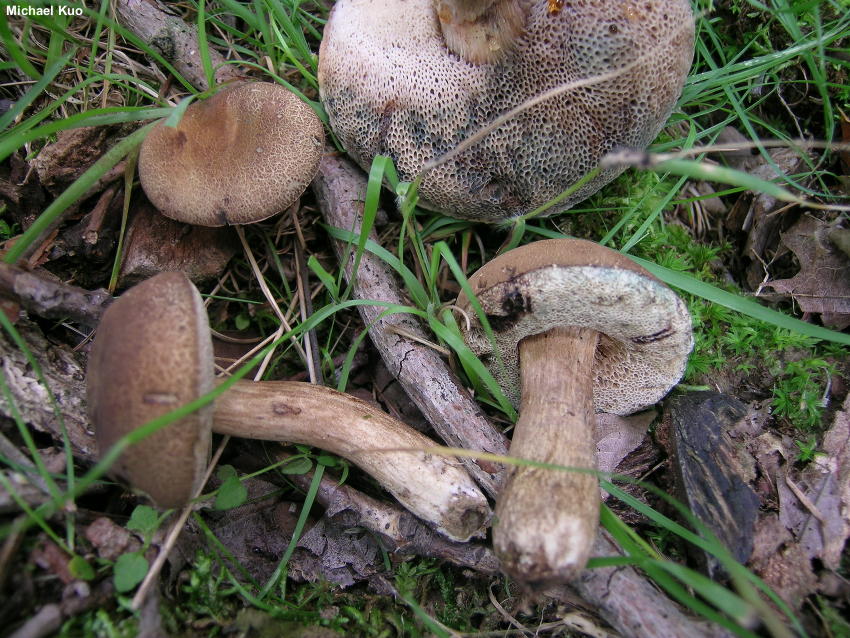
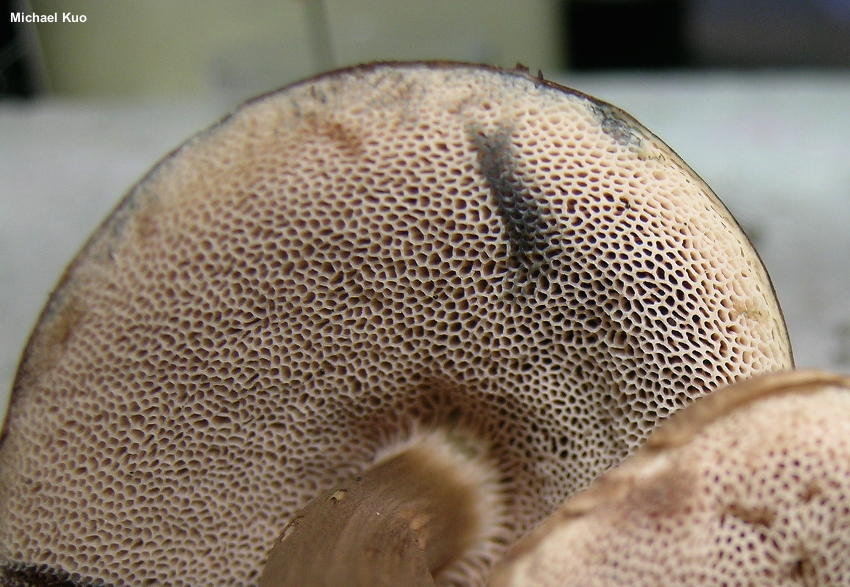
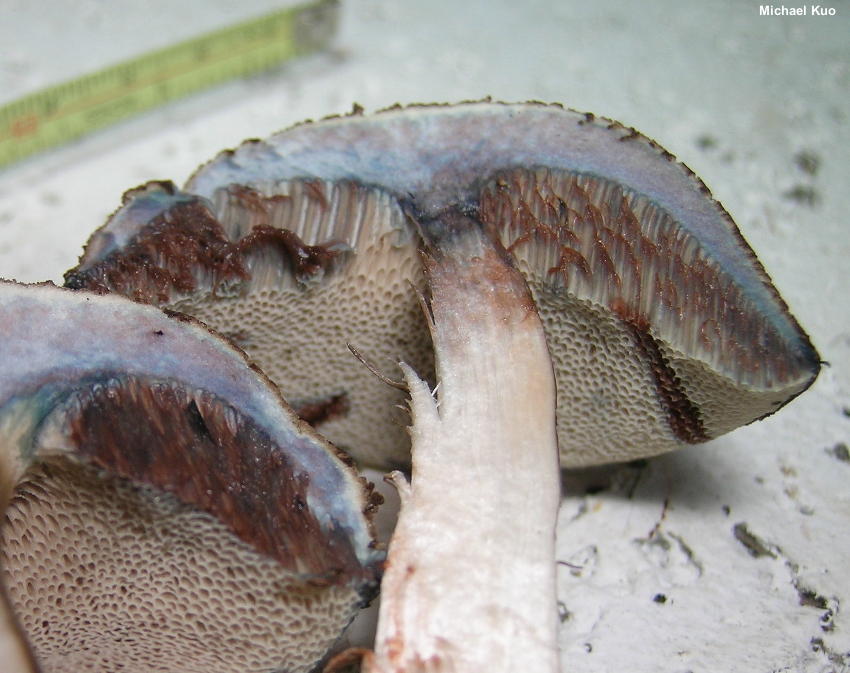
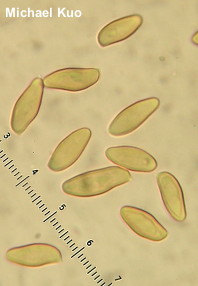
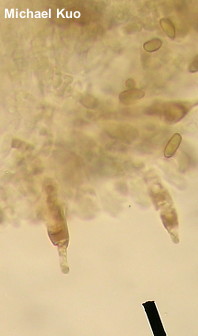
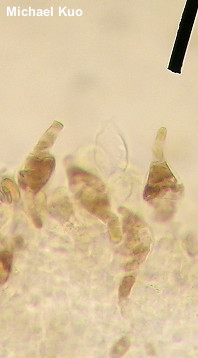
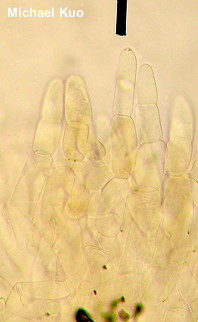
Tylopilus sordidus [ Basidiomycota > Boletales > Boletaceae > Tylopilus . . . ] by Michael Kuo This eastern North American bolete features a dark brown, velvety cap that usually becomes cracked and mosaic-like with age. Its pore surface is whitish to grayish when young, but becomes pinkish brown with maturity—and its surfaces and flesh stain blue when bruised. Under the microscope, it features an impressive palisadoderm on its cap surface, spores generally measuring 10–15 µm in length, and hymenial cystidia that are filled with brown, globular material. Tylopilus sordidus is part of a group of bolete species with dark brown colors and pinkish to reddish brown spore prints, currently placed in the genus Tylopilus. However, DNA studies have made it clear that these mushrooms are not, in fact, very closely related to the core group of Tylopilus species, centered around Tylopilus felleus (see, for example, Nuhn and collaborators, 2013, or Wu and collaborators, 2014). Thus the genus name for these mushrooms is likely to change soon—probably to "Porphyrellus," which is a genus name proposed for the group even before DNA studies. The Porphyrellus group in North America is in desperate need of research and clarification—especially the representatives from eastern North America with whitish to grayish young pore surfaces (as opposed to the species with a brown young pore surface, like Tylopilus porphyrosporus, which is also a bit stockier and features significantly larger spores). Species names in this group have been used, abused, and argued over for decades, including sordidus, fumosipes, cyaneotinctus, umbrosus. I have opted to use the oldest name available from the group, Frost's 1874 "Boletus sordidus," for the sake of simplicity, since most of the erudite microscopic features used to separate these taxa in the 1970s seem unlikely to be truly informative in a contemporary, DNA-based context. However, if you disagree with my approach, feel free to consult Smith & Thiers (1971; see the key to section Porphyrellus) and Wolfe (1979), who argues that Smith & Thiers got several things wrong. Description: Ecology: Mycorrhizal with oaks and other hardwoods; usually growing alone, in pairs, or scattered; summer and fall; probably widely distributed east of the Rocky Mountains. The illustrated and described collections are from Illinois and Pennsylvania. Cap: 3–7 cm; convex when young, becoming broadly convex or nearly flat in age; dry; finely velvety when young, becoming more or less bald and usually cracking and splitting with maturity, exposing whitish flesh that may stain pinkish or bluish; dark brown to nearly black when young, becoming medium yellowish brown or grayish brown with age; often with bluish tints by maturity, at least near the margin. Pore Surface: Depressed around the stem; whitish to grayish at first, becoming brown to dark pinkish brown; bruising blue, then slowly reddish brown (sometimes bruising red in very young specimens); pores circular, 1–2 per mm; tubes to 13 mm deep. Stem: 3–7 cm long; up to 1.5 cm thick; more or less equal above a slightly enlarged base; dry; bald or finely silky to dotted; brownish; not reticulate; sometimes longitudinally ridged; basal mycelium white; base bruising red. Flesh: Pale yellowish in cap; white in stem; staining blue and/or pinkish to purple when sliced. Odor and Taste: Not distinctive. Chemical Reactions: Ammonia dark purple to black on cap (sometimes with a red stage); yellowish to orangish on flesh. KOH red to reddish on cap; orangish on flesh. Iron salts negative on cap; blue-green on flesh. Spore Print: Brown to reddish brown. Microscopic Features: Spores 10–16 x 4–6 µm; subfusoid to ellipsoid; smooth; brownish yellow in KOH; brownish and "punched" in Melzer's. Cheilocystidia 35–50 x 10–20 µm; abruptly clavate to sphaeropedunculate; thin-walled; hyaline; smooth. Pleurocystidia 35–50 x 10–20 µm; fusiform to fusoid-ventricose, often developing a long neck; smooth; thin-walled; filled with globular brown inclusions. Pileipellis a palisadoderm; elements 10–15 µm wide, smooth, hyaline to yellow-brown in KOH; slightly constricted at septa; terminal cells short-cylindric with rounded, narrowed, or subfusiform apices. REFERENCES: (Frost, 1874) Smith & Thiers, 1968. (Saccardo, 1888; Coker & Beers, 1943; Snell & Dick, 1970; Smith & Thiers, 1971; Grund & Harrison, 1976; Wolfe, 1979; Smith, Smith & Weber, 1981; Phillips, 1991/2005; Both, 1993; Bessette, Roody & Bessette, 2000; McNeil, 2006; Kuo & Methven, 2014.) Herb. Kuo 07230401, 07070701, 06240801, 07201406. This site contains no information about the edibility or toxicity of mushrooms. |
© MushroomExpert.Com |
|
Cite this page as: Kuo, M. (2016, June). Tylopilus sordidus. Retrieved from the MushroomExpert.Com Web site: http://www.mushroomexpert.com/tylopilus_sordidus.html |