| Major Groups > Boletes > Tylopilus > Tylopilus rubrobrunneus |

|
Tylopilus rubrobrunneus [ Basidiomycota > Boletales > Boletaceae > Tylopilus . . . ] by Michael Kuo This beautiful, bitter tasting eastern North American mushroom is very common in some years—and seemingly absent in others. In my area (central Illinois), at least four species of Tylopilus can look very similar, especially at maturity, when their caps have faded to tan. Distinguishing these mushrooms in the field requires close observation of three details:
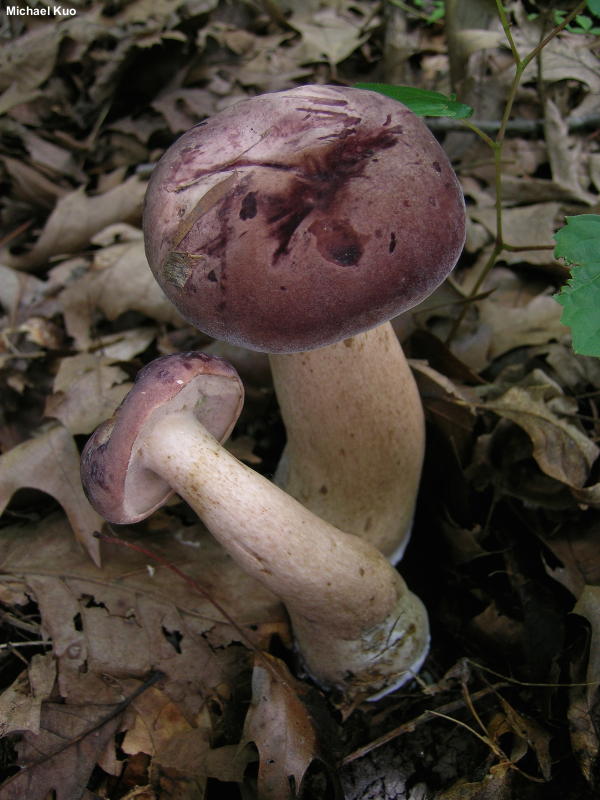
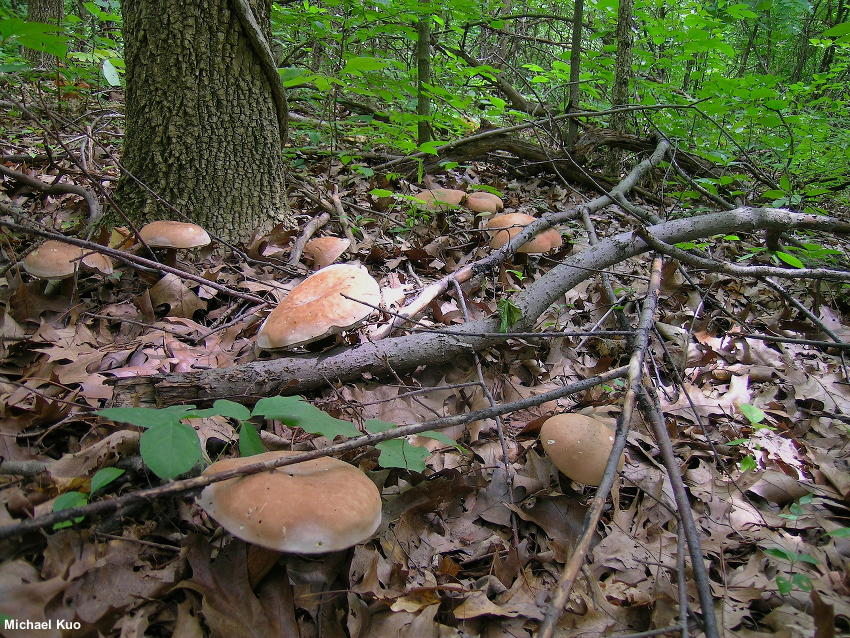
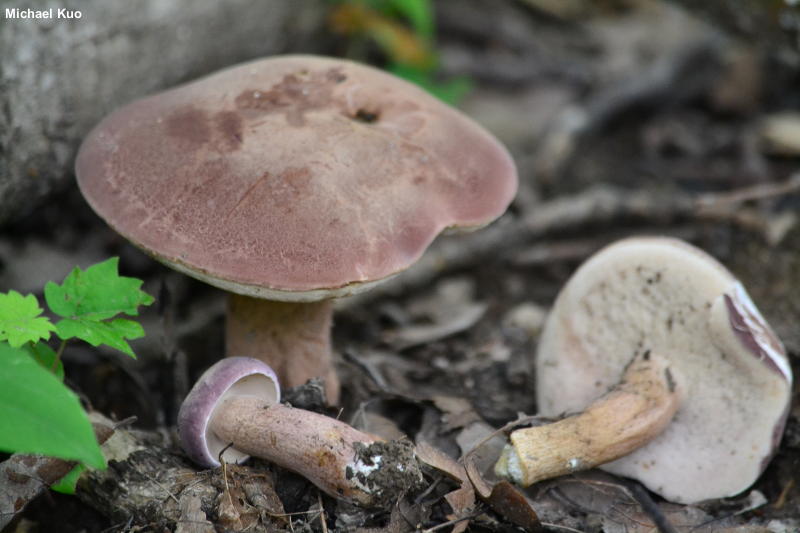
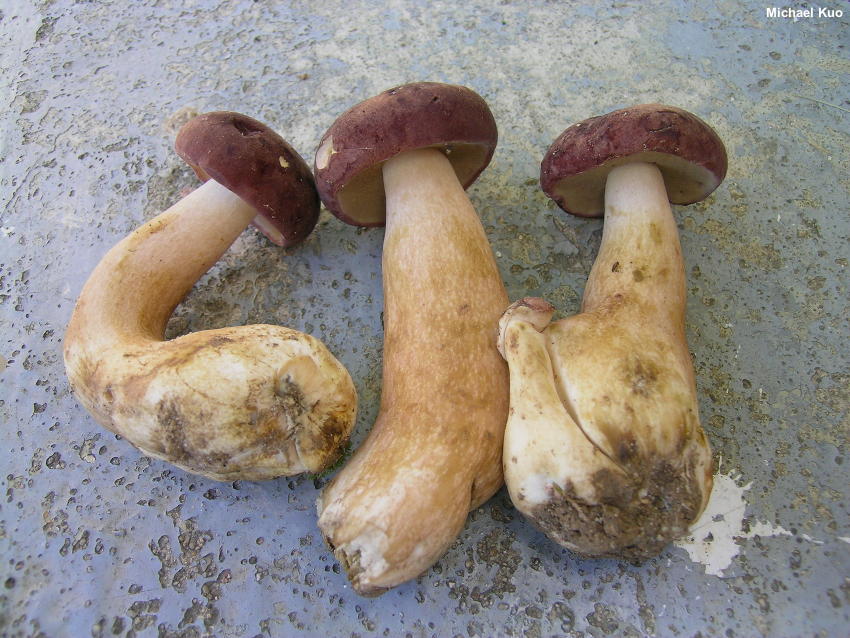
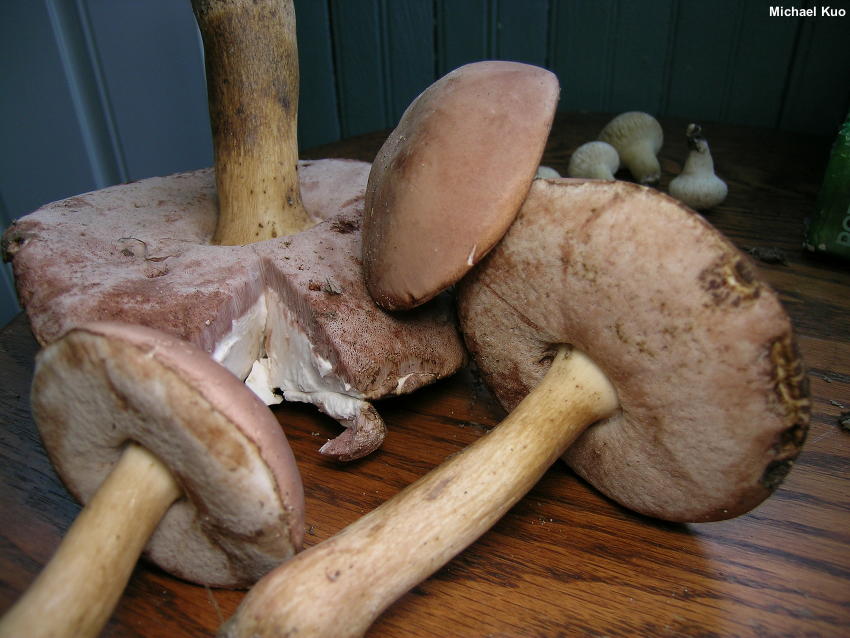
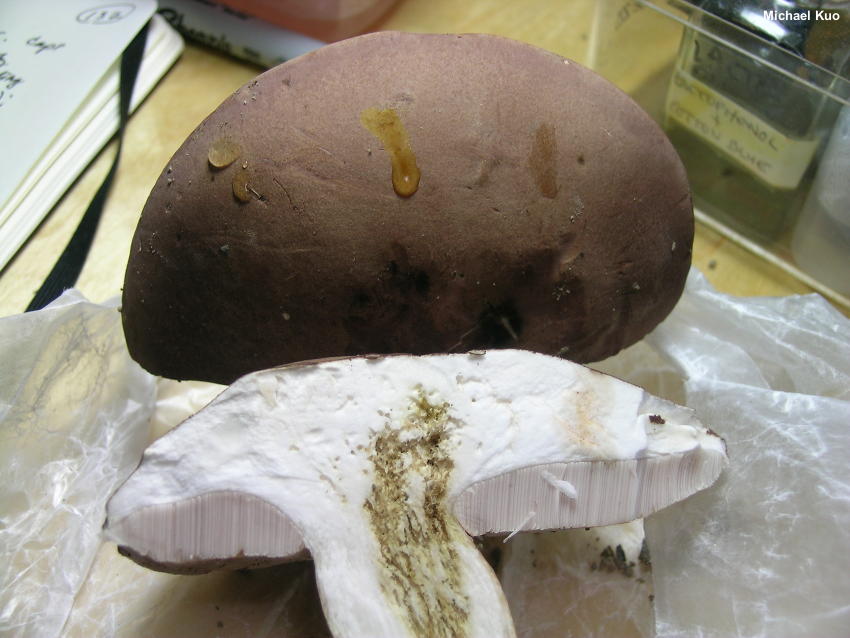
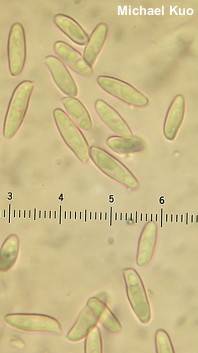
Description: Ecology: Mycorrhizal with oaks and other hardwoods; growing alone, scattered, or gregariously; summer and fall; widely distributed in North America east of the Rocky Mountains. The illustrated and described collections are from Illinois. Cap: 5–15 cm; convex, becoming broadly convex or nearly flat in age; dry; finely felty when young, becoming bald and soft-leathery; brownish purple to purplish brown when young, becoming purplish brown, brown, or fading to tan; the young margin whitish and incurved. Pore Surface: Whitish, becoming pinkish and finally dingy brown; bruising pinkish to brownish; pores circular, 2–3 per mm; tubes to 10 mm deep. Stem: 7–14 cm long; 1.5–4 cm thick; more or less equal, or club-shaped; whitish to brownish or brown; typically developing olive to olive-brown stains or bruising olive; bald; sometimes very finely reticulate near the apex; basal mycelium white. Flesh: Thick and white; unchanging when sliced; soft; often discolored olive around worm holes. Odor and Taste: Taste very bitter; odor not distinctive. Chemical Reactions: Ammonia negative on cap surface; negative on flesh. KOH rusty orange on cap surface; negative on flesh. Iron salts negative on cap surface; negative to pinkish on flesh. Spore Print: Dull pinkish to reddish brown. Microscopic Features: Spores 9–14 x 2.5–4 µm; fusiform; smooth; faintly ochraceous in KOH. Hymenial cystidia inconspicuous; not or only slightly projecting; fusoid-ventricose; hyaline in KOH. Pileipellis a collapsing trichoderm; golden to hyaline or brownish in KOH; elements 2.5–7.5 µm wide, smooth; terminal cells ranging from cylindric with rounded apices to fusiform-cystidioid. REFERENCES: Mazzer & Smith, 1967. (Smith & Thiers, 1971; Grund & Harrison, 1976; Smith, Smith & Weber, 1981; Both, 1993; Horn, Kay & Abel, 1993; Bessette, Roody & Bessette, 2000; Roody, 2003; McNeil, 2006; Miller & Miller, 2006; Binion et al., 2008; Kuo & Methven, 2014.) Herb. Kuo 07079502, 08300212, 09010204, 07020707, 07160802, 07021402, 07021403. This site contains no information about the edibility or toxicity of mushrooms. |
© MushroomExpert.Com |
|
Cite this page as: Kuo, M. (2016, June). Tylopilus rubrobrunneus. Retrieved from the MushroomExpert.Com Web site: http://www.mushroomexpert.com/tylopilus_rubrobrunneus.html |