| Major Groups > Boletes > Tylopilus > Tylopilus plumbeoviolaceus |

|
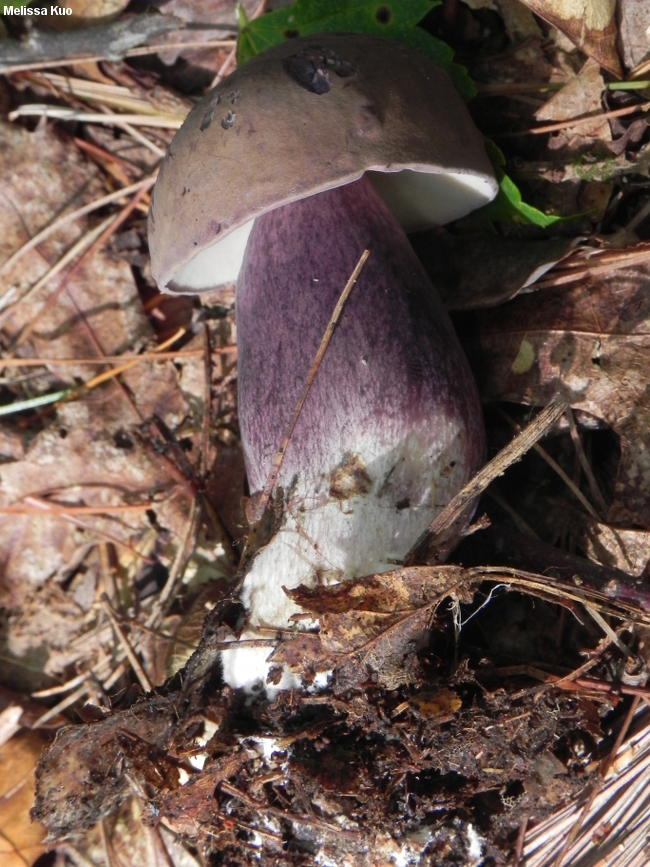
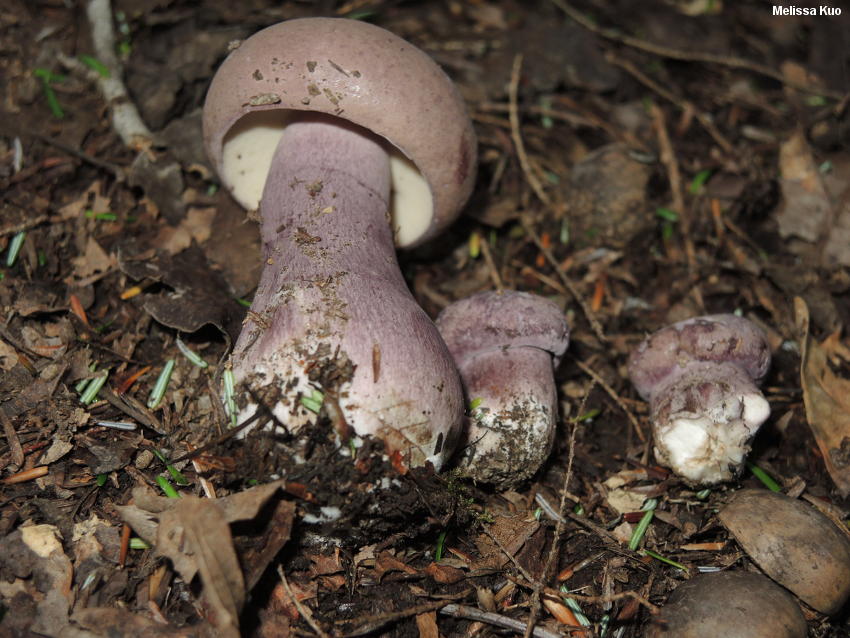
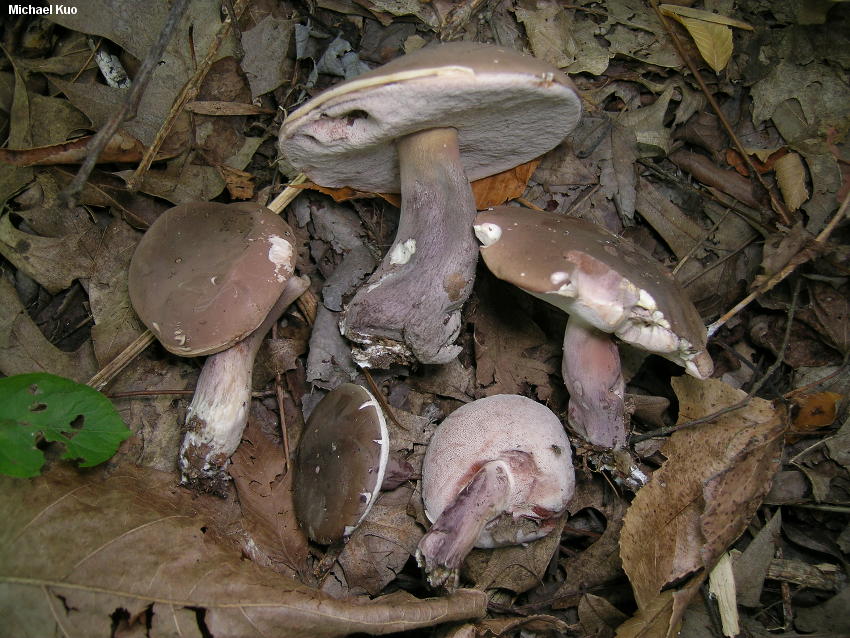
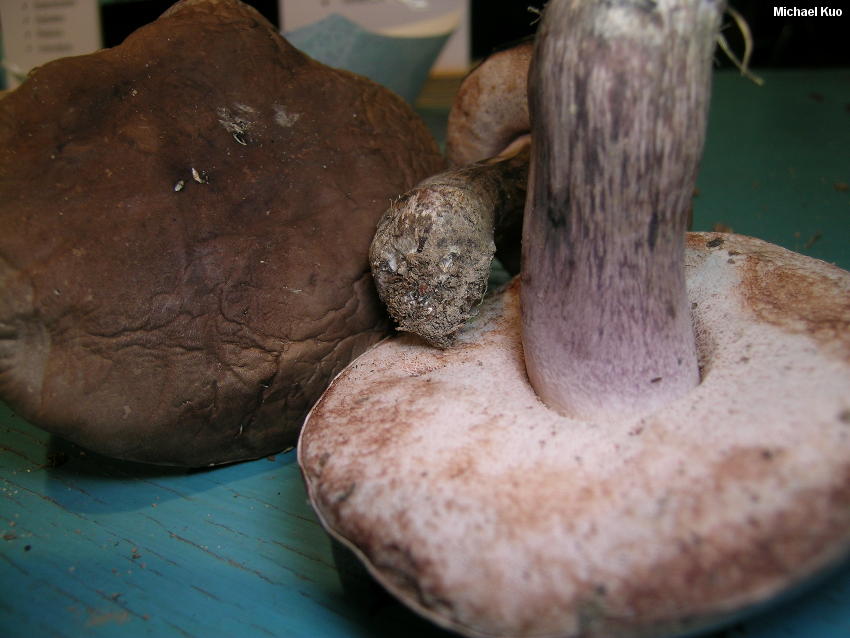
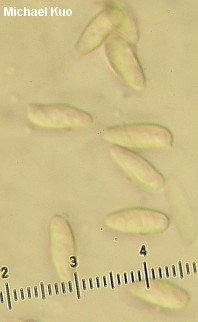
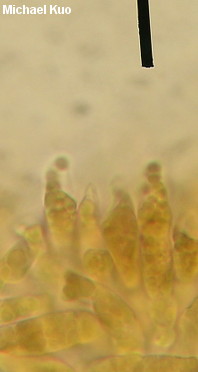
Tylopilus plumbeoviolaceus [ Basidiomycota > Boletales > Boletaceae > Tylopilus . . . ] by Michael Kuo One summer when I was in graduate school, Tylopilus plumbeoviolaceus appeared in stunning numbers, along with many other mushrooms. My friend and I made a movie, Mr. Puffball, in which a softball-sized puffball with a slit for a mouth was held puppet-like by Beth, who narrated in her best Mr. Puffball voice as we toured the mushrooms of Indiana County, Pennsylvania. Tylopilus plumbeoviolaceus was one of Mr. Puffball's favorites, and I would offer you a clip from the epic movie if my roommate had not taped an LA Law rerun over what might otherwise have been an Oscar winning documentary. When fresh and young, Tylopilus plumbeoviolaceus is one of the more beautiful eastern boletes. It is mycorrhizal with oaks, and widely distributed east of the Rocky Mountains from Canada to Mexico. The purplish brown to dark brown cap and the purple stem, combined with the extremely bitter taste, are distinctive. Tylopilus violatinctus is similar, but has a paler, lilac cap that develops rusty purple stains and discolorations along the margin. Its spores are slightly smaller, and its pileipellis is a cutis. It is recorded from New York to Mississippi, under hardwoods and conifers. Description: Ecology: Mycorrhizal with oaks; growing scattered or gregariously; summer and fall; widely distributed east of the Rocky Mountains. The illustrated and described collections are from Missouri, Kentucky, Ohio, and Georgia. Cap: 4–10 cm; convex, becoming broadly convex or nearly flat in age; dry; bald, or finely suede-like when young; dark purple or purple-brown when young, becoming grayish brown to dark brown. Pore Surface: Whitish becoming pinkish; not bruising, or bruising cinnamon brown; pores circular, 2–3 per mm; tubes to 1 cm deep. Stem: 4–7 cm long; 1.5–2.5 cm thick; more or less equal, or enlarging towards base; purple when young, fading to purplish gray or purplish brown; bald; basal mycelium white; becoming hollow. Flesh: White; unchanging when sliced. Odor and Taste: Taste quite bitter; odor not distinctive. Chemical Reactions: Ammonia negative on cap surface; negative on flesh. KOH negative on cap surface; negative on flesh. Iron salts negative on cap surface; blue to bluish on flesh. Spore Print: Pinkish brown. Microscopic Features: Spores 8–11 x 3–4 µm; fusiform to subfusiform; smooth; hyaline to faintly yellowish in KOH. Hymenial cystidia 30–50 x 7.5–12.5 µm; lageniform, with very narrow necks; thin-walled; smooth; hyaline in KOH. Pileipellis tightly packed trichoderm of thin-walled, septate, smooth elements 4–6 µm wide, with golden globular inclusions; terminal cells fusiform-cystidioid or cylindric, with subacute or merely rounded apices. REFERENCES: (Snell & E. A. Dick, 1941) Snell & Dick, 1941. (Singer, 1947; Grand, 1970; Snell & Dick, 1970; Smith & Thiers, 1971; Grund & Harrison, 1976; Smith, Smith & Weber, 1981; Weber & Smith, 1985; Wolfe, 1986; Phillips, 1991/2005; Both, 1993; Baroni & Both, 1998; Bessette, Roody & Bessette, 2000; McNeil, 2006; Miller & Miller, 2006; Binion et al., 2008; Kuo & Methven, 2014.) Herb. Kuo 09200802, 10170906, 09251001. This site contains no information about the edibility or toxicity of mushrooms. |
© MushroomExpert.Com |
|
Cite this page as: Kuo, M. (2016, February). Tylopilus plumbeoviolaceus. Retrieved from the MushroomExpert.Com Web site: http://www.mushroomexpert.com/tylopilus_plumbeoviolaceus.html |