| Major Groups > Boletes > Suillus > Suillus lakei |

|
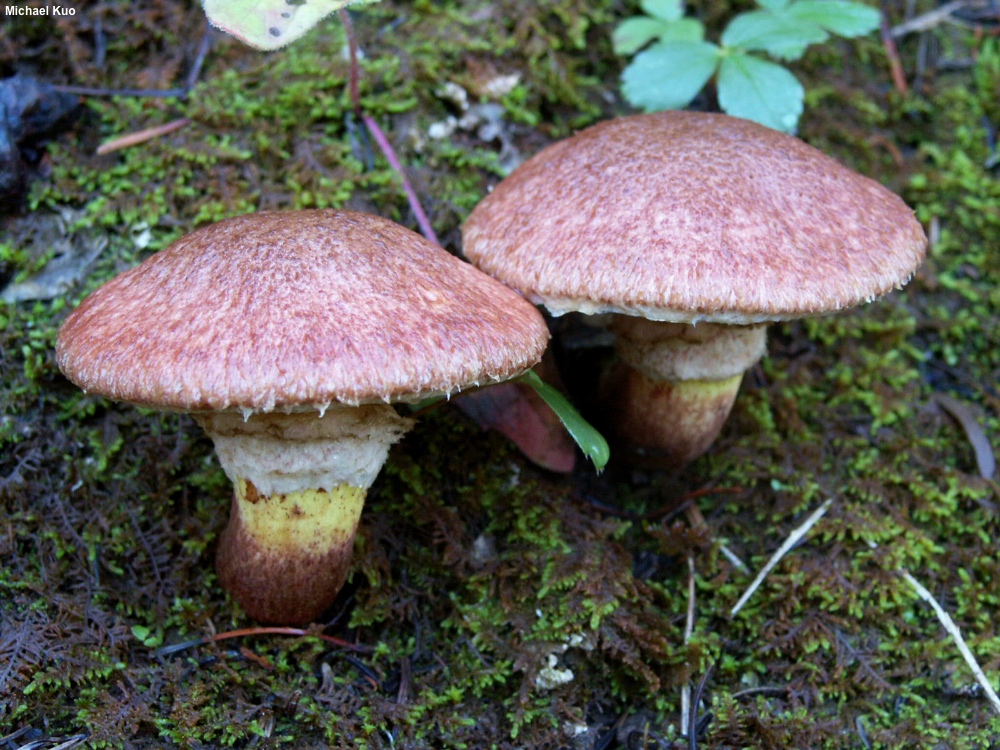
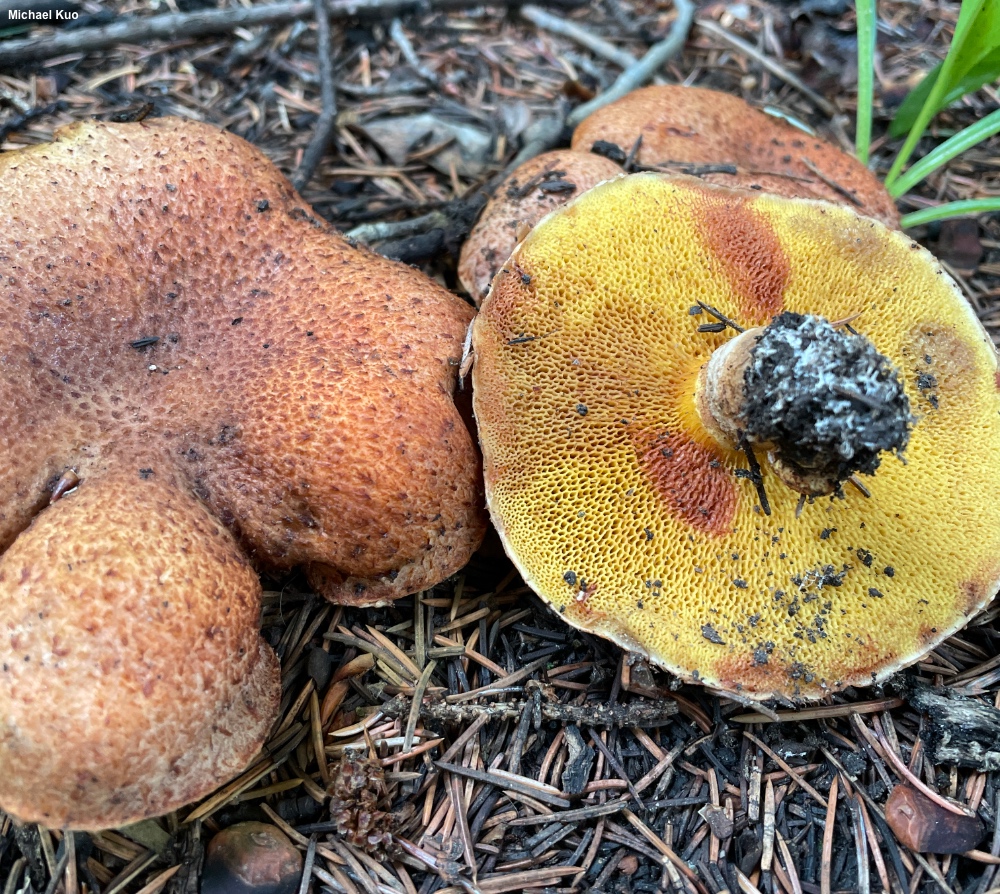
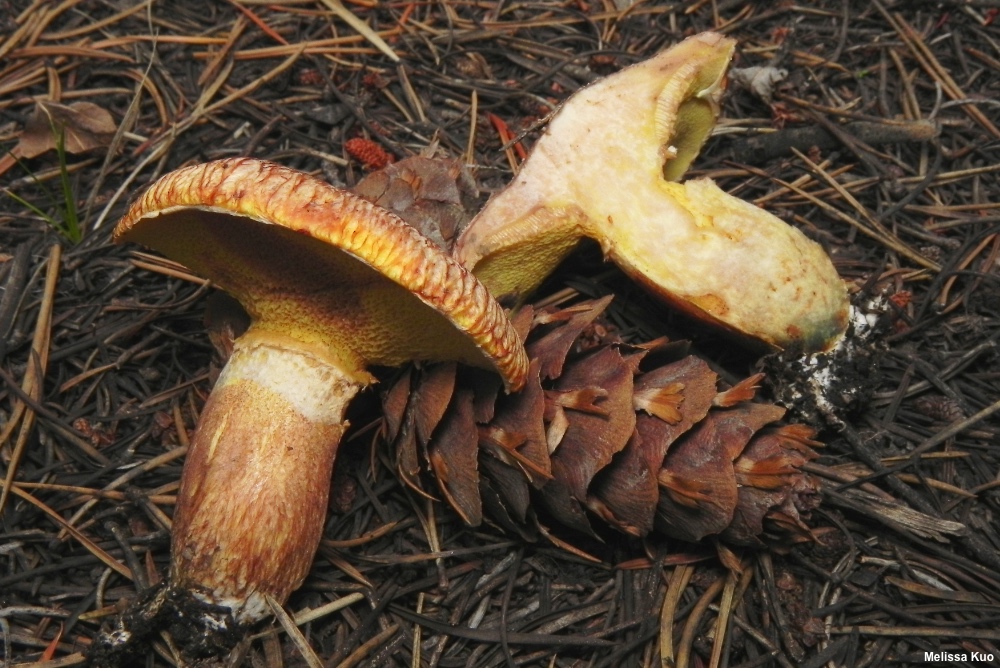
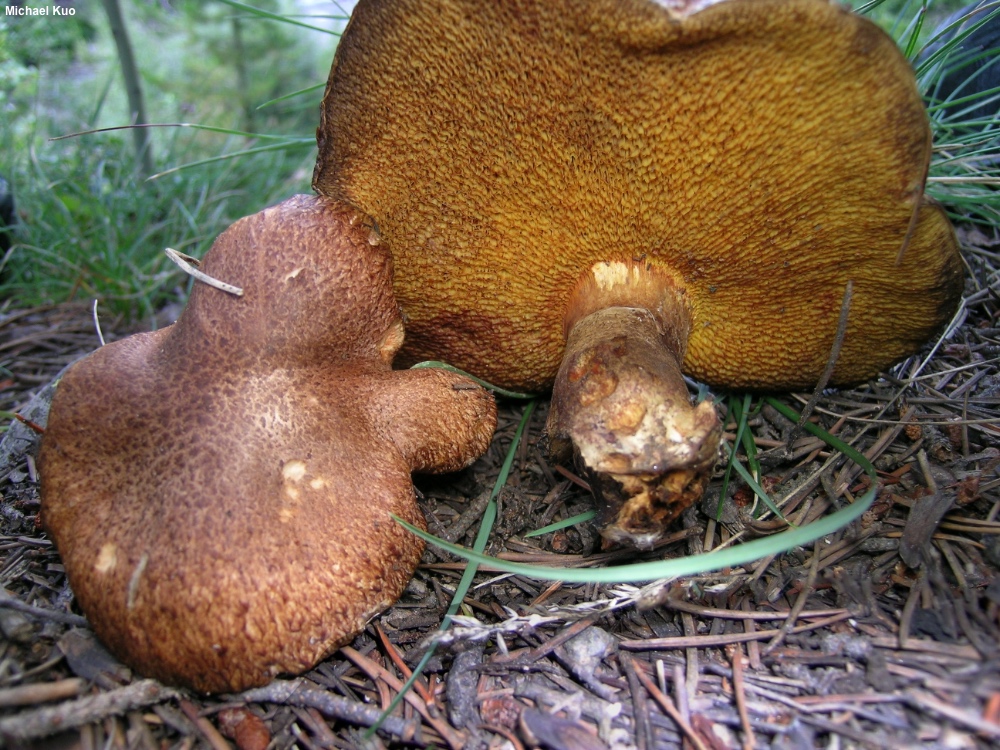
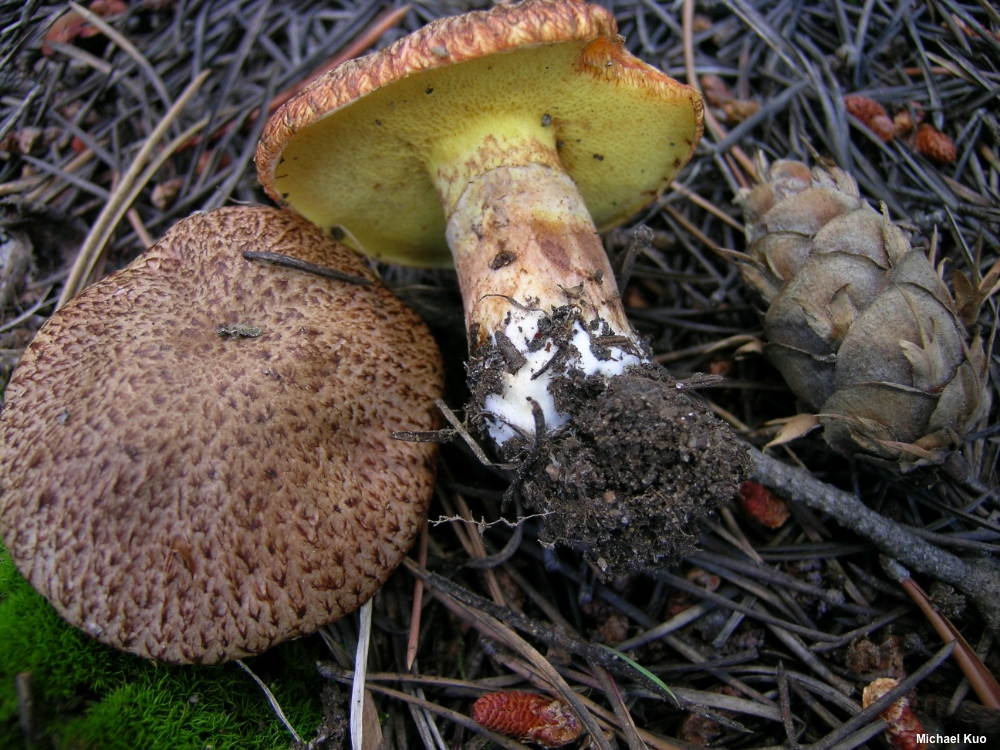
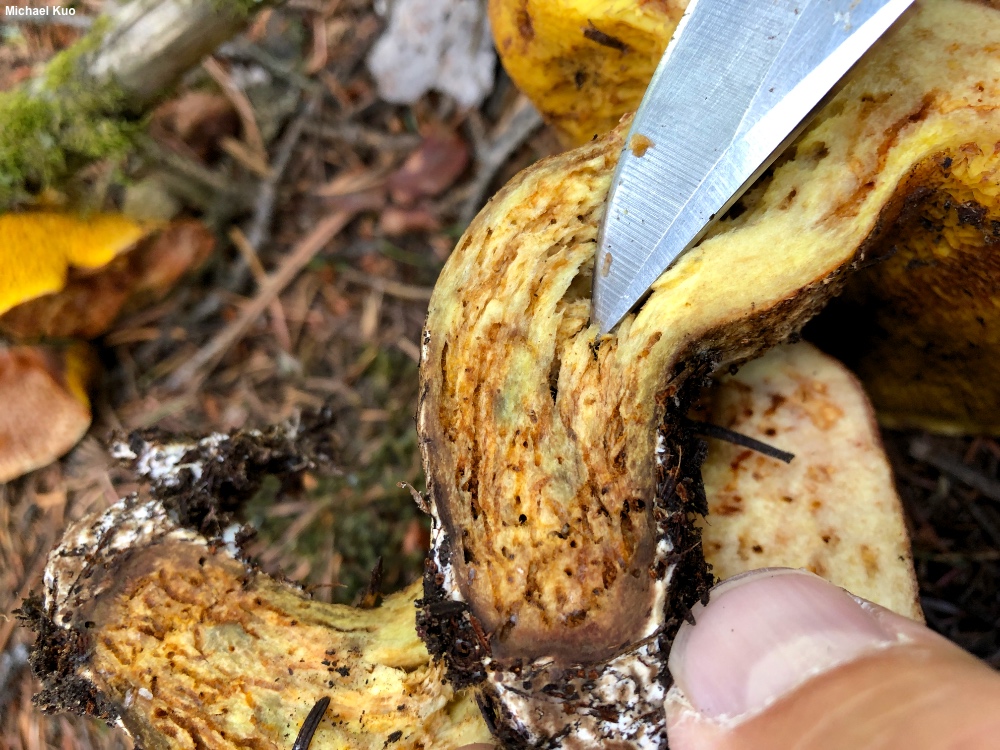
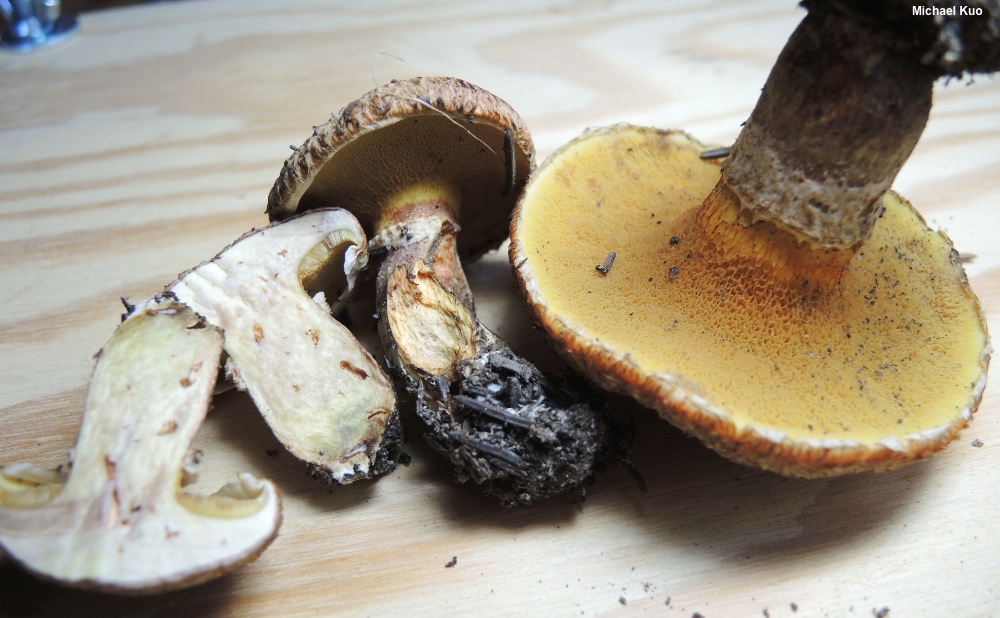
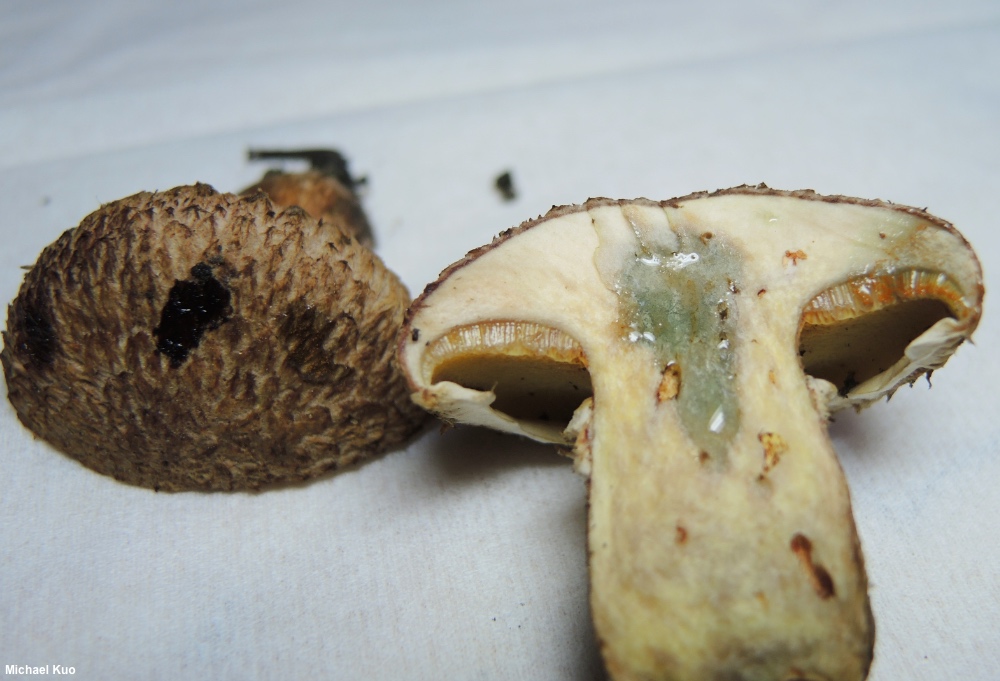
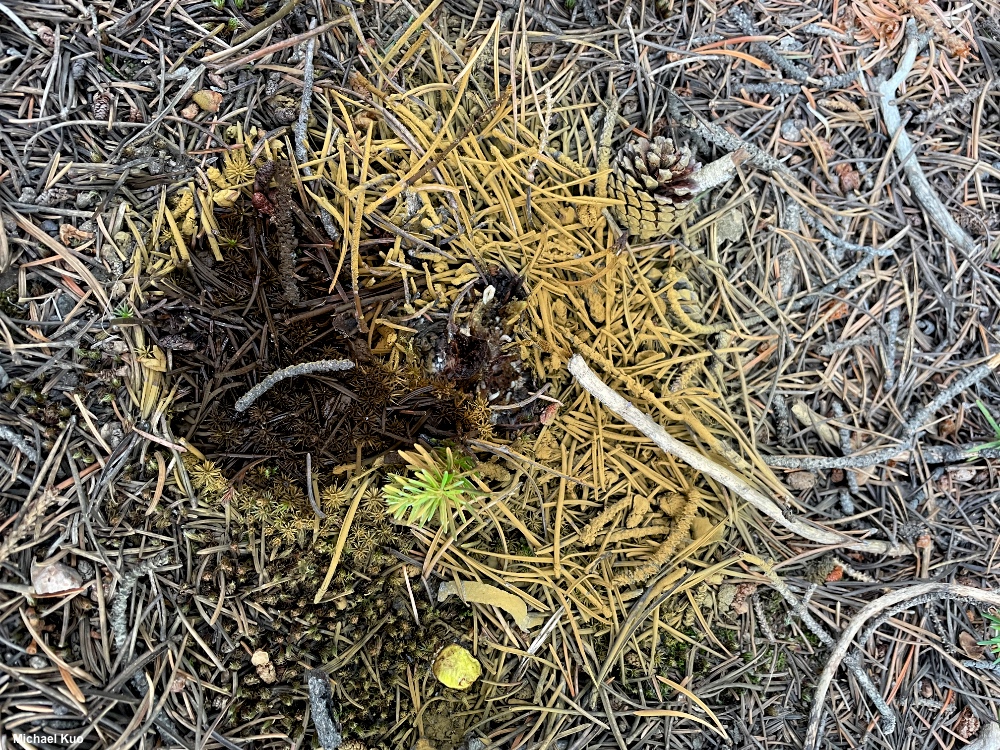
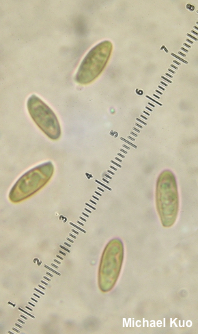
[ Basidiomycota > Boletales > Suillaceae > Suillus . . . ] Suillus lakei by Michael Kuo, 15 December 2022 The western North American "painted Suillus" is as beautiful as its eastern counterpart, Suillus spraguei, and is recognized by its dull brick red colors, its scruffy cap, the partial veil—which is whitish to reddish and leaves a ring on the stem—and the fact that the flesh in the stem base turns bluish green when sliced open. Suillus lakei grows only in mycorrhizal association with Douglas-fir. In the Rocky Mountains, it is consistently found growing alongside another Douglas-fir associate, Gomphidius subroseus. In fact Suillus species are often found alongside Gomphidius and Chroogomphus species, and recent investigations (see Binder & Hibbett 2006) have determined that the gilled mushrooms may be capable of parasitizing both the Suillus and the Douglas-fir; see the page for Gomphidius subroseus for more information. There is some debate about whether Suillus lakei has a slimy cap or not; some authors assign a dry-capped version with slightly smaller spores to Suillus lakei pseudopictus. Others lump these mushrooms together; Smith & Thiers (1964), for example, say that "[t]he viscidity is not always strongly developed and may be overlooked because of the dense development of the squamulose covering" (35). In my collections the stickiness of the cap surface appears to be dependent on weather conditions and on the developmental stage of the mushroom, with younger caps more likely to be sticky and demonstrate, under the microscope, gelatinized hyphae in the pileipellis. An Italian variety characterized by a light yellow cap with purplish red scales has been named Suillus lakei calabrus (Lavorato 2000). Thanks to Django Grootmyers for documenting, collecting, and preserving Suillus lakei for study; his collection is deposited in The Herbarium of Michael Kuo. Description: Ecology: Mycorrhizal with Douglas-fir, both within the natural range of the tree and where it has been introduced; growing alone or gregariously; late summer and fall in the Rocky Mountains, fall and winter on the West Coast; originally described (Murrill 1912) from Oregon; widely distributed in western North America where Douglas-fir occurs; also present in Europe and Oceania where Douglas-fir has been introduced. The illustrated and described collections are from Colorado. Cap: 5–12 cm across; convex, becoming broadly convex to flat; covered with dull reddish brown scales; base color yellowish to pale tan; with whitish partial veil tissue sometimes hanging from the margin; dry or sticky (see discussion above); fading with age. Pore Surface: Covered with a whitish to dull reddish partial veil when young; beginning to run down the stem; yellow to yellowish; darkening with age; bruising reddish brown; pores angular, 1–3 mm wide, more or less radially arranged at maturity; tubes to 1 cm deep. Stem: 3–6 cm long; 1–2.5 cm thick; more or less equal by maturity; without prominent glandular dots; yellow toward the apex, and often reticulate where the pores begin to descend the stem surface; with a fairly persistent whitish, adherent ring; reddish below the ring; base staining bluish to greenish when fresh; basal mycelium white. Flesh: Whitish in buttons, becoming yellowish to yellow throughout with maturity, or sometimes orangish in the stem; sometimes staining pinkish when sliced; usually bluish or green in the stem base when exposed. Odor and Taste: Not distinctive. Chemical Reactions: Ammonia gray to reddish gray on cap surface; pinkish on flesh. KOH dark red to black on cap surface; blue on flesh (sometimes after a red flash). Iron salts gray on cap surface; bluish on flesh. Spore Print: Brownish orange when very fresh; orangish brown otherwise. Microscopic Features: Spores 7–12 x 3–4 µm; boletoid-fusiform; smooth; dull golden in KOH and in Melzer's. Basidia 28–33 x 4–6 µm; clavate; 4-sterigmate. Hymenial cystidia in bundles; 45–70 x 4–10 µm; cylindric-flexuous with rounded apices, or subfusiform to subclavate; smooth; thin-walled; brownish golden in KOH; often gelatinizing and poorly defined individually, especially in older specimens. Pileipellis an ixocutis; elements in young caps often obscured by extensive gelatinization and dark yellow-brown pigment globules; elements in older caps 2.5–5 wide, smooth, brownish golden in KOH—occasionally interrupted by aggregations of upright, septate elements 5–12 wide, with cylindric terminal cells. REFERENCES: (W. A. Murrill, 1912) A. H. Smith & H. D. Thiers, 1964. (Smith & Thiers, 1967; Smith, 1975; Thiers, 1975; Thiers, 1979; Smith, Smith & Weber, 1981; Arora, 1986; States, 1990; Phillips, 1991/2005; Lincoff, 1992; Both, 1993; Bessette, Roody & Bessette, 2000; Lavortato, 2000; Miller & Miller, 2006; Kuo, 2007; Trudell & Ammirati, 2009; Klofac, 2013; Desjardin, Wood & Stevens, 2015; Evenson, 2015; Cripps, Evenson & Kuo, 2016; Nguyen et al., 2016; Siegel & Schwarz, 2016; Noordeloos, 2018; Pietras et al., 2018; MacKinnon & Luther, 2021; McKnight et al., 2021.) Herb. DBG RMNP 2008-128, 2008-135, 2008-202. Herb. Kuo 08140302, 08130702, 08130704, 08191602, 08031706, 08101804. This site contains no information about the edibility or toxicity of mushrooms. |
© MushroomExpert.Com |
|
Cite this page as: Kuo, M. (2022, December). Suillus lakei. Retrieved from the MushroomExpert.Com Web site: http://www.mushroomexpert.com/suillus_lakei.html |