| Major Groups > Boletes > Boletus > Retiboletus ornatipes |

|
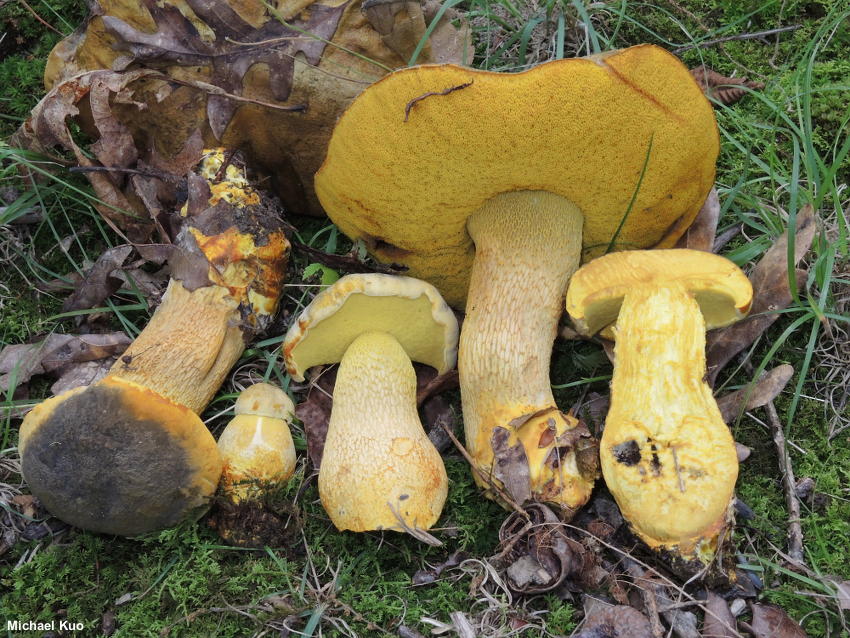
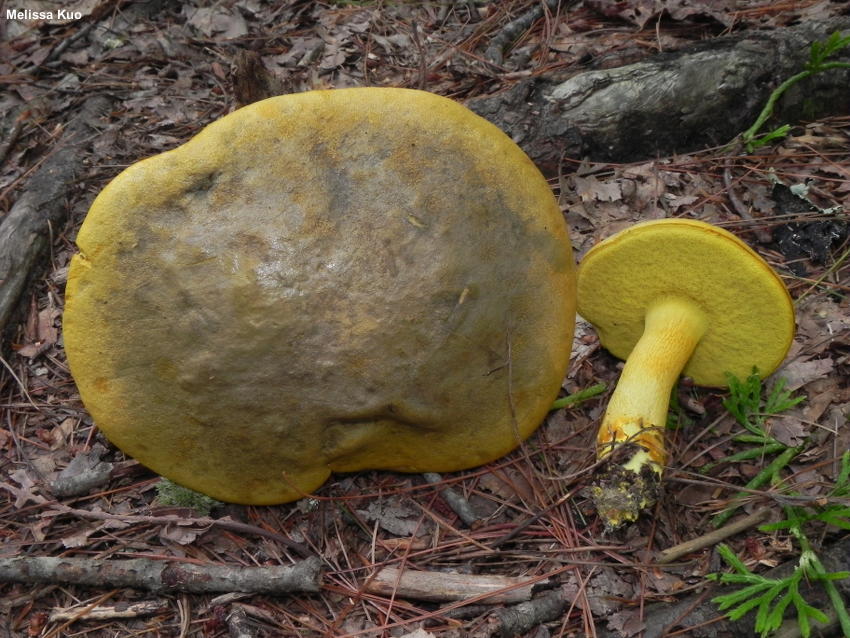
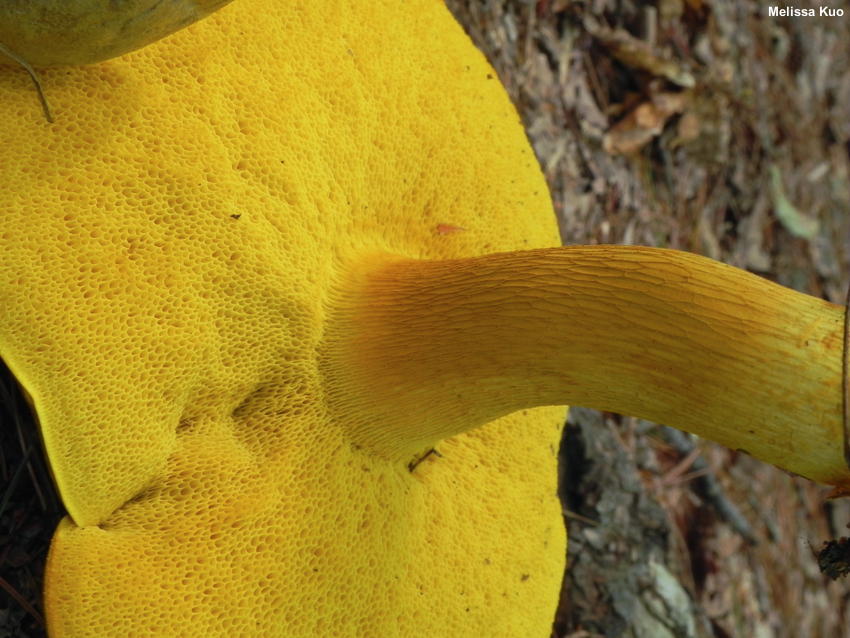
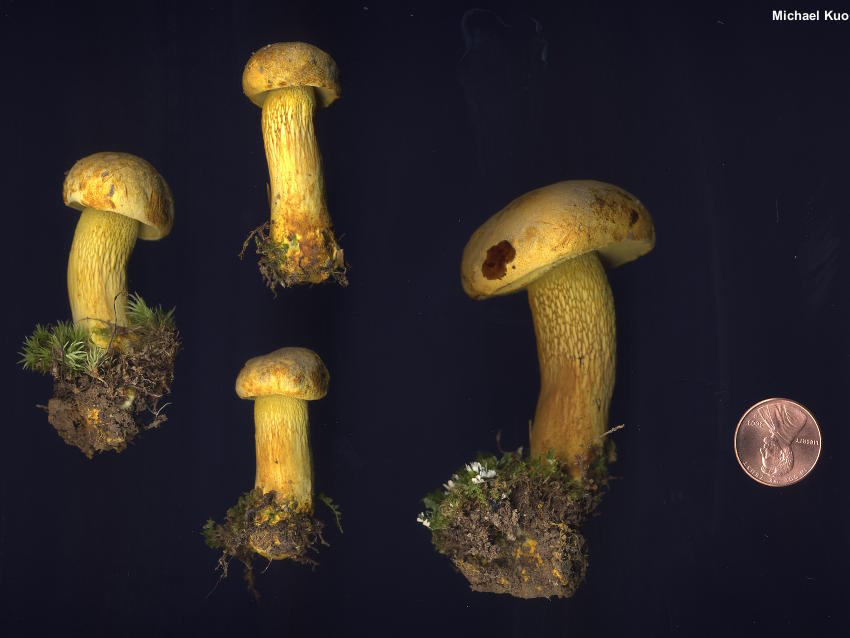
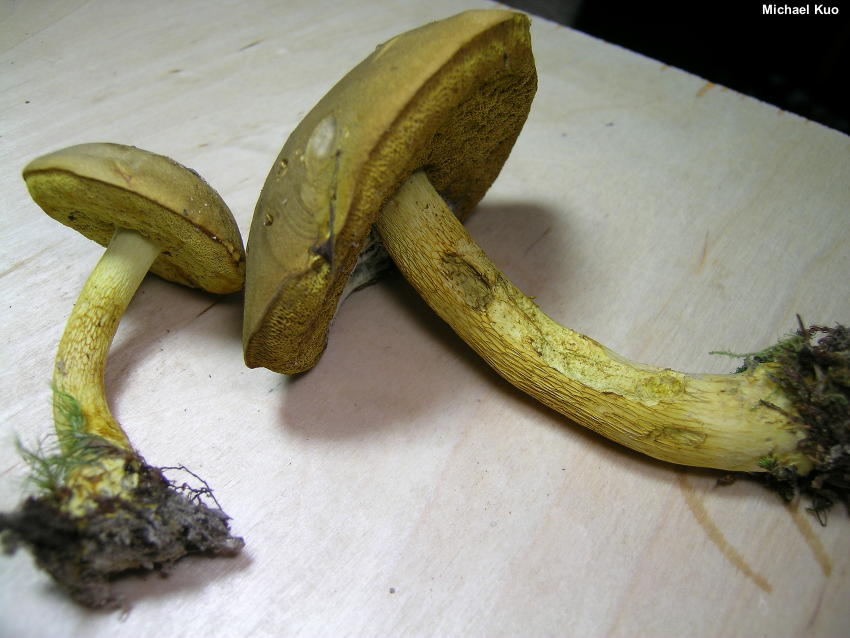
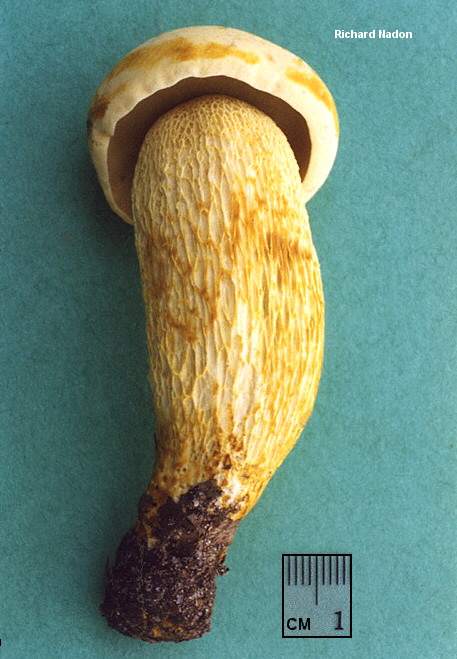
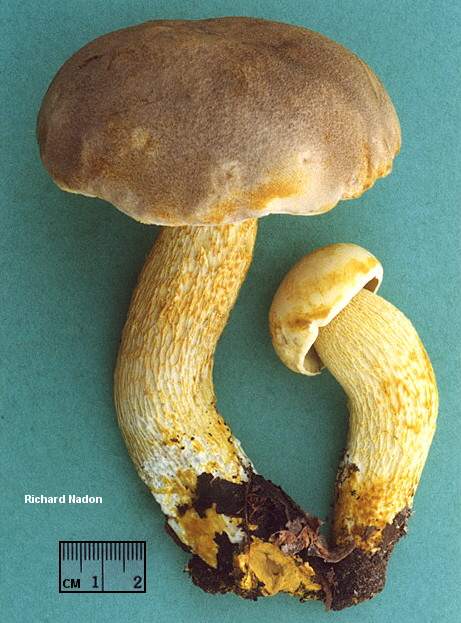
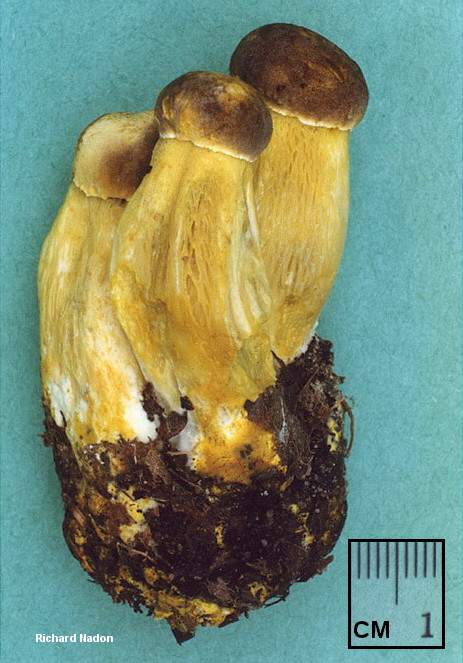
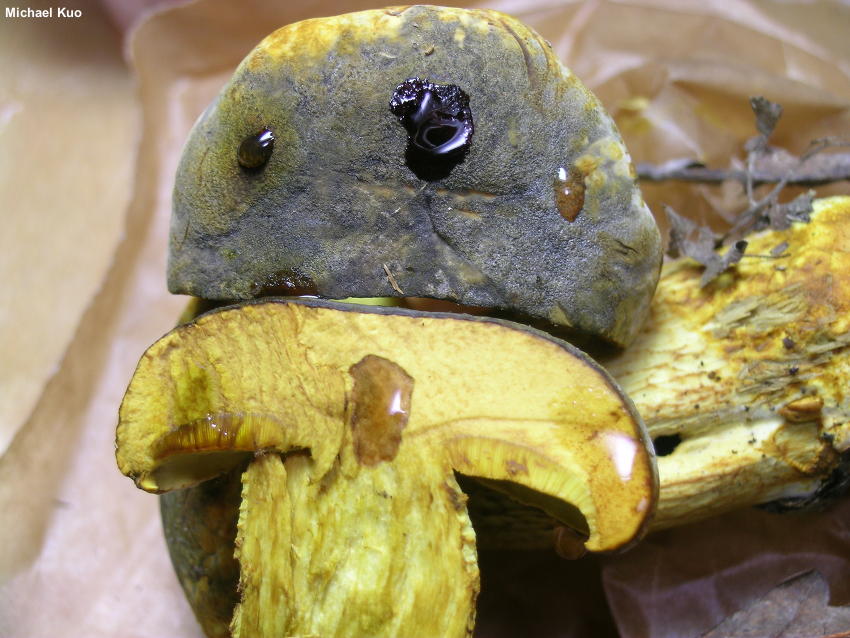
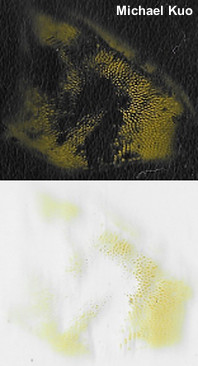
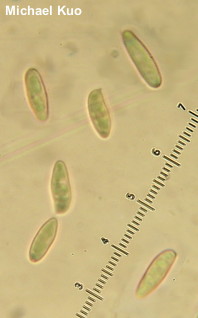
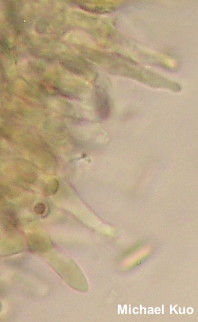
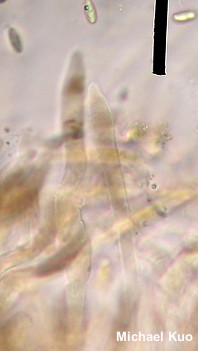
Retiboletus ornatipes [ Basidiomycota > Boletales > Boletaceae > Retiboletus . . . ] by Michael Kuo This is a striking bolete with a yellow, prominently reticulate stem (the species epithet ornatipes means "ornate-stemmed") and a yellow to brown cap. Its surfaces do not bruise blue, and its cap surface turns dark red to dark reddish brown with KOH. It grows under oaks and other hardwoods in eastern North America. Retiboletus griseus is similar, but features white flesh, a cap that is never yellow and does not turn dark red or reddish brown with KOH, and a stem that slowly becomes yellow from the base upward. Retiboletus ornatipes has traditionally been called "Boletus ornatipes," but DNA results from Binder & Bresinsky (2002) support placing it, along with Retiboletus griseus and a few other mushrooms, in a separate genus. The study also found support for at least three ornatipes-like species, two of which are apparently more southern (ranging from North Carolina to Costa Rica) and may correspond to "Boletus retipes," which has traditionally been separated on the basis of its southerly distribution and the presence of yellow powder on the young caps. However, the researchers were unable to find morphological separators that reliably predicted the three species. According to Zeng and collaborators (2016), the northern ornatipes-like species is the true Retiboletus ornatipes, and it contains xerocomic acid, along with another, unidentified substance, while the two southern species do not. Description: Ecology: Mycorrhizal with hardwoods, especially oaks; growing alone, scattered, or gregariously; often growing in moss; summer and fall; widely distributed in North America east of the Great Plains. The illustrated and described collections come from Illinois, Kentucky, and Québec. Cap: 4–12 cm; convex, becoming broadly convex; dry; finely velvety when young, becoming more or less bald; sulphur yellow or medium brown (or mottled with these colors) when young, usually becoming brown to medium brown or tan with age, often with a paler, yellower margin; the margin slightly inrolled when young. Pore Surface: Bright yellow, becoming orangish yellow to olive yellow with age; not bruising, or bruising slowly orangish brown; with 2–3 round pores per mm; tubes to 15 mm deep. Stem: 6–10 cm long; 1–3 cm thick; more or less equal, or tapered to the base; prominently reticulate from top to bottom with a wide-meshed, yellow reticulum that becomes brownish with age or on handling; bright yellow, discoloring brownish in age; solid; basal mycelium yellow. Flesh: Yellow to bright golden yellow; not staining when sliced. Odor and Taste: Odor not distinctive; taste mild or somewhat bitter. Chemical Reactions: Ammonia negative to orangish on cap surface; negative to greenish on flesh. KOH dark blackish red to orangish red or reddish brown on cap surface; gray on flesh. Iron salts negative on cap; negative on flesh. Spore Print: Bright orangish yellow with a very slight hint of olive. Microscopic Features: Spores 10–12 x 3–4.5 µm; subfusoid; smooth; yellowish in KOH. Hymenial cystidia 35–50 x 5–7.5 µm fusiform; smooth; thin-walled; golden to brownish in KOH. Pileipellis a collapsing trichoderm; golden to brownish golden or brown in KOH; elements 2.5–10 µm; wide, smooth; terminal cells subfusiform or cylindric with narrowed or rounded apices. REFERENCES: Binder & Bresinsky, 2002. (Peck, 1872; Saccardo, 1888; Coker & Beers, 1943; Singer, 1947; Snell & Dick, 1970; Smith & Thiers, 1971; Grund & Harrison, 1975; Smith, Smith & Weber, 1981; Arora, 1986; Phillips, 1991/2005; Lincoff, 1992; Both, 1993; Barron, 1999; Bessette, Roody & Bessette, 2000; Roody, 2003; McNeil, 2006; Miller & Miller, 2006; Kuo, 2007; Ortiz-Santana et al., 2007; Binion et al., 2008; Kuo & Methven, 2014; Bessette, Roody & Bessette, 2016; Zeng et al., 2016.) Herb. Kuo 05300408, 07240801, 06251501. This site contains no information about the edibility or toxicity of mushrooms. |
© MushroomExpert.Com |
|
Cite this page as: Kuo, M. (2017, January). Retiboletus ornatipes. Retrieved from the MushroomExpert.Com Web site: http://www.mushroomexpert.com/retiboletus_ornatipes.html |