| Major Groups > Gilled Mushrooms > Pale-Spored > Collybioid > Gymnopus dryophilus |

|
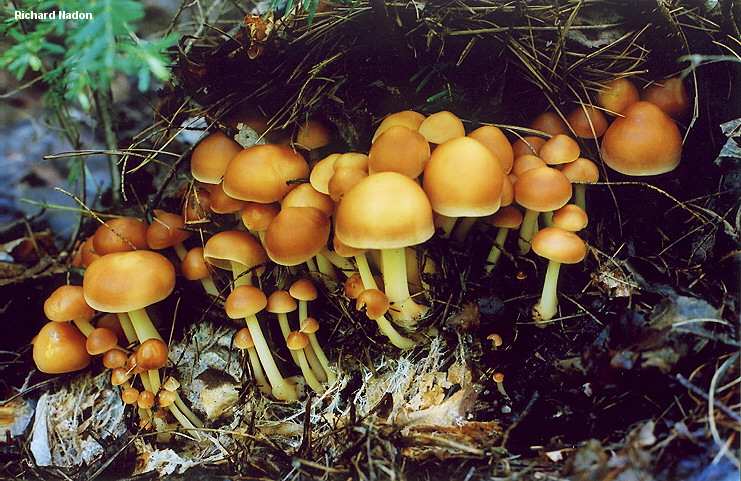
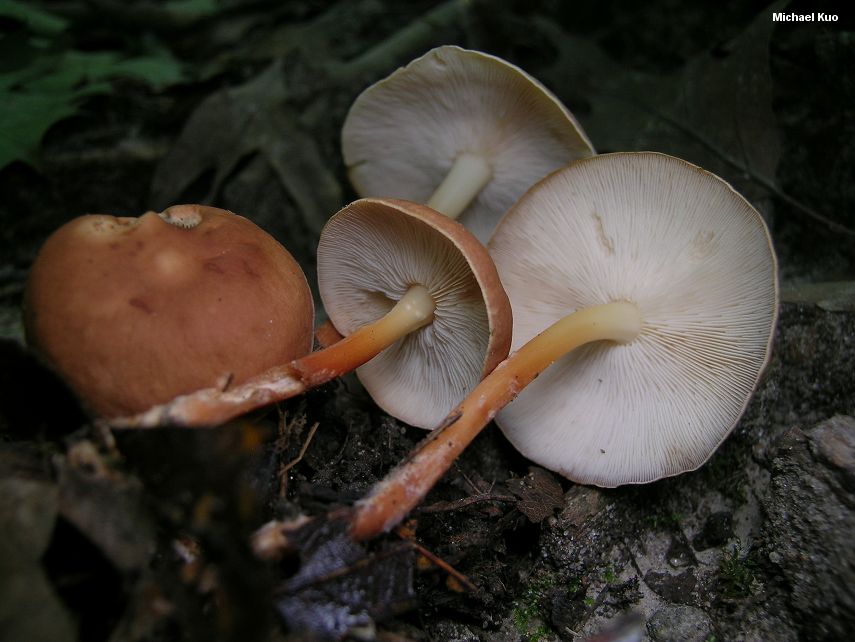
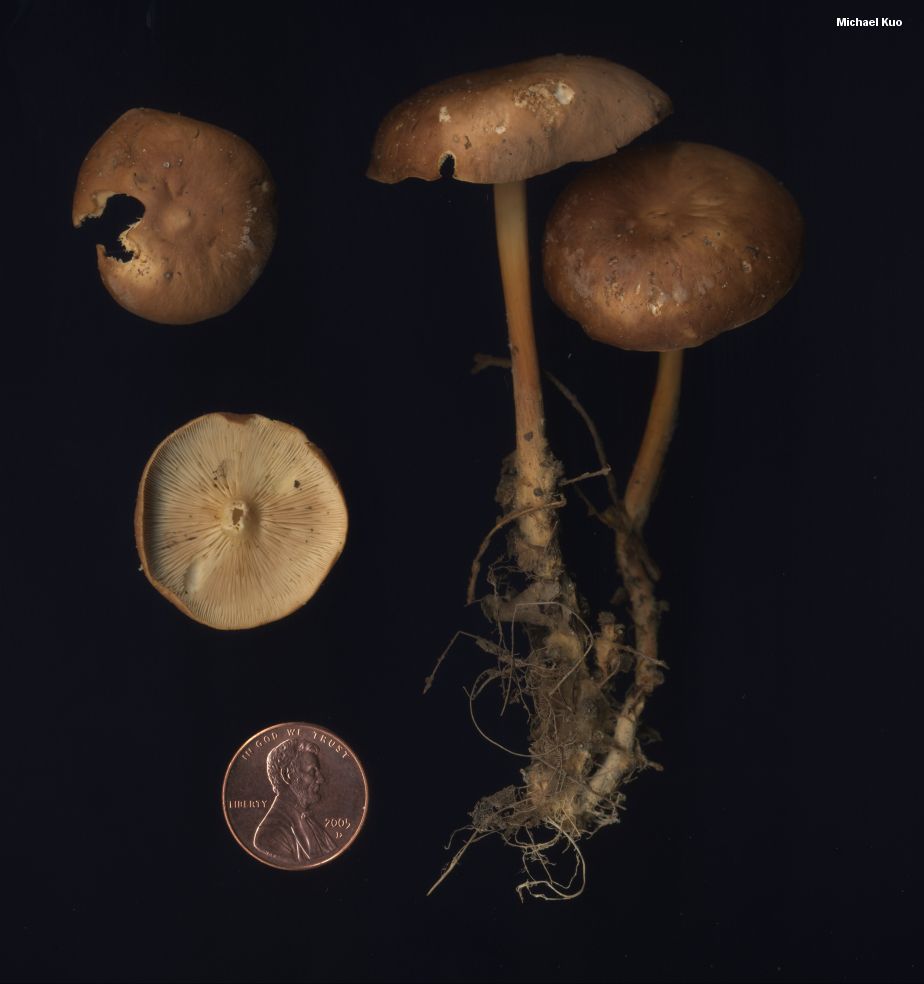
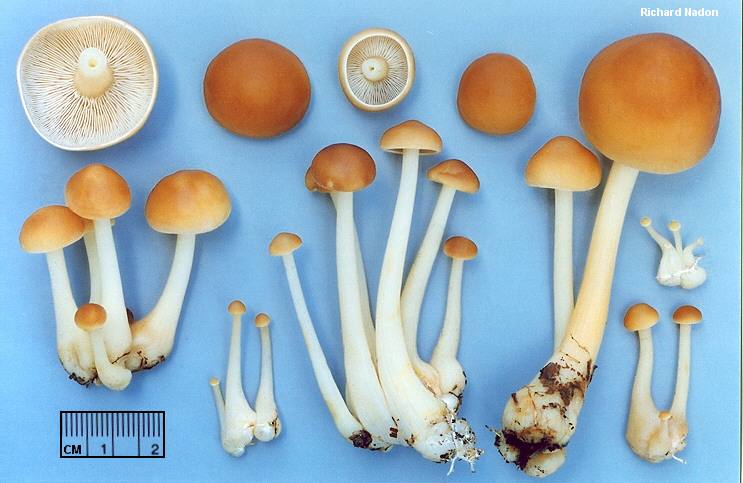
Gymnopus dryophilus [ Basidiomycetes > Agaricales > Marasmiaceae > Gymnopus . . . ] by Michael Kuo This little mushroom qualifies as the weed of the North American mushroom world, in my opinion; it is everywhere, all the time. Its distinguishing features include its greasy, tawny or tan cap; its attached, crowded, white gills; the absence of a partial veil; and its white spore print--but it fools you, again and again. I don't know how many times I have stooped over to examine something that looked interesting . . . only to discover that, once again, it was just Gymnopus dryophilus, posing as something interesting. A large number of Gymnopus and Rhodocollybia species look for all the world like Gymnopus dryophilus on casual observation. For help sorting these mushrooms out, see the key to collybioid mushrooms--or, if you are comfortable separating Rhodocollybia butyracea from Gymnopus dryophilus but you would like to fine tune your species concepts within the "Gymnopus dryophilus group," see the table and comments below. A jelly fungus parasite, Syzygospora mycetophila, sometimes attacks Gymnopus dryophilus, causing pale, tumorous growths on the stem, gills, and cap; see the linked page for illustrations. Collybia dryophila is a synonym. Description: Ecology: Saprobic; growing alone, scattered, gregariously, or loosely clustered; growing from litter or twigs, in almost any hardwood, conifer, or mixed forest ecosystem (despite its name, which translates as "oak-loving"); spring, summer, and fall (and in winter in warmer climates); widely distributed in North America. Cap: 1-7.5 cm; convex with an incurved margin when young, becoming broadly convex to flat; moist; bald; dark reddish brown to brown when young, becoming tan to orangish brown to very pale buff. Gills: Attached to the stem or free from it; whitish to pinkish, becoming buff; crowded. Stem: 1-10 cm long; 2-7 mm thick; equal (occasionally slightly flared to base); dry; pliant and fibrous; bald; whitish above, light buff below, becoming darker; soon hollow; usually with thin, whitish rhizomorphs attached to the base. Flesh: Whitish; thin. Odor and Taste: Not distinctive. Chemical Reactions: KOH negative to faintly yellowish-olive on cap surface. Spore Print: White to creamy or pale yellowish white. Microscopic Features: Spores: 5-6.5 x 2.5-3.5 µ; smooth; elliptical; inamyloid. Pleurocystidia absent. Cheilocystidia 15-50 x 2-6 µ; clavate, subclavate, cylindric, or irregular; often branched, lobed, or with coralloid projections. Pileipellis of branched and swollen, interwoven hyphae 2-13 µ wide. REFERENCES: (Bulliard, 1790) Murrill, 1916. (Fries, 1821; Saccardo, 1887; Kauffman, 1918; Coker & Beardslee, 1921; Smith, 1949; Smith, Smith & Weber, 1979; Halling, 1983; Vilgalys & Miller, 1983; Weber & Smith, 1985; Arora, 1986; Phillips, 1991/2005; Vilgalys, 1991; Lincoff, 1992; Horn, Kay & Abel, 1993; Noordeloos, 1995; Evenson, 1997; Halling, 1997; Barron, 1999; Halling, 2003; Roody, 2003; Halling & Mueller, 2005; McNeil, 2006; Miller & Miller, 2006; Binion et al., 2008; Trudell & Ammirati, 2009.) Herb. Kuo 09210102, 06080301, 06120306, 10090303, 09290501, 10010505, 08310902. Mating studies (Vilgalys & Miller, 1983; Vilgalys, 1991) have determined at least 11 interbreeding groups within the "Collybia dryophila complex" and have proposed separating at least five named species. Representatives of four of these species occur in North America; Vilgalys (1991) provides four morphological features that can be used in combination to predict the North American biological species, summarized below. |
|

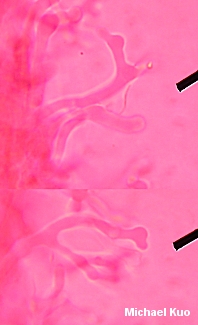
* Note: In my collections, cheilocystidia types of the species featured in the table have not always corresponded with the types listed by Vilgalys--although the other characters have been consistent. This website contains no information about the edibility or toxicity of mushrooms. Cite this page as: Kuo, M. (2013, January). Gymnopus dryophilus. Retrieved from the MushroomExpert.Com Web site: http://www.mushroomexpert.com/gymnopus_dryophilus.html © MushroomExpert.Com collybia brunneola |