| Major Groups > Chanterelles and Trumpets > Cantharellus lateritius |

|
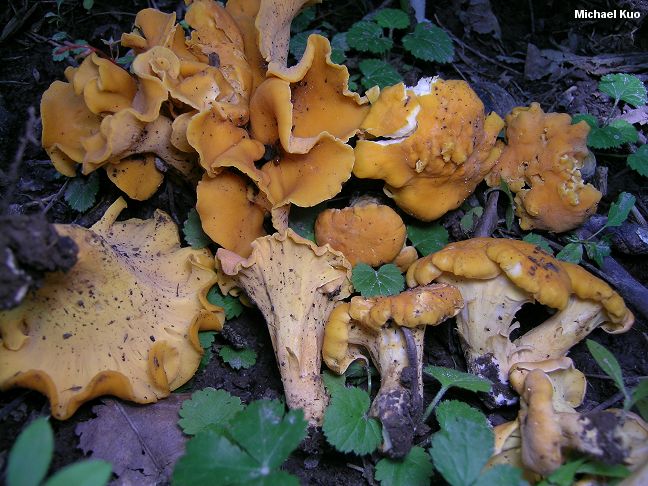
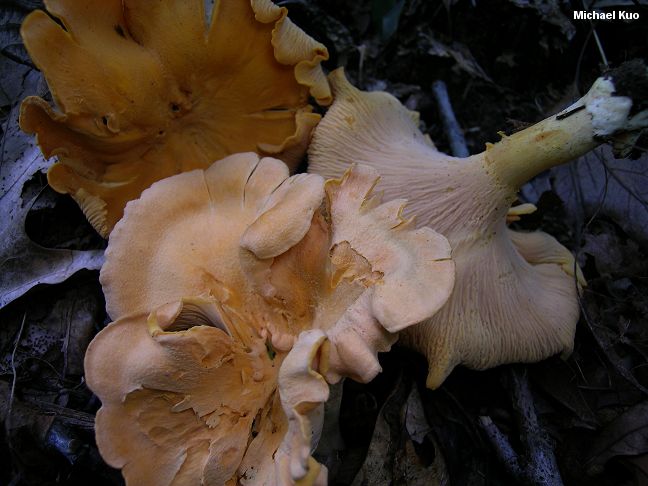
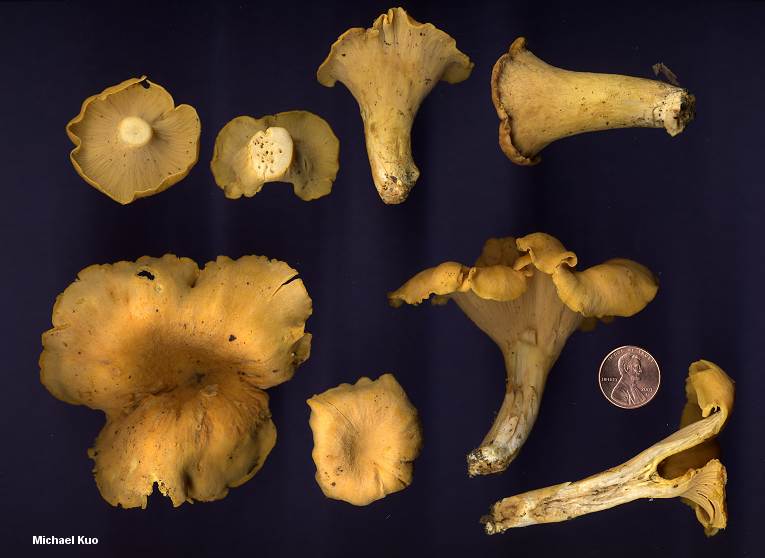
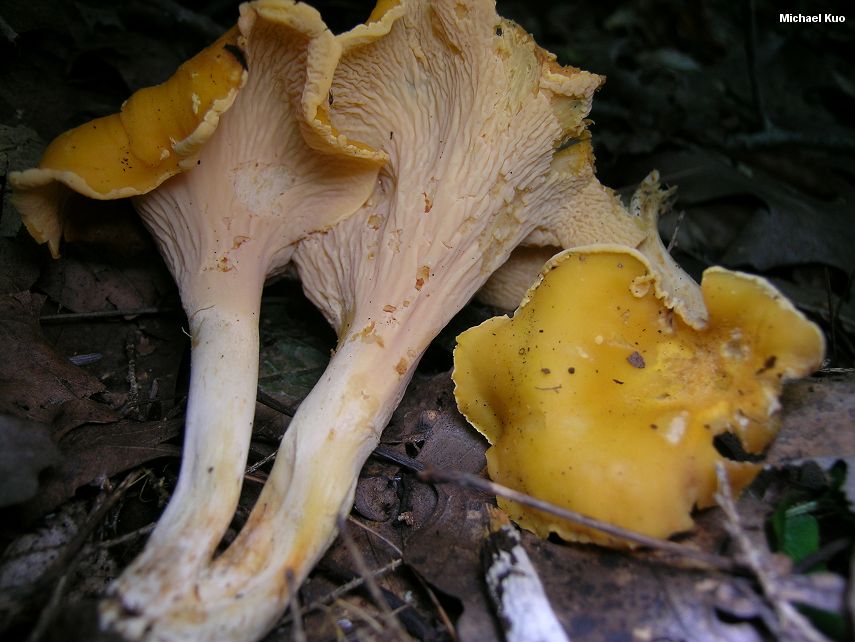
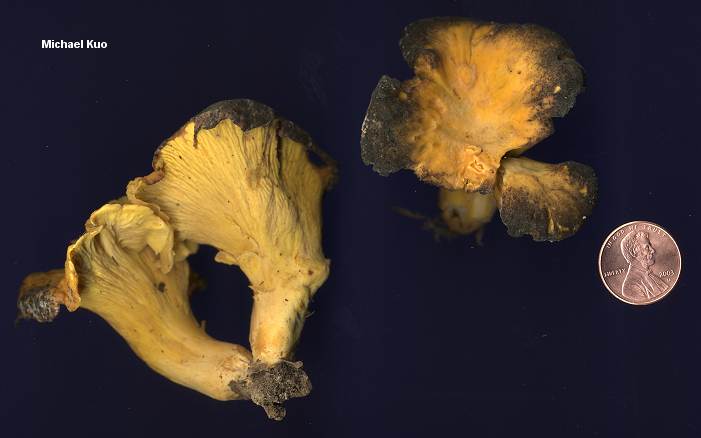
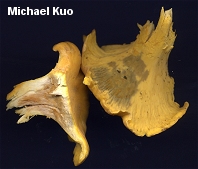
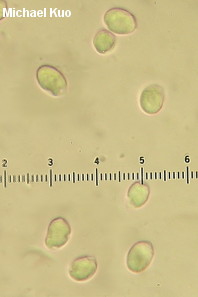
Cantharellus lateritius [ Basidiomycota > Cantharellales > Cantharellaceae > Cantharellus . . . ] by Michael Kuo Cantharellus lateritius, often called the "smooth chanterelle," is, in theory, easily recognized: it is a medium-sized to large chanterelle with a smooth to merely shallowly wrinkled undersurface and a single, well defined stem. It is a mycorrhizal partner with oaks in eastern North America, and it usually appears in July. But specimens that seem to intergrade between Cantharellus lateritius and "Cantharellus cibarius" are not infrequently encountered (see the illustrations)--and it is not always easy to decide just how "gill-like" the folds on the undersurface need to be before the line has been crossed. Further difficulties arise when Cantharellus confluens and Craterellus odoratus are considered. The former species is nearly identical but features stems that often give rise to multiple caps; the latter is a thin-fleshed, fragile species that is truly (rather than shallowly) vase-shaped. A 2011 paper by Buyck & Hofstetter in Fungal Diversity discusses Cantharellus lateritius and, specifically referring to this webpage and the illustrations to the right, maintains that "there seems to exist an important macroscopic variability with cap colors ranging from nearly pure white over pale yellow to orange with sometimes strong blackening margins. This species complex therefore seems in urgent need of more study combining precise morphological examination with molecular data." More recently, a 2014 paper by Buyck entitled "Exploring the diversity of 'smooth chanterelles'" describes as new several similar species from Africa, Asia, and new Caledonia, but does not treat North America's Cantharellus lateritius beyond including it in a key and referring to it, ominously, as "C. lateritius and its American satellite taxa." One wonders how many "satellite taxa" we are in for when Buyck publishes again on this group! Description: Ecology: Mycorrhizal with oaks and sometimes with hickories; growing alone, scattered, gregariously, densely gregariously, or in loose clusters; summer and fall; widely distributed east of the Rocky Mountains. The illustrated and described collections are from Pennsylvania and Illinois.Cap: 2.5-8 cm across; planoconvex to flat when young, becoming shallowly vase-shaped with an incurved, wavy, and irregular margin; bald; bright orange-yellow to egg-yolk yellow; bruising slowly yellowish to orangish brown and occasionally blackening in age at the margin. Undersurface: Running down the stem; smooth or with shallow wrinkles--but occasionally with more developed wrinkles that approach creating a veined surface, especially near the margin; colored like the cap, but paler--and often with a pinkish hue. Stem: 3-6 cm long; 1-3 cm thick; tapering to the base; bald; colored like the cap, or paler; bruising slowly yellowish to orangish brown; basal mycelium white. Flesh: White; unchanging when sliced. Odor and Taste: Taste not distinctive; odor usually strong, fragrant and sweet (reminiscent of apricots). Chemical Reactions: Iron salts pinkish gray to gray on flesh; dark gray on undersurface. Spore Print: Pale pinkish yellow. Microscopic Features: Spores 6.5-9 x 4-5.5 µ; ellipsoid to broadly ellipsoid; smooth; inamyloid; ochraceous in KOH; with minutely granular contents or, often, uniguttulate. Basidia 4- 6-sterigmate; 45-70 µ long. Elements from cap surface 5-12.5 µ wide; cylindric; thin- to thick-walled; clamped; hyaline to faintly ochraceous in KOH; terminal cells cylindric to subclavate. REFERENCES: (Berkeley, 1873) Singer, 1949. (Saccardo, 1888; Corner, 1966; Smith, 1968; Bigelow, 1978; Petersen, 1979; Smith, Smith & Weber, 1981; Phillips, 1991/2005; Lincoff, 1992; Metzler & Metzler, 1992; Miller & Miller, 2006; Kuo, 2007; Binion et al., 2008; Buyck & Hofstetter, 2011; Buyck, 2014; Kuo & Methven, 2014.) Herb. Kuo 07079401, 07220304, 07110702, 07010802, 07210906. This site contains no information about the edibility or toxicity of mushrooms. |
© MushroomExpert.Com |
|
Cite this page as: Kuo, M. (2015, March). Cantharellus lateritius. Retrieved from the MushroomExpert.Com Web site: http://www.mushroomexpert.com/cantharellus_lateritius.html |