| Major Groups > Chanterelles and Trumpets > Cantharellus cinnabarinus |

|
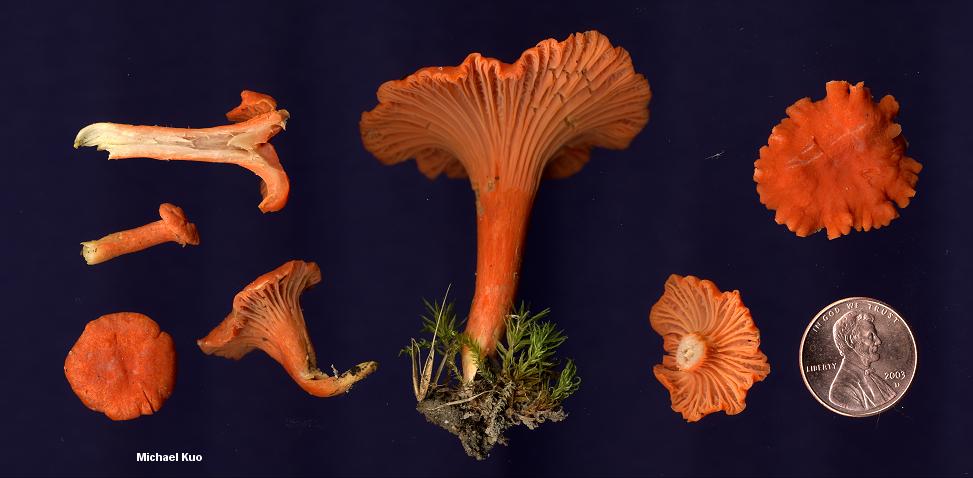
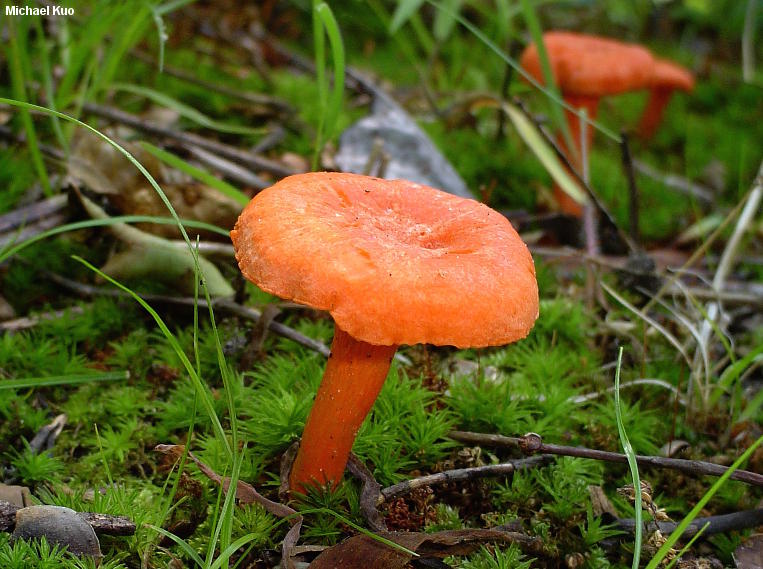
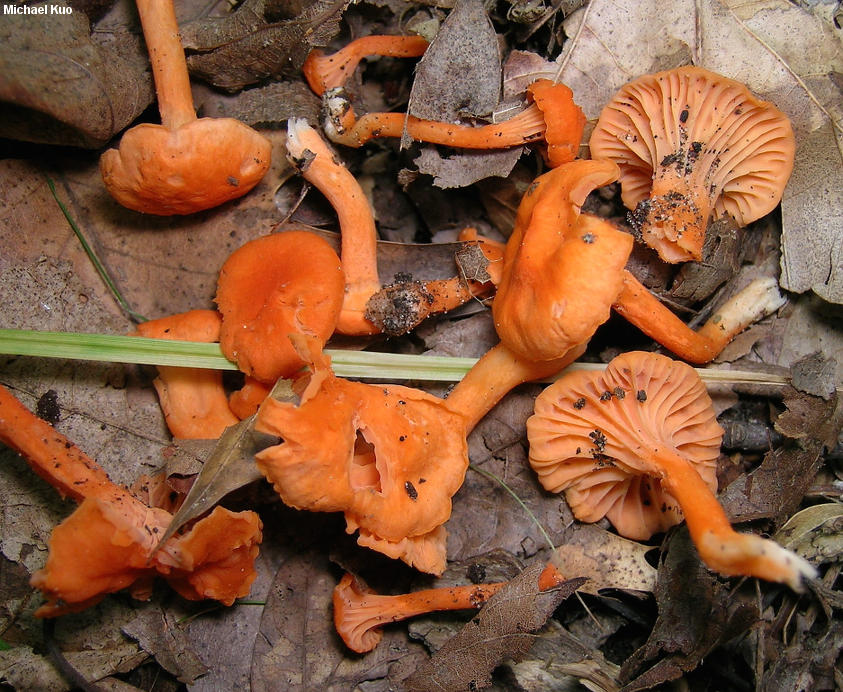
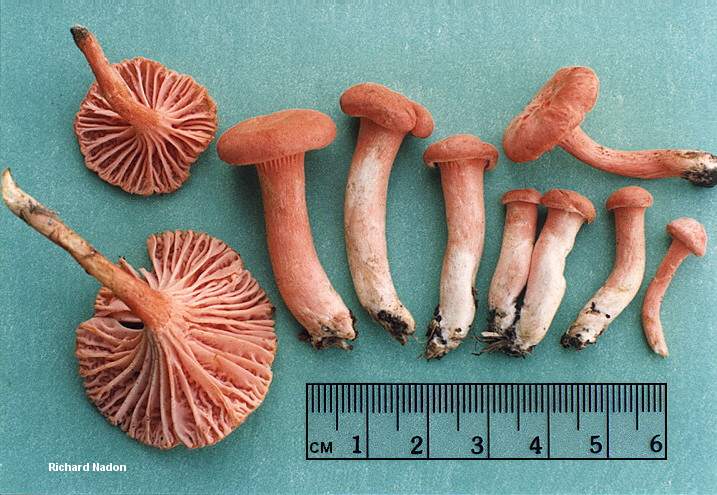
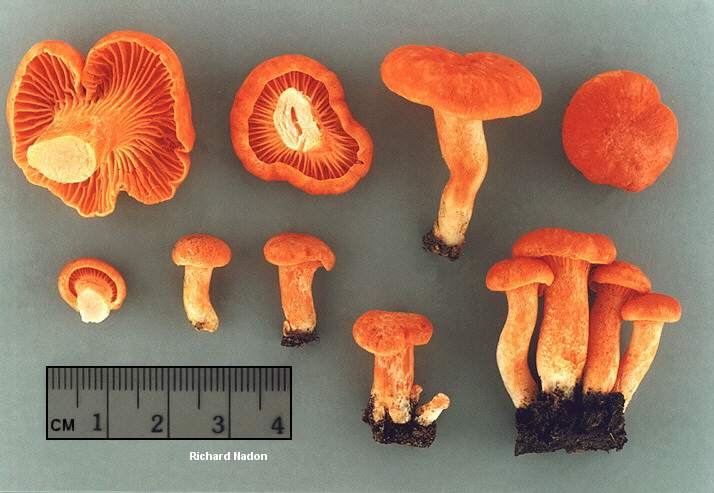
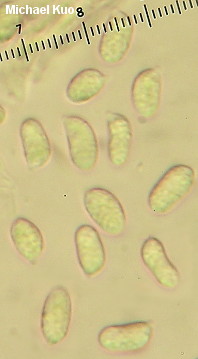
Cantharellus cinnabarinus [ Basidiomycota > Cantharellales > Cantharellaceae > Cantharellus . . . ] by Michael Kuo I think Cantharellus cinnabarinus is one of the most beautiful mushrooms in North America--easily recognized by its distinctive, flamingo-pink colors and the presence of false gills on the under side of the cap. It tends to be smaller and more graceful than cibarius-like chanterelles (which are often found growing nearby), and it grows on the ground in eastern North America's hardwood forests. Sadly, this beautiful little mushroom appears to be quite common in some years, but missing entirely in other years, even when other mushroom "regulars" are coming up. A nearly identical species, Cantharellus texensis, was described from Texas in 2011 (Buyck and collaborators) on the basis of differences in DNA and microscopic features: the spores of Cantharellus texensis are more proportionally elongated than those of Cantharellus cinnabarinus, and the terminal cells on the cap surface are thin-walled and cylindric, rather than thin- and thick-walled and cylindric to clavate. Whether or not Cantharellus texensis is distributed outside of the pine-oak forests of eastern Texas remains to be seen. Description: Ecology: Mycorrhizal with hardwoods--especially beech and oaks, but also with shagbark hickory, big-toothed aspen, and other hardwoods; growing alone, scattered, or gregariously; summer and fall; widely distributed in eastern North America. The illustrated and described collections are from Michigan, Québec, and Illinois.Cap: 1-4 cm wide; convex to broadly convex when young, becoming flat or shallowly centrally depressed; bald; dry; the margin inrolled when young, but expanding and becoming wavy with age; flamingo pink to "cinnabar red," pinkish orange, or reddish orange. Undersurface: With well spaced, well developed false gills that run down the stem; often developing cross-veins; colored like the cap or slightly paler. Stem: 1-4 cm long; 0.5-1 cm wide; equal when young but by maturity usually tapering to the base; bald; dry; colored like the cap or paler; not bruising; basal mycelium white to pale yellowish. Flesh: Whitish or tinged with the cap color; not changing color when sliced. Odor and Taste: Odor sweet and fragrant; taste not distinctive, or slightly peppery. Chemical Reactions: Iron salts on flesh negative to very pale gray; on undersurface negative to very pale gray. Spore Print: Whitish or slightly pinkish. Microscopic Features: Spores 6-8 x 3.5-5 µ; ellipsoid; occasionally constricted; smooth; inamyloid; ochraceous in KOH; with minutely granular contents. Basidia 4-6-sterigmate; 50-75 µ long. Elements from cap surface 3-8 µ wide; thin- or thick-walled; hyaline to yellow; septate; clamped at septa; terminal cells cylindric to clavate. REFERENCES: (Schweinitz, 1822) Schweinitz, 1832. (Coker, 1919; Corner, 1966; Smith, 1968; Bigelow, 1978; Petersen, 1979; Smith, Smith & Weber, 1981; Weber & Smith, 1985; Arora, 1986; Phillips, 1991/2005; Lincoff, 1992; Metzler & Metzler, 1992; Horn, Kay and Abel, 1993; Persson, 1997; Barron, 1999; Roody, 2003; McNeil, 2006; Miller & Miller, 2006; Kuo, 2007; Buyck et al., 2011; Kuo & Methven, 2014.) Herb. Kuo 07259401, 06140302, 07220302, 07200703. This site contains no information about the edibility or toxicity of mushrooms. |
© MushroomExpert.Com |
|
Cite this page as: Kuo, M. (2015, March). Cantharellus cinnabarinus. Retrieved from the MushroomExpert.Com Web site: http://www.mushroomexpert.com/cantharellus_cinnabarinus.html |