| Major Groups > Gilled Mushrooms > Pale-Spored > Amanita > Amanita populiphila |

|
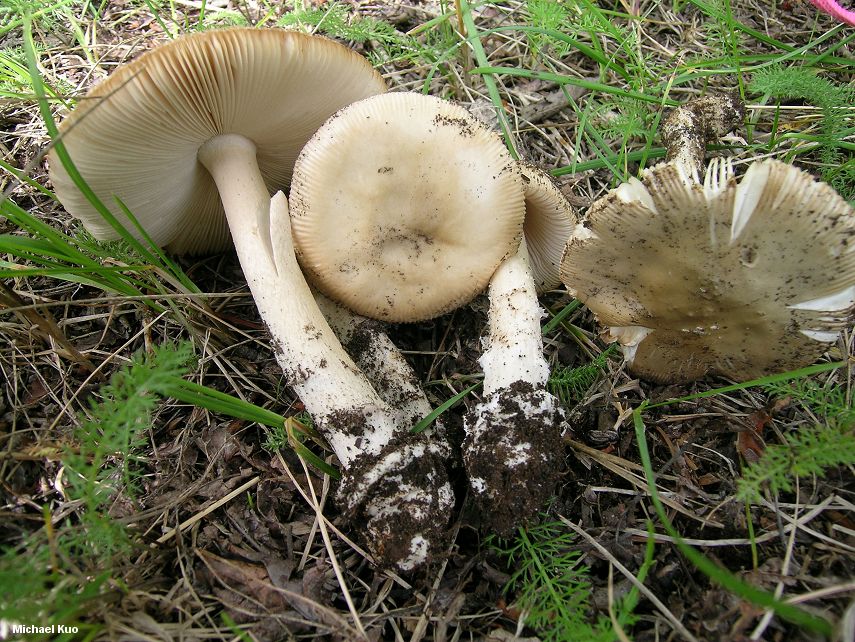
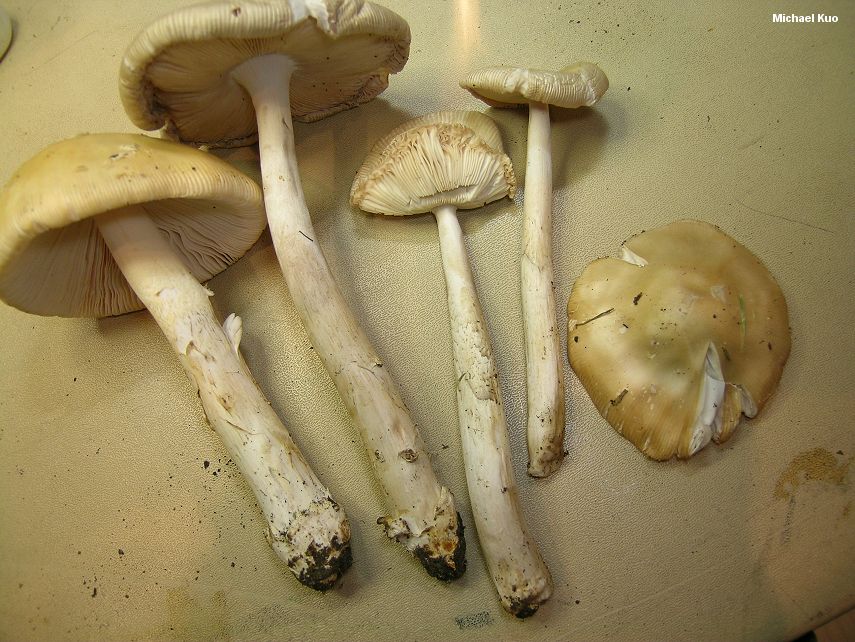
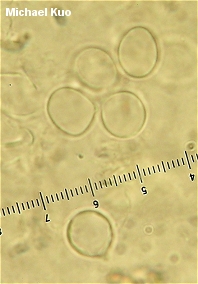
Amanita populiphila [ Basidiomycetes > Agaricales > Amanitaceae > Amanita . . . ] by Michael Kuo As its Latin species name indicates, Amanita populiphila is a "poplar-phile" and is associated with aspens and cottonwoods--the true poplars, in the genus Populus. It is a pale tan to yellowish or whitish member of the Amanita vaginata group; like other members of the group it lacks a ring, develops a lined cap margin, and features a sacklike volva at the stem base. In the case of Amanita populiphila, however, the volva is insubstantial and very fragile, and is often detached from the stem when the mushrooms are collected. Description: Ecology: Mycorrhizal with aspen and cottonwoods (narrowleaf cottonwood, eastern cottonwood, and plains cottonwood) in riparian and lowland ecosystems; usually growing scattered or gregariously; spring through fall; distributed from the Great Plains to Idaho and New Mexico, and in the northern Midwest. Cap: 3-12 cm wide; convex, becoming broadly convex or nearly flat; bald, or adorned with whitish to tan warts or small patches; sticky when fresh, but soon dry; pinkish tan to tan, yellowish, or nearly white; the margin becoming lined for 1 cm or more. Gills: Free from the stem or narrowly attached to it; close or crowded; white to creamy; short-gills frequent. Stem: 6-15 cm long; 0.5-2 cm wide; more or less equal; finely silky or hairy; whitish to pale tan; lacking a ring; base enclosed in an insignificant, fragile, whitish volva. Flesh: White; unchanging when sliced. Odor: Not distinctive, or faintly potato-like. Spore Print: White. Microscopic Features: Spores 9-12 µ; globose or subglobose; smooth; inamyloid. Basidia 4-spored; clamped. Pileipellis an ixocutis of elements 2-5 µ wide. Lamellar trama bilateral; subhymenium ramose. REFERENCES: Tulloss & E. Moses, 1995. (Kuo & Methven, 2010; Tulloss, 2013.) Herb. Kuo 08150711. This site contains no information about the edibility or toxicity of mushrooms. |
© MushroomExpert.Com |
|
Cite this page as: Kuo, M. (2013, May). Amanita populiphila. Retrieved from the MushroomExpert.Com Web site: http://www.mushroomexpert.com/amanita_populiphila.html |