| Major Groups > Stinkhorns > Phallus duplicatus |

|
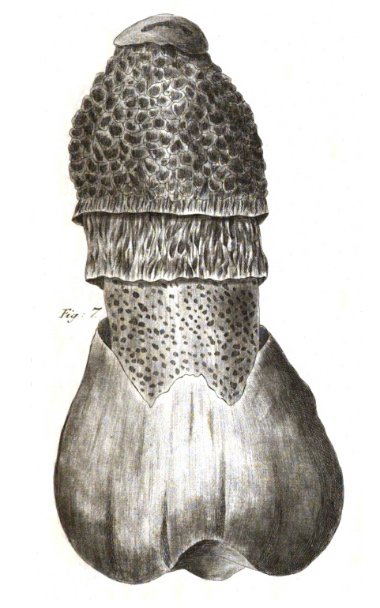
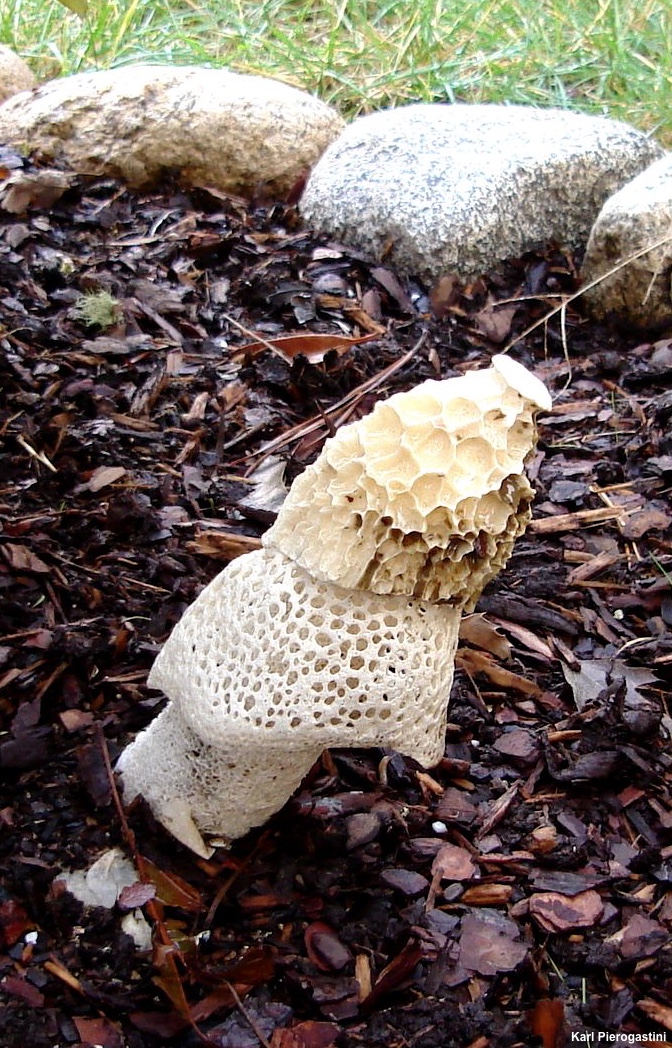
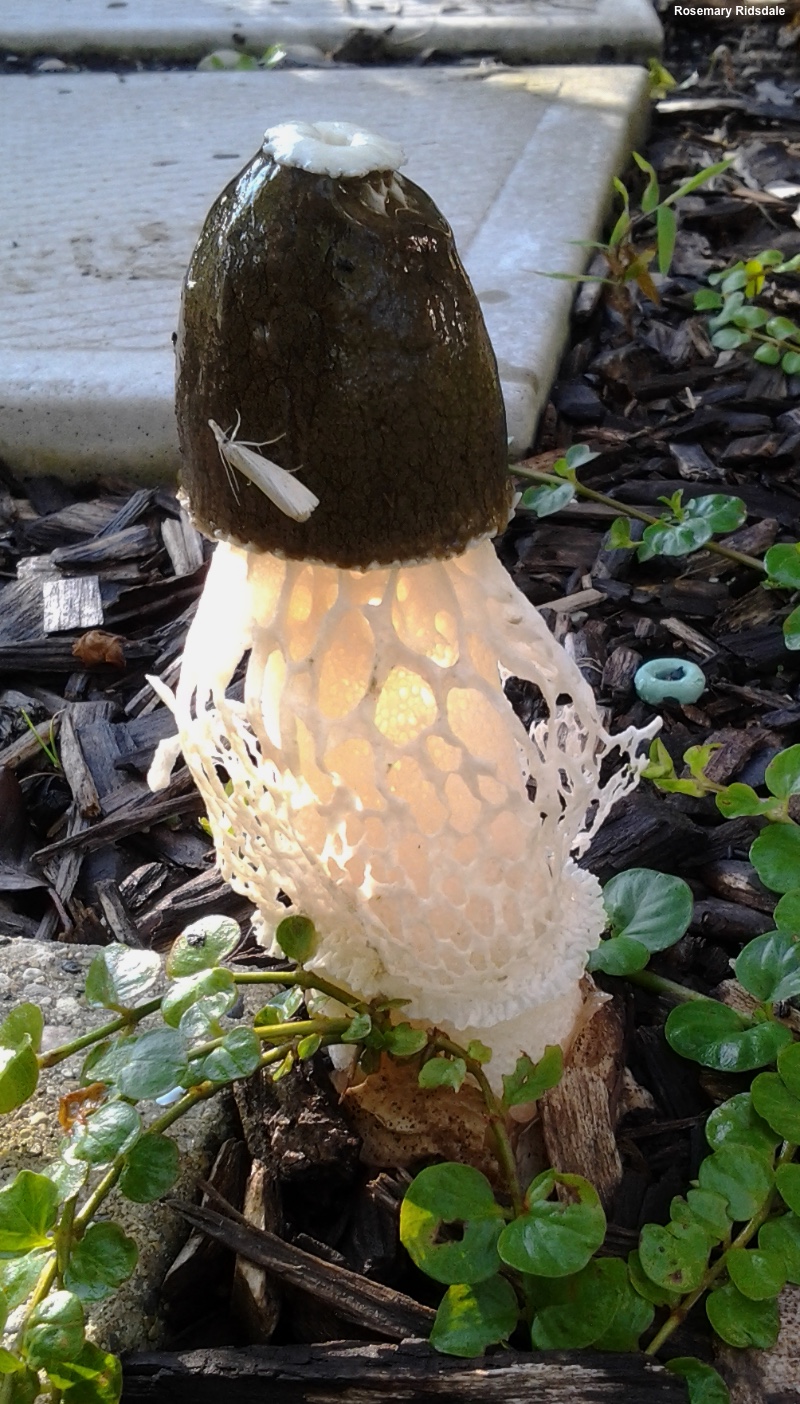
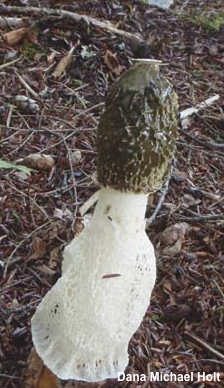
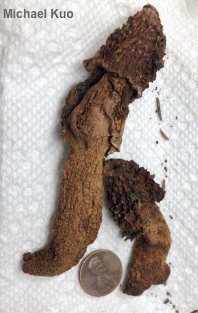
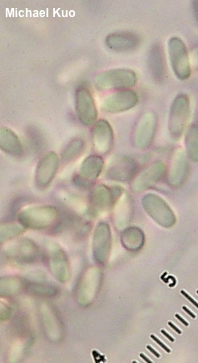
Phallus duplicatus [ Basidiomycota > Agaricomycetes > Phallales > Phallaceae > Phallus . . . ] by Michael Kuo As if stinkhorns like Phallus impudicus and Mutinus elegans weren't odd enough, this incredible mushroom had to go and add "adorned with a lace doily" to the list of possible stinkhorn features—along with the old standbys (being covered with a foul-smelling slime, arising from little underground "eggs," growing to full size fast enough that you can actually get the lawnchairs out and watch it happen, and so on). Sometimes called the "netted stinkhorn," Phallus duplicatus frequently grows in urban habitats in eastern North America. It is easily distinguished from the other North American stinkhorns by its astonishing net-like skirt, which hangs daintily below the cap, extending down about half the length of the stem. The only other "skirted" stinkhorn in North America is Phallus indusiatus, which is limited to Mexico on our continent and features a longer skirt with larger spaces in its meshes. Dictyophora duplicata is a synonym. Thanks to Dana Michael Holt, Karl Pierogastini, and Rosemary Ridsdale for documenting, collecting, and preserving Phallus duplicatus for study; their collections are deposited in The Herbarium of Michael Kuo. Description: Ecology: Saprobic; growing alone or gregariously in gardens, flowerbeds, meadows, lawns, woodchips, cultivated areas, and so on—also in hardwood forests; summer and fall; originally described from South Carolina; fairly widely distributed in North America east of the Rocky Mountains, especially in the southeast; reported (often erroneously, but reliably at least in Great Britain) in Europe and Asia; reliably reported in Brazil and Africa. The illustrated and described collections are from Maine, Massachusetts, and Michigan. Immature Fruiting Body: Like a whitish to purplish "egg" 3–8 cm high and 2–4 cm wide; egg-shaped or nearly round; base attached to white to purplish rhizomorphs; when sliced revealing the whitish stinkhorn-to-be encased in a brownish gelatinous substance. Mature Fruiting Body: Cylindric, with a clearly differentiated head structure that sits atop the stem; developing a net-like structure that extends below the head. Head: 3–5 cm high; broadly conic or nearly so; soon becoming perforated at the apex, with the perforation surrounded by a sterile whitish "lip"; becoming deeply pitted and pocketed in a reticulate pattern; surface white to creamy, but covered with a thick layer of dark brown spore slime (often thick enough to give the impression of a smooth, rather than pocketed, surface). Indusium (the "net"): Developing below the bottom rim of the head; eventually extending roughly halfway down the stem and flaring slightly away from it; white; with relatively small holes and thick dissepiments. Stem: 8–13 cm high; 2–3 cm thick; fairly equal; dry; white to whitish; pocketed with 1–2 declivities per mm; hollow; base enclosed in a whitish to purplish volva 2–5 cm high; attached to white or purplish rhizomorphs. Odor: Unpleasant and strong. Dried Specimens: Stem and head brownish orange in herbarium specimens. Microscopic Features: Spores 3–4 x 1–1.5 µm; subcylindric; smooth; without oil droplets; hyaline in KOH. Sphaerocysts of the pseudostipe 20–65 µm; irregularly subglobose; smooth; walls 1 µm thick; hyaline to orangish in KOH. Hyphae of the volva 2–6 µm wide (occasionally swollen up to 12 µm); smooth; thin-walled; hyaline in KOH; clamp connections present. Indusium (the "skirt") composed of chains of inflated cells that are sphaerocyst-like toward the surface but more hypha-like below; terminal cells subglobose to ellipsoid, 10–30 µm across; smooth, thin-walled, more or less hyaline in KOH. REFERENCES: Bosc, 1811. (Saccardo, 1888; Long, 1907; Lloyd, 1909; Coker & Couch, 1928; Smith, Smith & Weber, 1981; Arora, 1986; Guzmán, Montoya & Bandala, 1990; Phillips, 1991/2005; Lincoff, 1992; Metzler & Metzler, 1992; Kreisel, 1996; Barron, 1999; Roody, 2003; Calonge, 2005; Calonge et al., 2005; McNeil, 2006; Miller & Miller, 2006; Kreisel & Hausknecht, 2009; Cortez et al., 2011; Cabral et al., 2012; Hosaka, 2012; Kibby & McNeil, 2012; Kuo & Methven, 2014; Li et al., 2014; Li et al., 2016; Baroni, 2017; Woehrel & Light, 2017; Trierveiler-Pereira et al, 2017; Cabral et al., 2019.) Herb. Kuo 09111201, 09301201, 10091301. Phallus duplicatus Bosc, Magazin der Gesellschaft Naturforschenden Freunde Berlin 5: 86 (1811); English translation of protologue by Stephen Canfield: DOUBLE SATYR. Phallus duplicatus Bosc. Satyr with a perforated, spongy stipe surrounded at the base by a voluminous volva; the cap is bluntly and broadly conical, irregularly lacunose, with an oval perforation at the apex with edges recurved; a detached, folded, reticulate membrane descends from the apex to the midpoint of the stipe. This species exhibits certain elements in common with the tunic morel (Phallus indusiatus Vent.) although the two are very different. The cylindrical stipe is fistulous and pierced along its entire length with a multitude of holes of unequal size and irregular distribution. At maturity, the entire fungus gives off a very fetid odor. It is found during springtime in the humid, sandy areas of South Carolina. It is not particularly common. Would not this species and the tunic morel justify formation of a new genus? Plate 6. fig. 7 is a life-sized representation of this species.
(Protologue illustration, public domain, adapted from a scan provided online by the Hathi Trust Digital Library, https://babel.hathitrust.org/cgi/pt?id=hvd.32044106317993) This site contains no information about the edibility or toxicity of mushrooms. |
© MushroomExpert.Com |
|
Cite this page as: Kuo, M. (2021, February). Phallus duplicatus. Retrieved from the MushroomExpert.Com Web site: http://www.mushroomexpert.com/phallus_duplicatus.html |