| Major Groups > Gilled Mushrooms > Pale-Spored > Macrocybe titans |

|
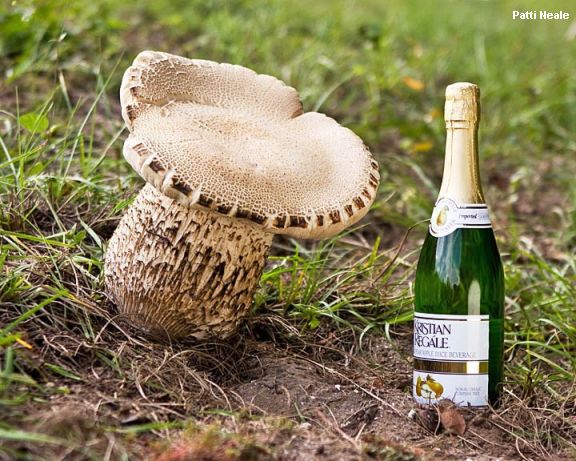
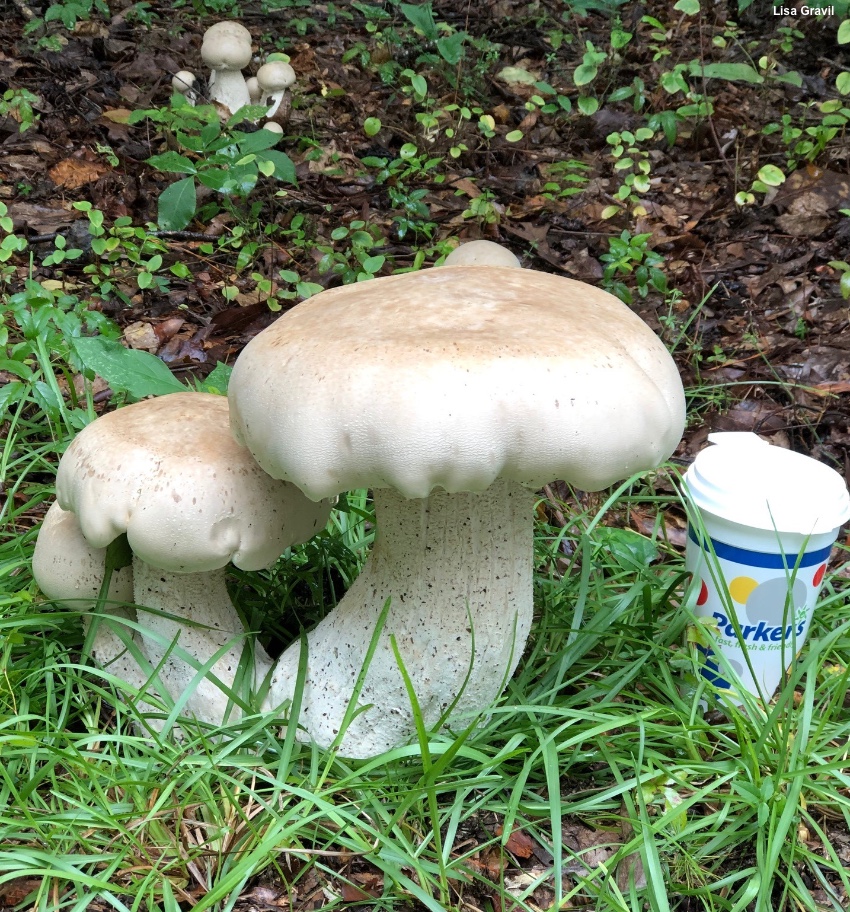
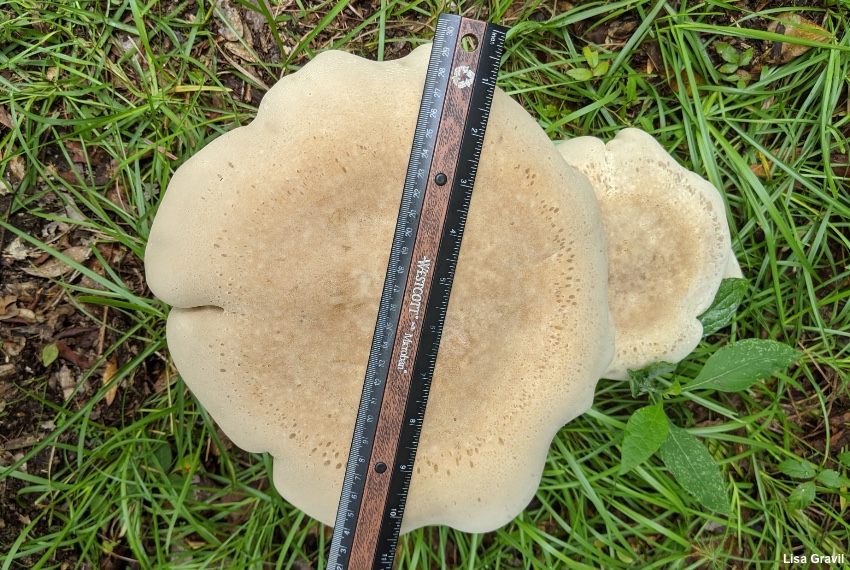
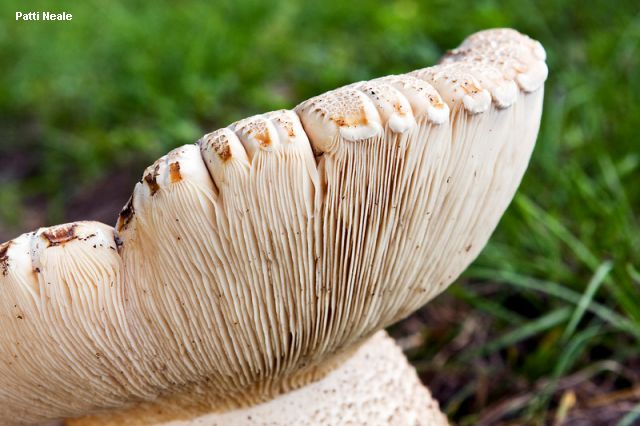
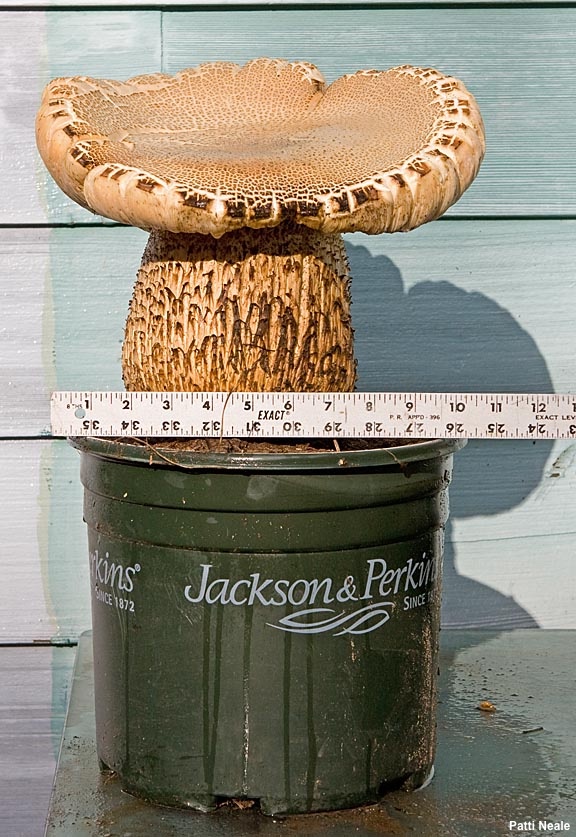
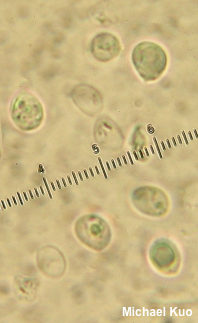
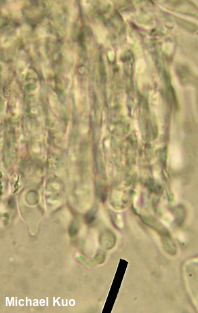
Macrocybe titans [ Basidiomycota > Agaricales > Callistosporiaceae > Macrocybe . . . ] by Michael Kuo There is a monster living in the southeastern United States and Mexico. It is probably the largest gilled mushroom in North America, with a cap that can measure over a yard across. It regularly appears in urban areas, causing considerable amazement. Believe it or not, there are a dozen or so gilled mushrooms in the world that get this large, most of which belong in the genus Macrocybe—Latin for "huge head." Macrocybe titans was originally described (as "Tricholoma titans") from grassy areas in northern Florida. Its defining features include the presence of bent-back scales on the stem, and, under the microscope, the presence of pseudocystidia on the faces of the gills. (However, the scales are not always prominent, and the pseudocystidia can be difficult to observe.) According to Pegler and collaborators (1998), the Costa Rican version of Macrocybe titans is unique in that it grows "from active Atta ant gardens" and has pseudocystidia on the edges (as well as the faces) of its gills. In a recent publication, Karlsen-Ayala and Smith (2020) hypothesize that Macrocybe titans may have been introduced to Florida from the Caribbean, and that it "has been spreading within the southeastern United States since its introduction," either naturally (through dispersal of spores on air currents) or with human assistance by way of woodchips and soil movement, along with warming climate. Thanks to Patti Neal and Lisa Gravil for collecting, documenting, and preserving Macrocybe titans for study; their collections are deposited in The Herbarium of Michael Kuo. Description: Ecology: Apparently saprobic; growing alone or, more often, gregariously or in loose clusters in grassy or sandy areas, or in ground disturbed by landscaping (usually in the year after the disturbance to the soil)—or, in Central America, growing from ant colonies; fall and winter; In North America distributed from Mexico to Texas, Florida, and the Carolinas; also found in Central America, the Caribbean, and South America. The illustrated and described collections are from Florida and South Carolina. Cap: 20–30 (reportedly up to 100) cm across at maturity; convex, becoming broadly convex or flat; dry; bald, but sometimes cracking in age or in dry weather; pale yellowish to brownish or buff; fading with age. Gills: Attached to the stem; crowded; short-gills frequent; white to pale brownish. Stem: 15–25 cm long; 8–14 cm thick; equal or slightly swollen; dry; whitish overall, with small, bent-back, brownish to whitish scales that become more prominent with age. Flesh: White; firm; not changing on exposure. Odor: Not distinctive. Spore Print: Reported as creamy white. Microscopic Features: Spores 5–7 x 4–5 µm; broadly ellipsoid; smooth; hyaline in KOH; inamyloid. Lamellar trama parallel. Basidia 4-sterigmate; 30–35 x 5–8 µm; clavate. Pseudocystidia scattered on gill faces, scarcely projecting; to 50 x 7.5 µm; fusiform to lageniform, with or without an extended neck; thin-walled; with refractive contents in KOH. Pileipellis a cutis of elements 2–5 µm wide. Clamp connections present. REFERENCES: (H. E. Bigelow & Kimbrough, 1980) Pegler, Lodge & Nakasone, 1998. (Bigelow & Kimbrough, 1980; Pegler, Lodge & Nakasone, 1998; Halling & Mueller, 2004; Bessette et al., 2007; Elliott & Stephenson, 2018; Karlsen-Ayala & Smith, 2020.) Herb. Kuo 10150702. This site contains no information about the edibility or toxicity of mushrooms. |
© MushroomExpert.Com |

|
Cite this page as: Kuo, M. (2020, July). Macrocybe titans. Retrieved from the MushroomExpert.Com Web site: http://www.mushroomexpert.com/macrocybe titans.html |