| Major Groups > Gilled Mushrooms > Pale-Spored > Lyophyllum decastes group > Lyophyllum decastes |

|
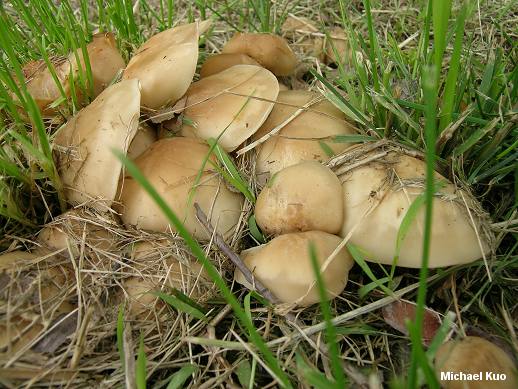
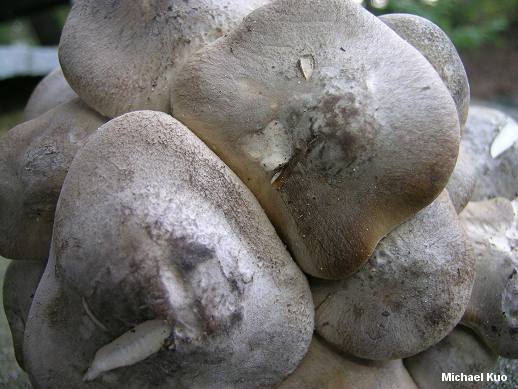
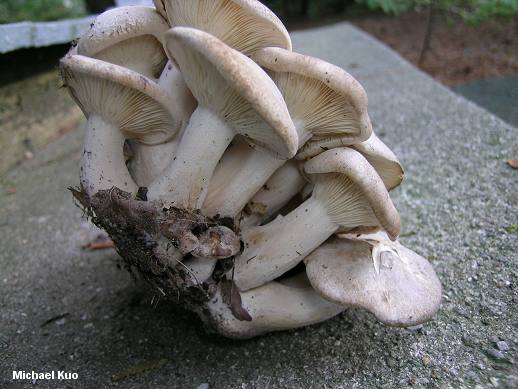
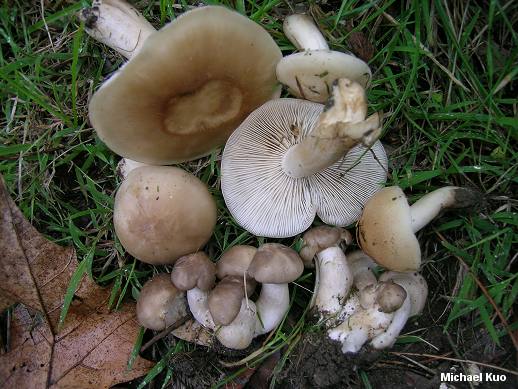
Lyophyllum decastes [ Basidiomycetes > Agaricales > Tricholomataceae > Lyophyllum . . . ] by Michael Kuo I don't know how many mushroom species are hiding out under the name "Lyophyllum decastes," but it wouldn't surprise me to find out there are several. Just flip through your field guides and take a look at the pictures. Then again, if we have learned anything from DNA studies of mushrooms we have learned that the physical features of mushrooms (for example the color of the cap) are not necessarily indicative of meaningful genetic difference--so it may be the case that there is only one species involved. At any rate, many sources treat Lyophyllum decastes as a constellation of (potential) species, and that is what I will do here. The salient features of the group, then, are:
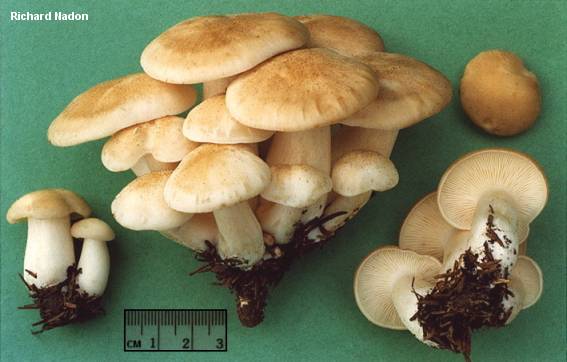
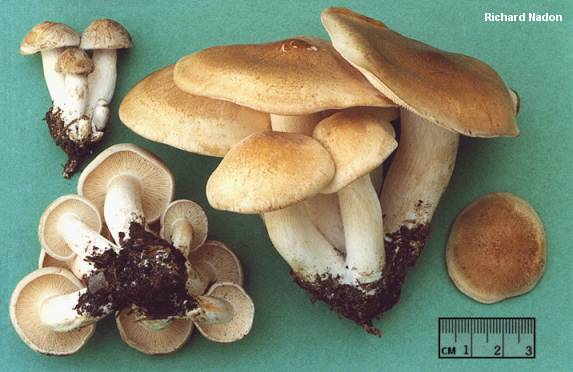
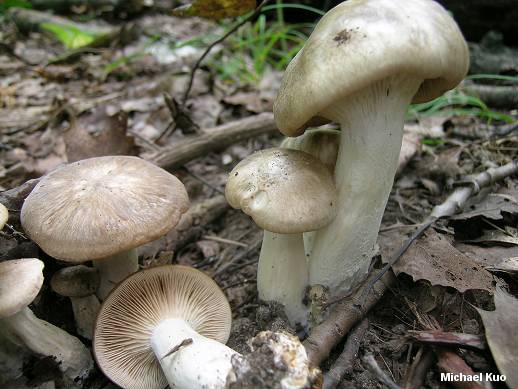
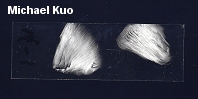
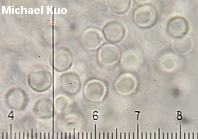
If you have matched all of these characters, you can be pretty sure you have found a member of the Lyophyllum decastes species group. Yes, that's Description: Ecology: Saprobic; usually growing in dense clusters in disturbed soil (roadbeds, paths, landscaping areas, and so on), or occasionally growing alone or scattered (and sometimes occurring in woods); summer and fall (fall through spring on the West Coast); widely distributed in North America. Cap: 3-12 cm; convex, becoming broadly convex or flat; moist (but not slimy) when fresh; smooth; grayish brown to yellowish brown or brown (usually darker when young); often somewhat streaked in appearance; the margin inrolled at first, later even, lobed, or upturned. Gills: Attachment variable (attached to the stem, sometimes by a notch, or beginning to run down it); close; white, sometimes yellowing somewhat with age. Stem: 5-10 cm long; up to 2 cm thick; smooth; more or less equal; dry; whitish, sometimes becoming brownish toward the base. Flesh: White; firm; not changing on exposure. Odor and Taste: Taste pleasant and mild, or faintly radish-like; odor not distinctive or somewhat fragrant. Spore Print: Pure white. Microscopic Features: Spores 4-6 µ; round or nearly so; smooth; inamyloid. Cystidia absent. Basidia with siderophilous granules when mounted in acetocarmine. Clamp connections present. REFERENCES: (Fries, 1818) Singer, 1951. (Fries, 1821; Saccardo, 1887; Kauffman, 1918; Smith, 1975; Smith, Smith & Weber, 1979; Arora, 1986; Phillips, 1991/2005; Lincoff, 1992; Barron, 1999; Roody, 2003; McNeil, 2006; Miller & Miller, 2006; Kuo, 2007; Trudell & Ammirati, 2009.) Herb. Kuo 09110406, 01130516, 09110514, 05140601, 11110701 (WW). This site contains no information about the edibility or toxicity of mushrooms. |
|
|
Key to 4 species in the Lyophyllum decastes group
Cite this page as: Kuo, M. (2010, May). Lyophyllum decastes. Retrieved from the MushroomExpert.Com Web site: http://www.mushroomexpert.com/lyophyllum_decastes.html © MushroomExpert.Com |
