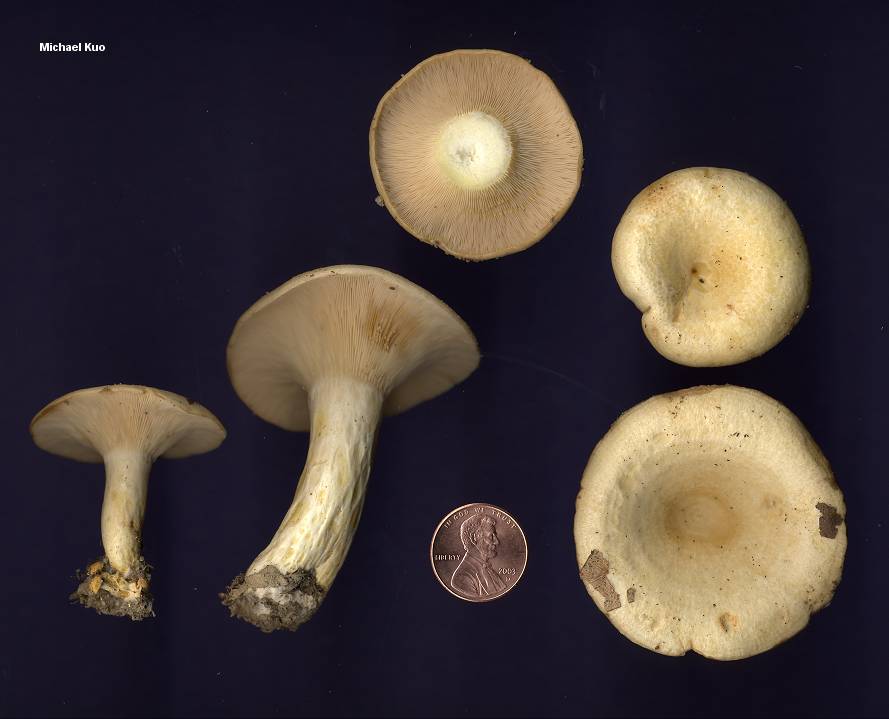
The features defining this species include the fact that the white milk quickly turns yellow when exposed to air, the pale yellowish cap, the pale gills (which may bruise tan but do not develop reddish stains or change color substantially in age), and the stem, which is somewhat slimy when the mushroom is fresh and young. Lactarius maculatipes is found under oaks; it is probably fairly widely distributed east of the Rocky Mountains (see below). The principal competitors for your identification attention are Lactarius chrysorrheus and Lactarius vinaceorufescens, which lack the slimy stem; see the comments below for help separating them from Lactarius maculatipes.
Potholes and Slime
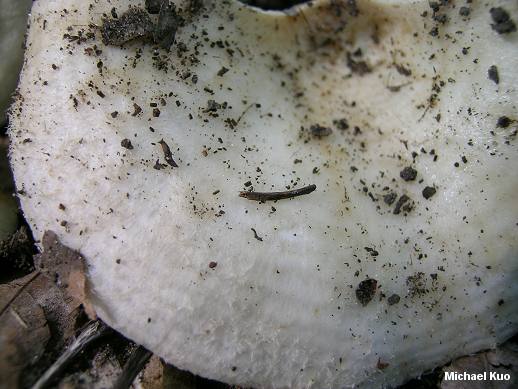
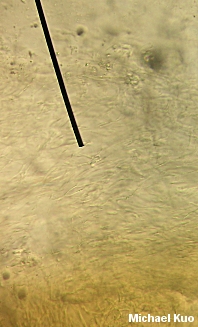
One of the more curious features of some Lactarius species is the presence of small potholes on the stems. These species are said to be "scrobiculate" in Mycologese, and the potholes are called "scrobiculi." The potholes are the result of a thin layer of slime, and represent areas where the cells on the stem surface have become gelatinized. A study of Lactarius stems by Nancy Weber "came to the conclusion that the viscid areas were the smooth shiny scrobiculi present on many species" (Hesler & Smith, 1979, p. 51). Under the microscope, a layer of gelatin-like material can be seen over the potholes.
Since identifying species of Lactarius sometimes hinges on whether or not the stem and/or cap are viscid (Mycologese for "thinly slimy"; very slimy surfaces are called "glutinous"), and since weather conditions can easily dry out mushrooms, the presence or absence of potholes can thus serve as a secondary indicator of the stem's "slime factor." Sadly, this does not transfer to other mushroom genera where the sliminess of the stem is taxonomically important (for example, Hygrocybe), since mushrooms in those genera do not develop potholes.
Lactarius chrysorrheus and Lactarius vinaceorufescens (both with white milk that turns yellow on exposure) have dry stems, and thus lack the potholes. Both species demonstrate pinkish to cinnamon shades: Lactarius chrysorrheus has a pale cap that may develop "yellowish cinnamon" colorations, and pale to pinkish gills that do not bruise or discolor; it grows under oaks, like Lactarius maculatipes. Lactarius vinaceorufescens has a pinkish cinnamon cap that becomes reddish in age, and pale pink gills that bruise and discolor pink to reddish or reddish brown--and, making things easier, it grows under pines.
Description:
Ecology: Mycorrhizal with oaks and possibly other hardwoods; summer and fall (November through January in Florida); originally described from Florida, but also collected in Michigan, Minnesota, Tennessee, and Illinois; probably to be expected throughout the oak forests of eastern North America.
Cap: 3-10 cm; broadly convex with an inrolled margin when young; becoming shallowly depressed or vase-shaped with an uplifted margin; slimy when wet; smooth or finely roughened; whitish to pale yellowish; typically with vague zones of color or texture, at least when young.
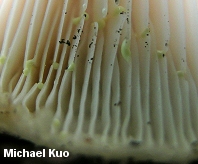
Gills: Beginning to run down the stem; close or crowded; pale yellowish; typically bruising tan.
Stem: 3-8 cm long; 1-2 cm thick; tapering to base; slimy when fresh or wet; usually with yellowish potholes by maturity; whitish.
Flesh: White; firm; appearing to yellow when sliced, due to the milk.
Milk: White, becoming yellow on exposure to air (usually quickly, but originally described by Burlingham (1942) as taking from 10 minutes to an hour to change color; staining white paper yellow.
Odor and Taste: Odor not distinctive; taste acrid (sometimes developing slowly).
Spore Print: Yellowish.
Chemical Reactions: KOH greenish yellow on cap surface.
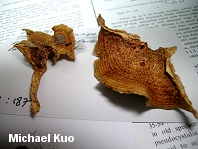
Dried Specimens: Dried caps, stems, and gills are bright, golden brownish orange. The oldest specimens in my herbarium have retained this color for 16 years--and Gertrude Burlingham's 1941 type collection for the species is still this color in online records.
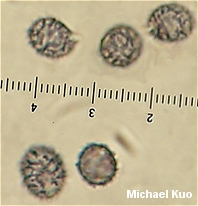
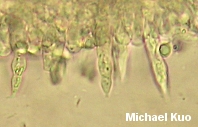
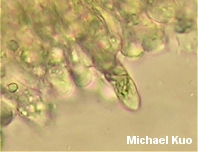
Microscopic Features: Spores 6.5-9 x 6-7.5 µ; broadly ellipsoid or occasionally subglobose; ornamentation 0.5-1 µ high, as amyloid warts and connecting lines that branch into short patterns but do not form complete reticula. Pleuromacrocystidia scattered; subcylindric to subfusiform; to about 55 x 8 µ. Cheilocystidia abundant; subcylindric to fusiform; to about 50 µ long. Pileipellis a very thick ixocutis.
REFERENCES: Burlingham, 1942. (Hesler & Smith, 1979; Smith, Smith & Weber, 1979; Metzler & Metzler, 1992; Roody, 2003; Binion et al., 2008.) Herb. Kuo 06269501, 07290306, 08290501, 07090704.
This site contains no information about the edibility or toxicity of mushrooms.