| Major Groups > Gilled Mushrooms > Pale-Spored > Lactarius > Lactarius argillaceifolius |

|
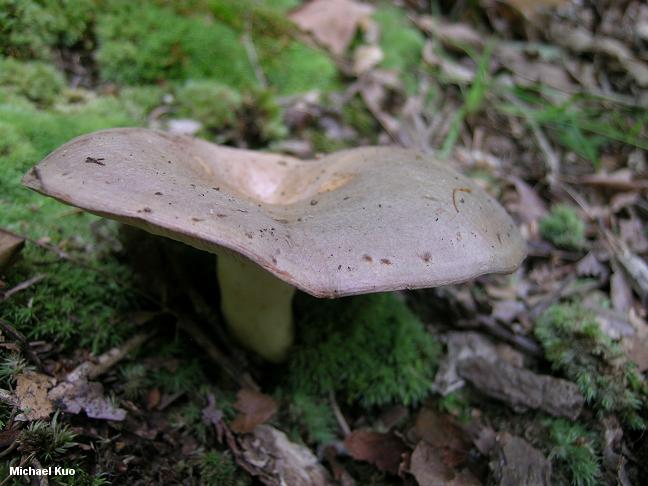
Lactarius argillaceifolius [ Agaricomycetes > Russulales > Russulaceae > Lactarius . . . ] by Michael Kuo This drab species is one of several North American species that are similar to the European species Lactarius trivialis. But while Lactarius trivialis favors conifers and birches in boreal and subalpine forests in Europe, Lactarius argillaceifolius associates with oaks in eastern North America. Also unlike Lactarius trivialis, Lactarius argillaceifolius has gills that are stained brownish by the milk. Other defining features include the dingy cinnamon color of the mature gills, the drab lilac cap color, and the off-white (rather than pure white) color of the milk. Lactarius argillaceifolius var. megacarpus associates with coast live oak on the West Coast; it is a much larger mushroom featuring partially reticulate spores with shorter ornamentation. Lactarius argillaceifolius var. dissimilis was described by Hesler & Smith (1979) from South Carolina on the basis of a single collection that featured a pileipellis disposed as an ixotrichoderm. Description: Ecology: Mycorrhizal with oaks; growing alone or gregariously; spring (it is often one of the first mycorrhizal mushrooms to appear in oak-hickory forests), summer and fall; widely distributed east of the Rocky Mountains. Cap: 3-18 cm; convex becoming flat or shallowly vase-shaped; drab cinnamon to drab lilac brown; without zones; bald or minutely pocked and rugged; sticky when fresh. Gills: Beginning to run down the stem; close or crowded; cream colored when young, becoming dingy cinnamon with age; stained slowly brown (or rarely olive to greenish) by the latex where damaged. Stem: 3-9 cm long; 1-3.5 cm thick; tapering to base; pale or brownish in age; dry or slightly sticky; smooth; without potholes. Flesh: White; unchanging, or discoloring faintly tan. Milk: Off-white; unchanging when exposed; staining tissues brown to brownish, or rarely olive to greenish; over time staining white paper yellow. Odor and Taste: Odor not distinctive to mildly fragrant; taste mild to slowly slightly acrid. Spore Print: Pale yellowish. Chemical Reactions: KOH on cap surface erasing pigments to pale orange or tan. Microscopic Features: Spores 8-10 x 7-8 µ; broadly ellipsoid or subglobose; ornamentation 0.5-1 µ high, composed of fairly isolated warts and ridges that sometimes form broken reticula. Pleuromacrocystidia fusoid-ventricose; to 100+ µ long. Cheilomacrocystidia similar but usually shorter. Pileipellis an ixolattice. REFERENCES: Hesler & Smith, 1979. (Smith, Smith & Weber, 1979; Weber & Smith, 1985; Binion et al., 2008.) Herb. Kuo 06119505, 09020101, 05290301, 05300403, 07100702. This site contains no information about the edibility or toxicity of mushrooms. |
© MushroomExpert.Com |


|
Cite this page as: Kuo, M. (2011, February). Lactarius argillaceifolius. Retrieved from the MushroomExpert.Com Web site: http://www.mushroomexpert.com/lactarius_argillaceifolius.html |