| Major Groups > Gilled Mushrooms > Dark-Spored > Lacrymaria velutina |

|
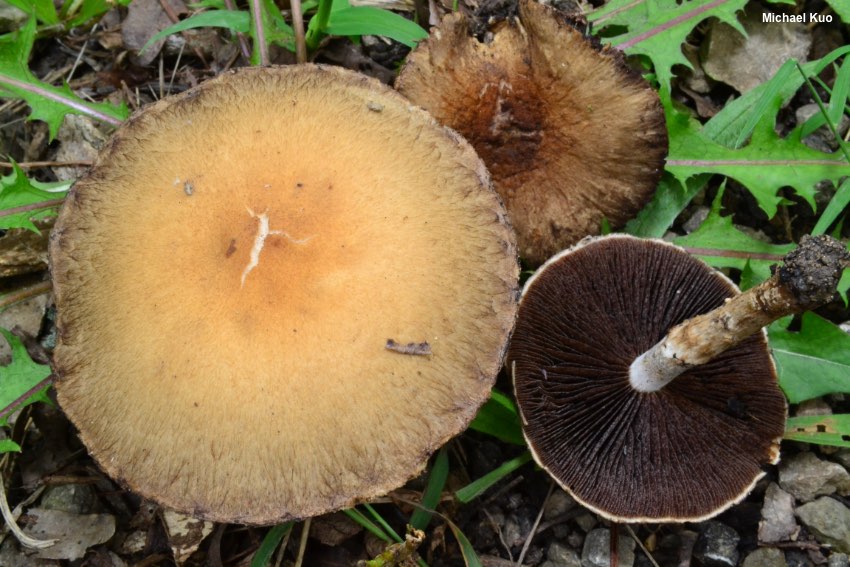
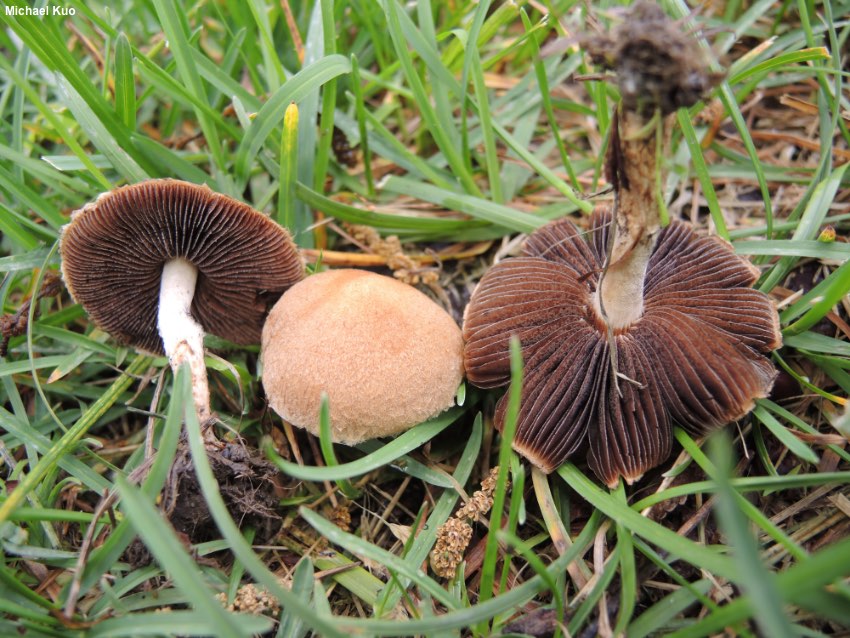
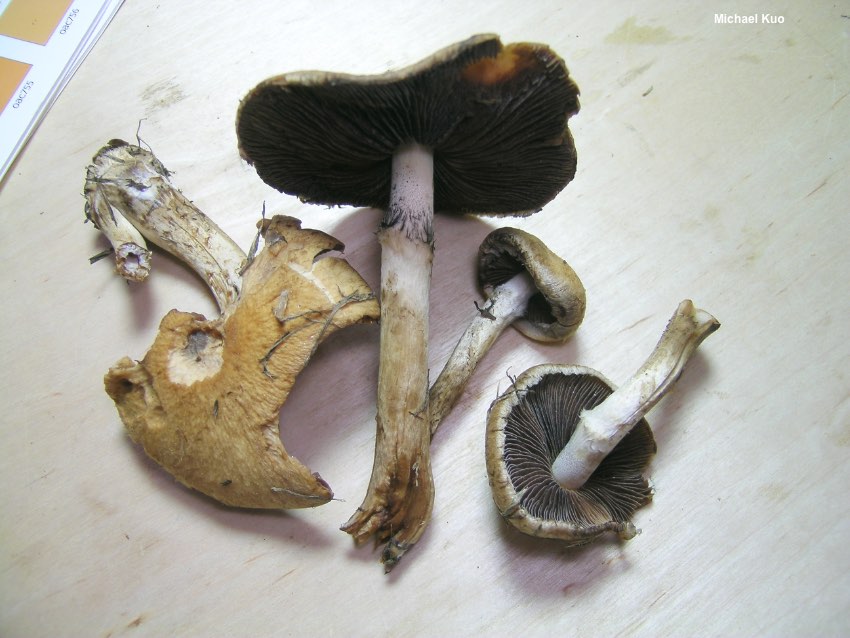
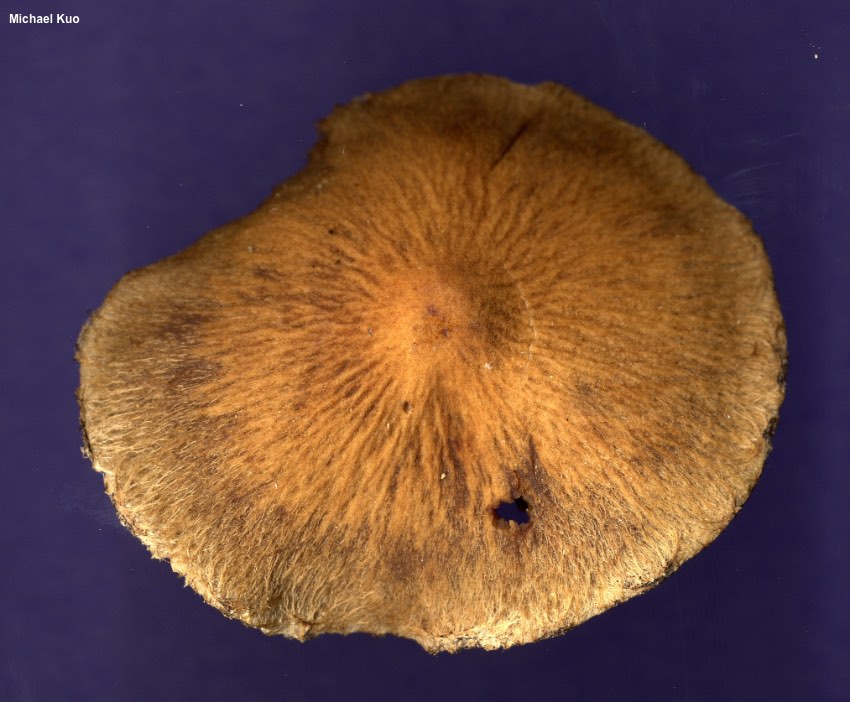
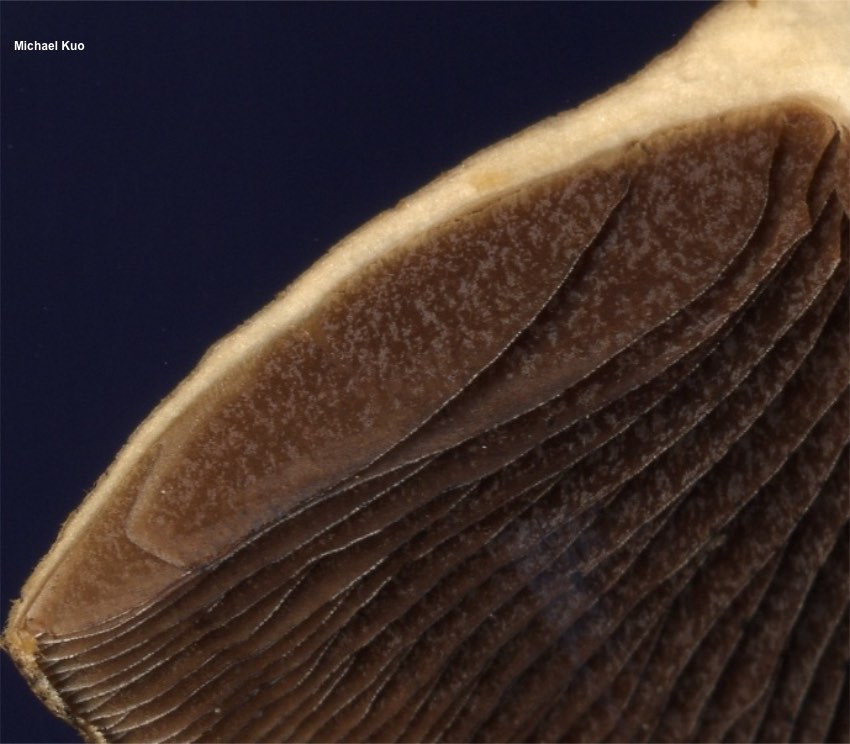
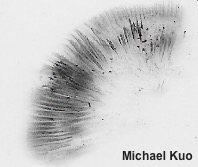
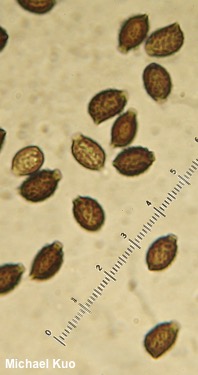
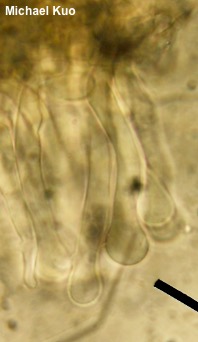
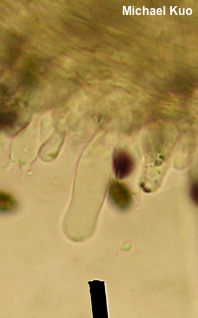
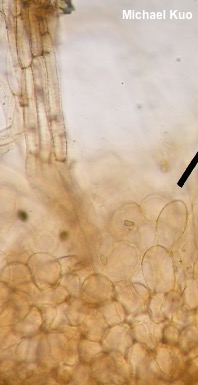
Lacrymaria velutina [ Basidiomycota > Agaricales > Psathyrellaceae > Lacrymaria . . . ] by Michael Kuo This lawn and garden dweller, formerly known as Psathyrella velutina, is widely distributed on the continent, and easily recognized by its dark, mottled gills, its nearly black spore print, its hairy ("fibrillose," in Mycologese) cap, and the ring zone on its stem. It was always rather un-Psathyrella-ish, and mycologists over the years have debated where to place it. Recent DNA studies (see Padamsee and collaborators, 2008; Larsson & Örstadius, 2008) have supported the idea that, while it is closely related to species of Psathyrella, it belongs outside that genus. Lacrymaria echiniceps is similar but features a more prominently fibrillose-scaly cap, a scaly stem, and smaller spores. Lacrymaria velutina is a big thrill for mushroom geeks like me; like Pluteus cervinus, it is one of those species with fascinating microscopic features that are not predicted by its drab macrofeatures. The spores are roughened or finely warty, and have little snouts—while the gills feature cool, knob-headed cystidia. How much more action-packed could a mushroom be? Lacrymaria lacrymabunda is seen as a synonym by some authors, but is separated by others on the basis of its smoother spores. Padamsee and collaborators (2008) found specimens identified as "Lacrymaria velutina" to be genetically separated, suggesting that species concepts in Lacrymaria may need to be modified. Thanks to Cecily Franklin for collecting, documenting, and preserving Lacrymaria velutina for study; her collection is deposited in The Herbarium of Michael Kuo. Description: Ecology: Saprobic; growing alone, gregariously, or in clusters on lawns, in pastures, along roads and in gravelly soil, usually near recently dead hardwood trees; sometimes appearing in woods; summer through fall; widely distributed in North America. The illustrated and described collections are from Illinois and Pennsylvania. Cap: 3–8 cm; convex when young, becoming broadly convex, broadly bell-shaped, or nearly flat; dry; finely appressed-fibrillose when fresh and young, but sometimes becoming more or less bald in age; grayish brown to medium yellowish brown, fading to dull tan; the young margin sometimes hung with whitish partial veil remnants, at least when young. Gills: Narrowly attached to the stem; close or crowded; short-gills frequent; pale at first, becoming pale grayish brown and eventually dark brown; mottled at maturity; with whitish edges. Stem: 4–10 cm long; 4–10 mm thick; equal; fibrillose or nearly bald; with a fragile ring or a ring zone that is darkened by spores; white above, pale brownish below; hollow; basal mycelium white. Flesh: Whitish to watery brownish; unchanging when sliced. Odor and Taste: Not distinctive. Chemical Reactions: KOH on cap surface negative or pinkish. Spore Print: Very dark brown to black. Microscopic Features: Spores 8–12 x 5–7 µm; ellipsoid to subamygdaliform; with a large, snout-like pore; coarsely, moderately verrucose; brown in KOH; reddish brown in Melzer's. Basidia 4-sterigmate. Cheilocystidia 50–80 x 5–10 µm; cylindric-flexuous, with clavate to subcapitate or capitate apices; smooth; thin-walled; hyaline in KOH. Pleurocystidia 35–75 x 7.5–12.5 µm; widely cylindric to subutriform; smooth; thin-walled; hyaline; scattered; sometimes grouped in twos or threes; sometimes hard to find or apparently absent. Pileipellis a hymeniform layer of widely clavate elements, from which arise bundles of cylindric, clamped elements 5–10 µm wide, with slightly encrusted walls; orangish brown in KOH. REFERENCES: (Persoon, 1801) Konrad & Maublanc, 1925. (Smith, 1972; Smith, Smith & Weber, 1979; Arora, 1986; Phillips, 1991/2005; Lincoff, 1992; Horn, Kay & Abel, 1993; Barron, 1999; Roody, 2003; McNeil, 2006; Miller & Miller, 2006; Larsson & Örstadius, 2008; Padamsee et al., 2008; Kuo & Methven, 2014; Desjardin, Wood & Stevens, 2015; Siegel & Schwarz, 2016; Woehrel & Light, 2017.) Herb. Kuo 09229601, 07250301, 05211002, 09291104, 08221403, 05101602, 09181701. This site contains no information about the edibility or toxicity of mushrooms. |
© MushroomExpert.Com |

|
Cite this page as: Kuo, M. (2018, February). Lacrymaria velutina. Retrieved from the MushroomExpert.Com Web site: http://www.mushroomexpert.com/lacrymaria_velutina.html |