| Major Groups > Oddballs & Misfits / Mycotrophs > Hypomyces > Hypomyces chrysospermus |

|
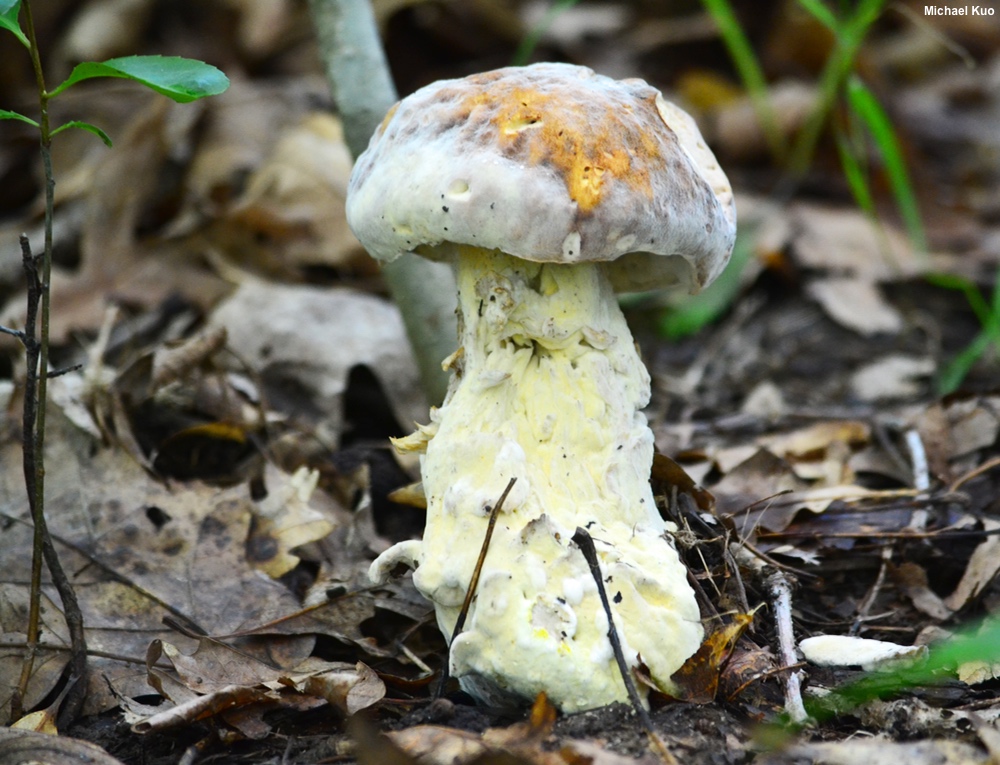
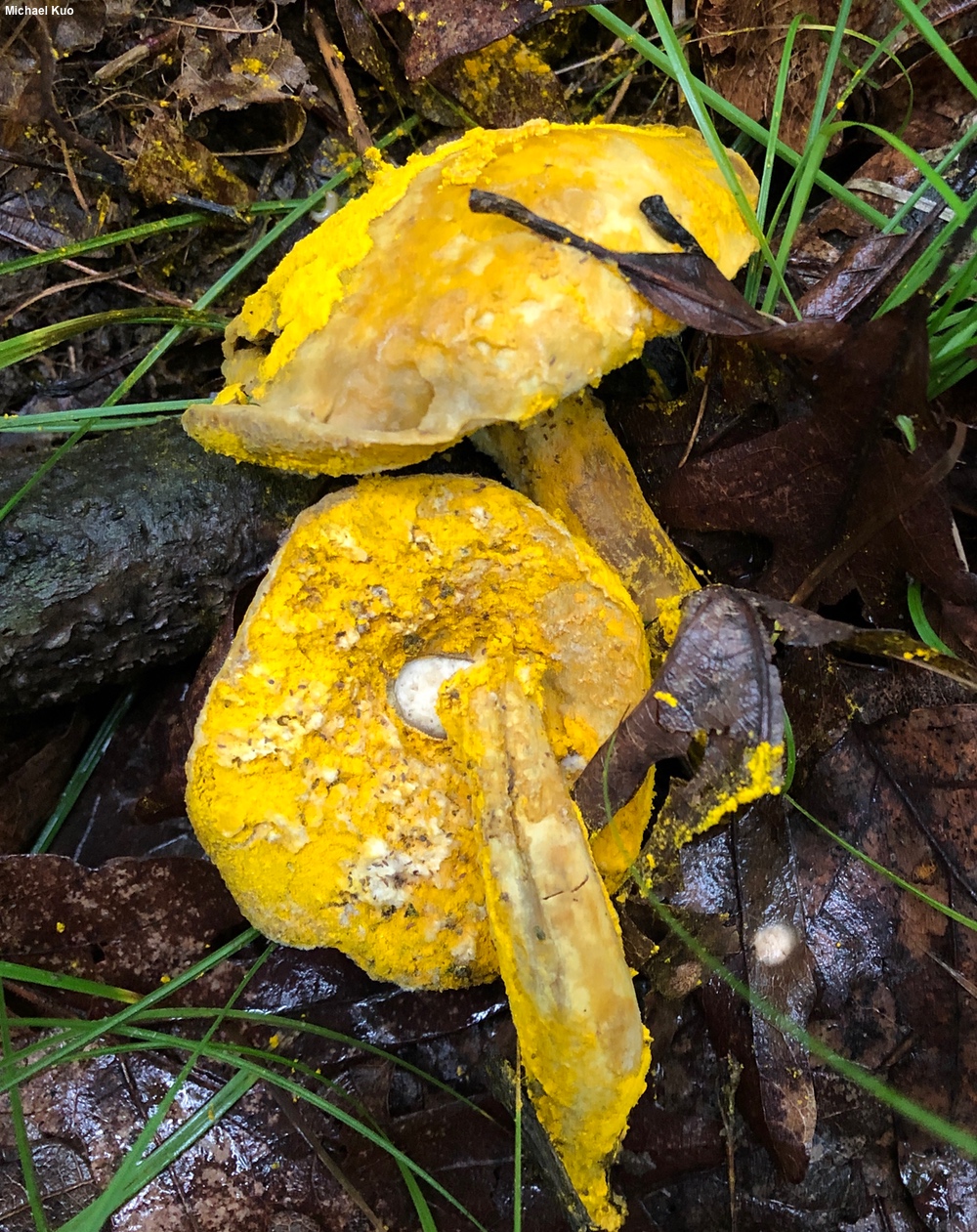
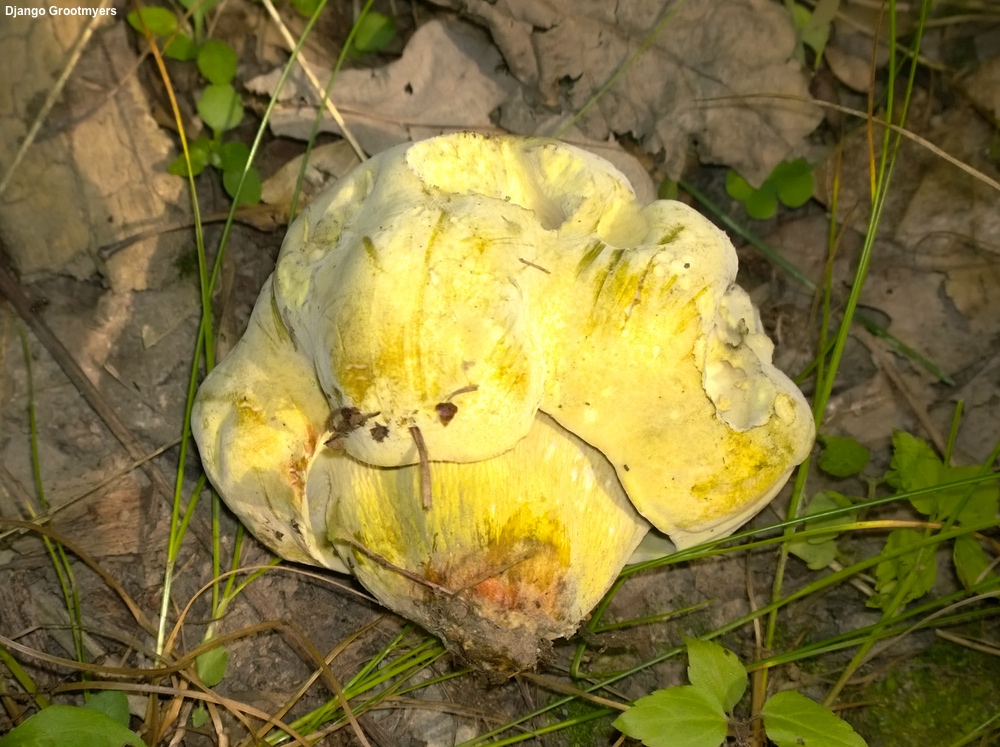
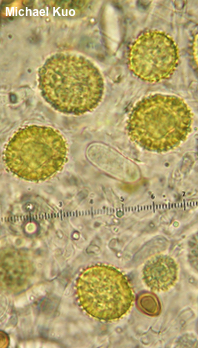
[ Ascomycota > Sordariomycetes > Hypocreales > Hypocreaceae > Hypomyces . . . ] Hypomyces chrysospermus by Michael Kuo, 29 September 2023 This "bolete mold" attacks a wide range of boletes, including the so-called gilled bolete. Hypomyces chrysospermus spreads across its victim, eventually covering the entire mushroom. As the Hypomyces develops it turns from white to pale yellow and then dark, golden yellow—and eventually it becomes crustlike and reddish brown, though neither the mushroom nor the mold is often seen in this last stage, since decay has set in. Hypomyces microspermus is identical to the naked eye, but can be partially separated through identification of the bolete victim: it attacks only xerocomelloid boletes—a group of small or medium-small boletes with slender stems and red to brown, subvelvety caps that often become cracked and mosaic-like; see Xerocomellus chrysenteron, Xerocomellus rubellus, and Boletus harrisonii for examples. I say "partially" separated because Hypomyces chrysospermus also parasitizes xerocomelloid boletes. So if your bolete is not xerocomelloid and your mold is golden yellow and powdery, Hypomyces chrysospermus is a good bet. If the bolete is xerocomelloid, however, you will need to consult microscopic features, since both chrysospermus and microscpermus are possible. The aleuriospores of Hypomyces chrysospermus are larger (16–25 µm across) than the aleuriospores of Hypomyces microspermus (12–16 µm across); this difference is probably the most easily assessed microscopic difference, since bolete molds are rarely collected when they are mature and feature sexual spores (which are also larger in chrysospermus). Thanks to Django Grootmyers for documenting, collecting, and preserving Hypomyces chrysospermus for study; his collection is deposited in The Herbarium of Michael Kuo. Description: Ecology: Parasitic on various species of boletes; summer and fall, or over winter in warm climates; originally described from France (Tulasne & Tulasne 1860); widely distributed in Eurasia and in North America; also recorded in Central America and Oceania. The illustrated and described collections are from Illinois and Ohio. Fruiting Body: A mold-like covering that spreads across the bolete, eventually covering it entirely; white and tissue-like at first, becoming powdery and golden yellow, and, eventually, crustlike and brown to reddish brown. Microscopic Features: Aleuriospores 16–22 µm including ornamentation; globose; echinate with spines about 1 µm long; thick-walled; golden yellow in KOH. Conidia 11–20 x 4–8 µm; ellipsoid or irregularly ellipsoid; smooth; hyaline in KOH. Subicular hyphae 2–5 µm wide, septate, smooth, hyaline in KOH. REFERENCES: L. R. Tulasne & C. Tulasne, 1860. (Arora, 1986; Rogerson & Samuels, 1989; Phillips, 1991/2005; Schalkwijk-Barendsen, 1991; Lincoff, 1992; Horn, Kay & Abel, 1993; Barron, 1999; Põldmaa et al., 1999; Roody, 2003; Douhan & Rizzo, 2004; McNeil, 2006; Trudell & Ammirati, 2009; Valdez & Douhan, 2012; Desjardin, Wood & Stevens, 2015; Baroni, 2017; Woehrel & Light, 2017; Elliott & Stephenson, 2018; Læssøe & Petersen, 2019.) Herb. Kuo 07241601, 05181902. This website contains no information about the edibility or toxicity of mushrooms. |
© MushroomExpert.Com |
|
Cite this page as: Kuo, M. (2023, September). Hypomyces chrysospermus. Retrieved from the MushroomExpert.Com Web site: http://www.mushroomexpert.com/hypomyces_chrysospermus.html |