| Major Groups > Gilled Mushrooms > Pale-Spored > Waxy Caps > Hygrophorus pudorinus |

|
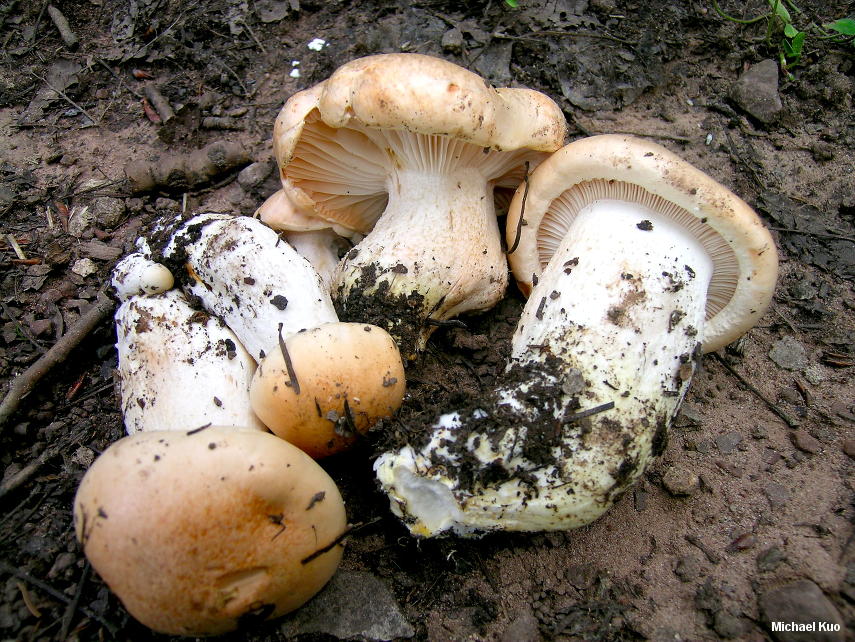
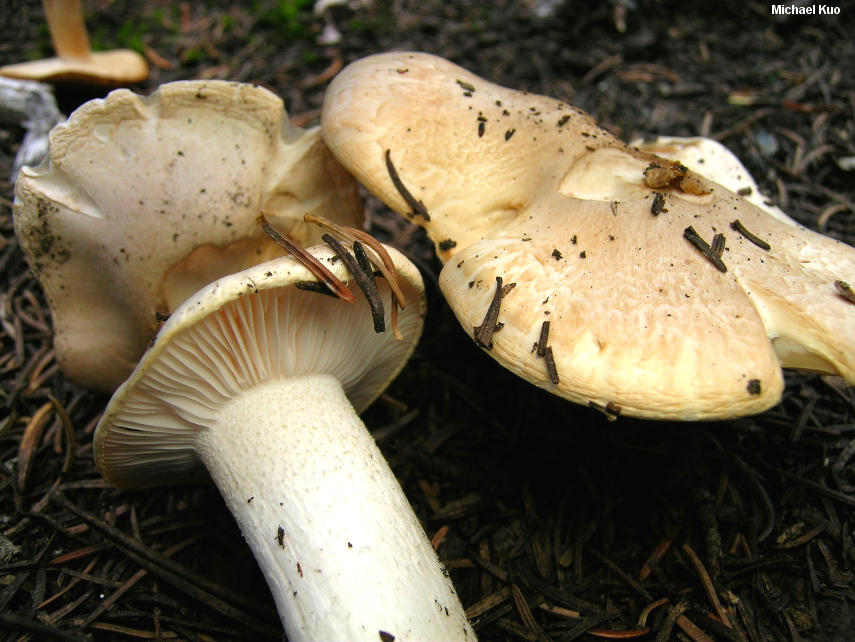
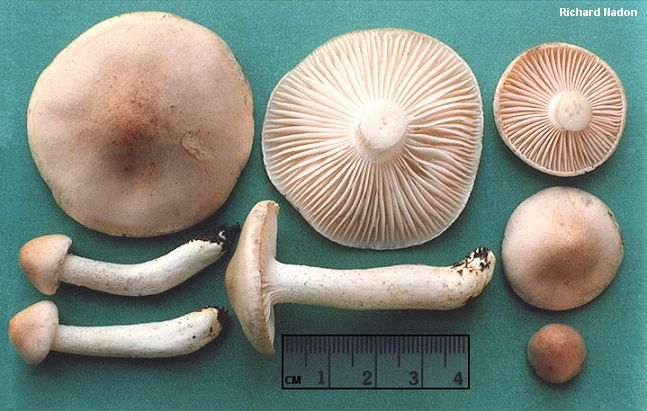
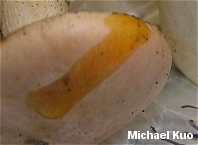
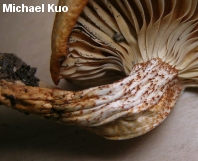
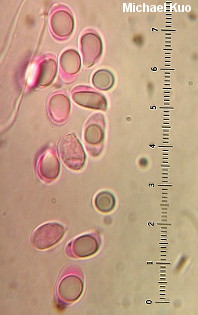
Hygrophorus pudorinus [ Basidiomycota > Agaricales > Hygrophoraceae > Hygrophorus . . . ] by Michael Kuo This is one of those waxy caps, like Hygrophorus russula, that can seem a bit too stocky and, well, "un-waxy-cappish" to belong in the genus Hygrophorus. I was pretty convinced I was looking at a Tricholoma the first time I collected Hygrophorus pudorinus. But fresh specimens do have sticky caps and thick, waxy gills--and, under the microscope the species displays classic Hygrophorus features, including elongated basidia and divergent gill tissue. Hygrophorus pudorinus associates with spruces and other conifers, and can apparently be found wherever spruce trees occur naturally on our continent. It can be recognized in the field by its pinkish-orangish cap, its thick white gills, and the upper stem surface, which features little white dots and tufts of fibers that darken to reddish brown when specimens are dried. Several North American varieties have been described (see below); "Hygrophorus pudorinus" in North America may represent a constellation of genetically distinct species. For a similar species found under hardwoods, see Hygrophorus poetarum. Actually, according to Lodge and collaborators (2013), Hygrophorus pudorinus is a generally misapplied name: "The type species of H. pudorinus Fr. matches H. persicolor Ricek, but the name has been misapplied to H. abieticola. The North American taxon called H. 'pudorinus' appears in a sister clade to H. persicolor in our ITS analysis . . . so it is close to the original concept of H. pudorinus." And if you were successful at following that through to a logical conclusion about what name to apply to Hygrophorus pudorinus in North America, you are a better reader than I am. Hygrophorus pudorinus var. fragrans is distributed from Colorado to Oregon and California; it features a fragrant odor, an orangish yellow stem base (inside and out), and it bruises fairly bright orange where handled. I have collected specimens in Colorado that seem to intergrade between var. pudorinus and var. fragrans. Hygrophorus pudorinus var. fragrans f. pallidus (say that three times fast), described from California, has a whitish cap; Hygrophorus pudorinus var. subcinereus, described from northern Michigan, has a grayish cap. Description: Ecology: Mycorrhizal with spruces and other conifers; growing scattered to gregariously; late summer and fall; fairly widely distributed in western North America from Colorado to the West Coast, and found in central and northeastern North America from about the Great Lakes northward. The illustrated and described collections are from Engelmann spruce forests in Colorado, and from Québec. Cap: 3-10 cm; convex, becoming broadly convex or broadly bell-shaped; sticky when fresh, but soon dry and shiny; bald or, in age, developing fine scales and cracks; pale pinkish orange (very similar to the color of Albatrellus confluens) or pinkish tan; the margin at first inrolled and cottony. Gills: Broadly attached to the stem or beginning to run down it; close or nearly distant; white, unchanging or becoming yellowish to pinkish with age; short-gills frequent. Stem: 3-8 cm long; up to 3 cm thick; more or less equal above a tapered base that is often underground; dry; finely dotted with tiny white tufts of fibers toward the apex that turn reddish brown when specimens are dried (illustrated); whitish, often turning yellowish where handled or near the base; thick. Flesh: Firm; white, or slightly pinkish to yellowish or orangish in the stem base; unchanging or turning slightly yellowish. Odor and Taste: Odor often soapy and fragrant or slightly unpleasant--or not distinctive; taste mild. Spore Print: White. Chemical Reactions: KOH golden orange on cap and stem surface. Microscopic Features: Spores 7-10 x 4-5.5 µ; smooth; ellipsoid; hyaline in KOH; inamyloid. Basidia 4-sterigmate; to about 55 µ long. Hymenial cystidia absent. Lamellar trama divergent. Pileipellis an ixocutis or an ixotrichoderm. REFERENCES: (Fries, 1821) Fries 1836. (Saccardo, 1887; Hesler & Smith, 1963; Smith, 1975; Bird & Grund, 1979; Smith, Smith & Weber, 1979; Largent, 1985; Arora, 1986; States, 1990; Phillips, 1991/2005; Evenson, 1997; Barron, 1999; McNeil, 2006; Miller & Miller, 2006; Lodge et al., 2013.) Herb. Kuo 09010601, 08160709. Herb. DBG RMNP 2012 5022-19. This website contains no information about the edibility or toxicity of mushrooms. |
© MushroomExpert.Com |
|
Cite this page as: Kuo, M. (2014, July). Hygrophorus pudorinus. Retrieved from the MushroomExpert.Com Web site: http://www.mushroomexpert.com/hygrophorus_pudorinus.html |