| Major Groups > Saddles |

|
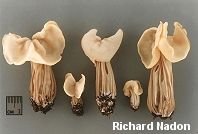
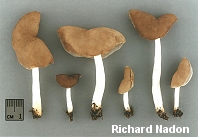
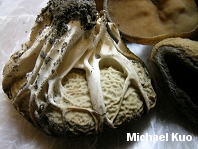
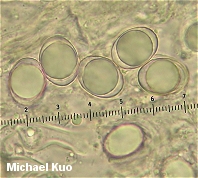
Saddles: The Genus Helvella [ Ascomycota > Pezizales > Helvellaceae . . . ] by Michael Kuo The mushrooms in Helvella, sometimes called the "Elfin Saddles," are among my favorites. Many of them are stunningly beautiful, and even those that are not beautiful somehow manage to be interesting. Species of Helvella have irregular caps that are saddle-shaped, lobed, cuplike, or downright irregular. The caps are not brightly colored, and are usually white, cream, buff, brown, gray, black, or tan. Helvella species grow on the ground or, in a few cases, on rotting wood. Most species fruit in summer and fall, but several can be found in the winter and spring in warm climates. Most if not all Helvella species are mycorrhizal. Traditionally, identification of Helvella species was mostly accomplished through careful inspection of macroscopic physical features, with special attention focused on the shape of the cap, the fuzziness or baldness of the undersurface of the cap, and (especially) the stem, which may be dramatically ribbed and/or pocketed, along with occasional references to microscopic analysis (for example, separating Helvella macropus from its many look-alikes with analysis of spore morphology). However, contemporary study of the genus is beginning to discover that there are many more species than we thought there were, with more limited ranges and ecologies; thus geography and mycorrhizal hosts are important for identification of species, as well. Nine years ago, in 2012, I wrote the following on a previous version of this webpage: "To my knowledge DNA studies have yet to be focused on the genus Helvella . . . but after working with the fairly closely related morels it would not surprise me at all if such studies were to more or less trash all of our current species concepts and reveal a much larger number of North American species than we currently acknowledge." At the time classic European species names were being applied to most North American Helvella collections. While this is still the case overall, DNA-informed studies in the last decade have, indeed, begun to create a proliferation of North American helvellas, many of which may be cryptic species; see the Helvella lacunosa group to read the writing on the North American helvelloid wall. |
|

|
Key to 17 Saddle-like and Lobed (Noncupulate) Taxa of Helvella in North America
References Abbott, S. O. & Currah, R. S. (1988). The genus Helvella in Alberta. Mycotaxon 33: 229–250. Abbott, S. O. & Currah, R. S. (1997). The Helvellaceae: Systematic revision and occurrence in northern and northwestern North America. Mycotaxon 62: 1–125. Anderson, P. J. & M. G. Ickis (1921). Massachusetts species of Helvella. Mycologia 13: 201–229. Batra, L. R. (1976). Helvella and Gyromitra (Pezizales: Operculatae) in the southern Appalachians. In B. C. Parker & M. K. Roane, eds. Distributional history of the biota of the southern Appalachians. Part IV. Algae & fungi: biogeography, systematics and ecology. Charlottesville, Virginia: University Press of Virginia. 145–204. Dissing, H. & Lange, M. (1967). Notes on the genus Helvella in North America. Mycologia 59: 349–360. Hansen, K., T. Schumacher, I. Skrede, S. Huhtinen & X. -H. Wang (2019). Pindara revisited—evolution and generic limits in Helvellaceae. Persoonia 42: 186–204. Harmaja, H. (1974). Notes on the genus Helvella, including the merging of the genus Wynnella. Karstenia 14: 102–104. Harmaja, H. (1977). A note on Helvella solitaria (syn. H. queletii) and H. confusa n. sp. Karstenia 17: 40–44. Harmaja, H. (1978). New species and combinations in Helvella and Gyromitra. Karstenia 18: 57. Harmaja, H. (1979). Studies on cupulate species of Helvella. Karstenia 19: 33–45. Kanouse, B. B. (1946). Some studies in the genus Helvella. Papers of the Michigan Academy of Science, Arts and Letters 32: 83–90. Kanouse, B. B. (1949). Studies in the genus Otidea. Mycologia 41: 660–677. Kempton, P. E. & V. L. Wells (1970). Studies on the fleshy fungi of Alaska. IV. A preliminary account of the genus Helvella. Mycologia 62: 940–959. Landeros, F., T. Iturriaga & L. Guzmán-Dávalos (2012). Type studies in Helvella (Pezizales) 1. Mycotaxon 119: 35–63. Landeros, F. & L. Guzmán-Dávalos (2013). Revisión del género Helvella (Ascomycota: Fungi) en México. Revista Mexicana de Biodiversidad: S3–S20. Landeros, F., J. Carranza & L. Guzmán-Dávalos (2014). Registros nuevos del género Helvella (Fungi: Ascomycota) para Costa Rica. Revista Mexicana de Micología 39: 13–19. Landeros, F., T. Iturriaga, A. Rodríguez, G. Vargas-Amado & L. Guzmán-Dávalos (2015). Advances in the phylogeny of Helvella (Fungi: Ascomycota), inferred from nuclear ribosomal LSU sequences and morphological data. Revista Mexicana de Biodiversidad 86: 856–871. Landeros, F., F. M. Ferrusca-Rico, L. Guzmán-Dávalos, E. U. Esquivel-Naranjo, N. Matías-Ferrer, C. Burrola-Aguilar, G. Viurcos-Martínez & R. Garibay-Orijel (2021). Helvella jocatoi sp. nov. (Pezizales, Ascomycota), a new species from H. lacunosa complex with cultural importance in Mexico Abies religiosa forests. Phytotaxa 498: 1–11. López, A. R. & J. García (2005). Helvella atra. Funga Veracruzana 88. Løken, S. B., I Skrede & T. Schumacher (2020). The Helvella corium species aggregate in Nordic countries—phylogeny and species delimitation. Fungal Systematics and Evolution 5: 169–186. Nguyen, N. H., F. Landeros, R. Garibay-Orijel, K. Hansen & E. C. Vellinga (2013). The Helvella lacunosa species complex in western North America: cryptic species, misapplied names and parasites. Mycologia 105: 1275–1286. Parslow, M. & B. Spooner (2009). Wynnella silvicola (Beck) Nannf. (Helvellaceae), an elusive British discomycete. Field Mycology 10: 99–104. Seaver, F. J. (1928, 1942). The North American cup-fungi (operculates). Supplemented edition. Lancaster, PA: Lancaster Press. 377 pp. Skrede, I., T. Carlsen & T. Schumacher (2017). A synopsis of the saddle fungi (Helvella: Ascomycota) in Europe—species delimitation, taxonomy and typification. Persoonia 39: 201–253. Skrede, I., L. Ballester Gonzalvo, C. Mathiesen & T. Schumacher (2020). The genera Helvella and Dissingia (Ascomycota: Pezizomycetes) in Europe—Notes on species from Spain. Fungal Systematics and Evolution 6: 65–93. Spooner, B. (2003). The larger cup fungi in Britain—part 5 Helvellaceae. Field Mycology 4: 52–62. Vooren, N. van (2002). Helvella cupuliformis Dissing & Nannfeldt. Bulletin Mycologique et Botanique Dauphiné-Savoie 164: 31–33. Vooren, N. van (2013). Wynnella silvicola (Helvellaceae): note de synthèse taxinomique et nomenclaturale. Ascomycete.org 5: 171–174. Vooren, N. van (2014). Notes sur le genre Helvella L. (Ascomycota, Pezizales). 2. Les sous-genres Cupuliformes et Macropodes. Bulletin Mycologique et Botanique Dauphiné-Savoie 212: 29–47. Wang, X. -C., T. -Z. Liu, S. -L. Chen, Y. Li & W. -Y. Zhuang (2019). A four-locus phylogeny of rib-stiped cupulate species of Helvella (Helvellaceae, Pezizales) with discovery of three new species. MycoKeys 60: 45–67. Weber, N. S, (1972). The genus Helvella in Michigan. The Michigan Botanist 11: 147–201. Weber, N. S, (1975). Notes on western species of Helvella. I. Beihefte Nova Hedwigia 51: 25–38. Zhao, Q., B. Tolgor, Y. Zhao, Z. L. Yang & K. D. Hyde (2015). Species diversity within the Helvella crispa group (Ascomycota: Helvellaceae) in China. Phytotaxa 239: 130–142. Acknowledgments Thanks to the Herbarium of the University of Michigan for lending Helvella specimens I examined in connection with this treatment of the genus; thanks also to Lee Barzee, Django Grootmyers, Ron Kerner, Ed Lubow, and Hugh Smith for donating Helvella collections. This site contains no information about the edibility or toxicity of mushrooms. Cite this page as: Kuo, M. (2021, July). Saddles: The genus Helvella. Retrieved from the MushroomExpert.Com Web site: http://www.mushroomexpert.com/helvella.html © MushroomExpert.Com |