| Major Groups > Puffballs > Geastrum saccatum |

|
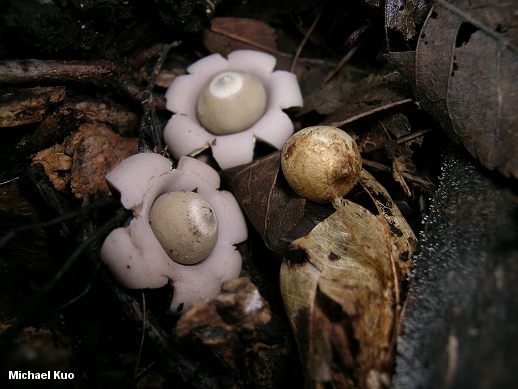
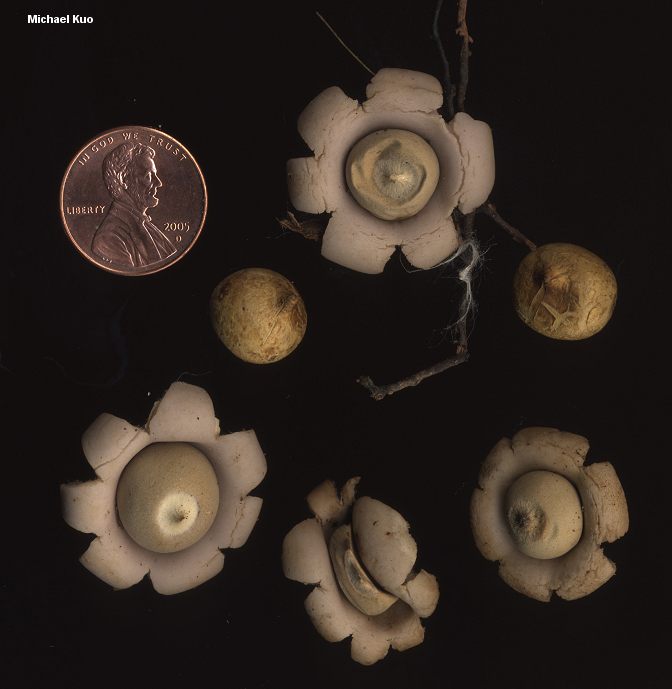
Geastrum saccatum [ Basidiomycetes > Phallales > Geastraceae > Geastrum . . . ] by Michael Kuo Geastrum saccatum is the earthstar most commonly featured in field guides--probably because it is widely distributed and common. It is a small but beautiful mushroom that features a round spore case sitting atop a star with 4-9 arms. Several species of Geastrum are very similar, however, so precise identification should rely on the following features:
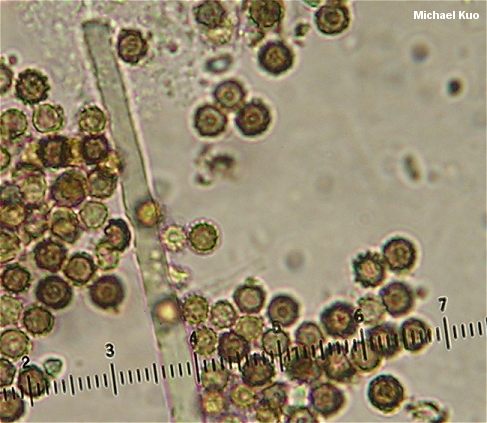
Geastrum fimbriatum is a similar mushroom; its beak is not surrounded by a marked ridge or depression, and its buttons are attached to the substrate over a large portion of the mushroom rather than at a basal point (thus the buttons and, later, the undersides of the arms are usually covered with debris). Description: Ecology: Saprobic; growing alone or gregariously under hardwoods or conifers; often appearing around stumps; spring through fall (over winter in warmer climates); widely distributed in North America. Fruiting Body: At first a smooth, egg-shaped ball with a pointed beak, 2-3 cm wide, attached to the substrate by a point at the base; with maturity the outer skin peeling back to form 4-9 more or less triangular, buff colored, non-hygroscopic arms; spore case up to 2 cm wide, more or less round, smooth, brownish to purplish brown, with a small conical beak that is surrounded by circular ridge or depression (often resulting in a pale area); 2-5 cm across when arms are opened; interior of spore case initially solid and white but soon powdery and medium brown. Microscopic Features: Spores 3.5-4.5 µ; round; spiny; brownish to yellowish in KOH. Capillitial threads 4-8 µ wide; yellowish to brownish in KOH; slightly incrusted. REFERENCES: Fries, 1829. (Saccardo, 1888; Coker & Couch, 1928; Smith, 1951; Ponce de Leon, 1968; Smith, Smith & Weber, 1981; Arora, 1986; Phillips, 1991/2005; Lincoff, 1992; Metzler & Metzler, 1992; Horn, Kay, and Abel, 1993; Barron, 1999; McNeil, 2006; Miller & Miller, 2006.) Herb. Kuo 07030804. This website contains no information about the edibility or toxicity of mushrooms. |
© MushroomExpert.Com |
|
Cite this page as: Kuo, M. (2008, November). Geastrum saccatum. Retrieved from the MushroomExpert.Com Web site: http://www.mushroomexpert.com/geastrum_saccatum.html |