| Major Groups > Gilled Mushrooms > Pale-Spored > Cystoderma & Cystodermella > Cystoderma carcharias |

|
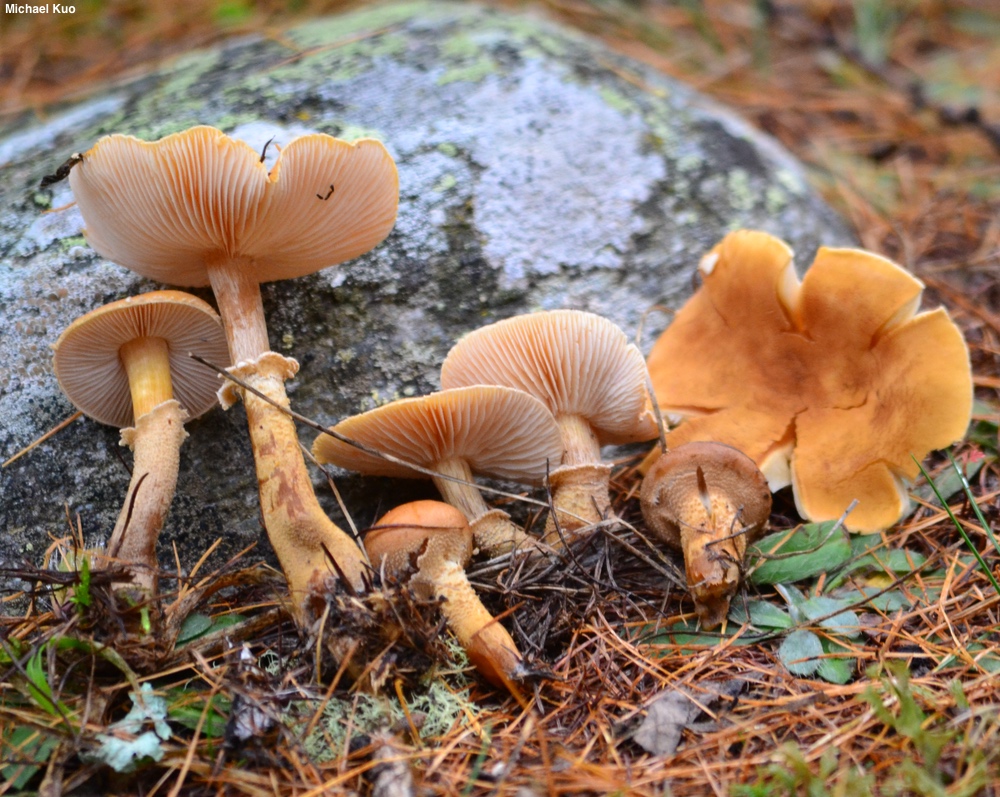
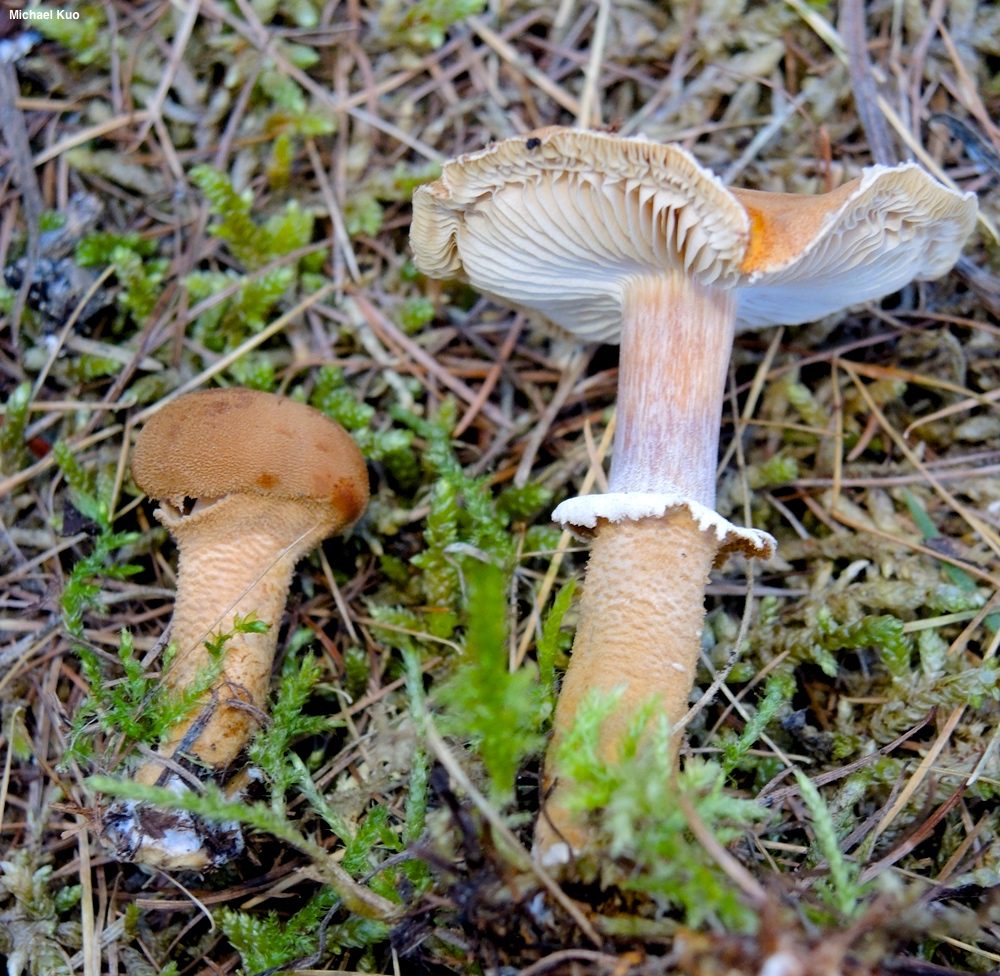
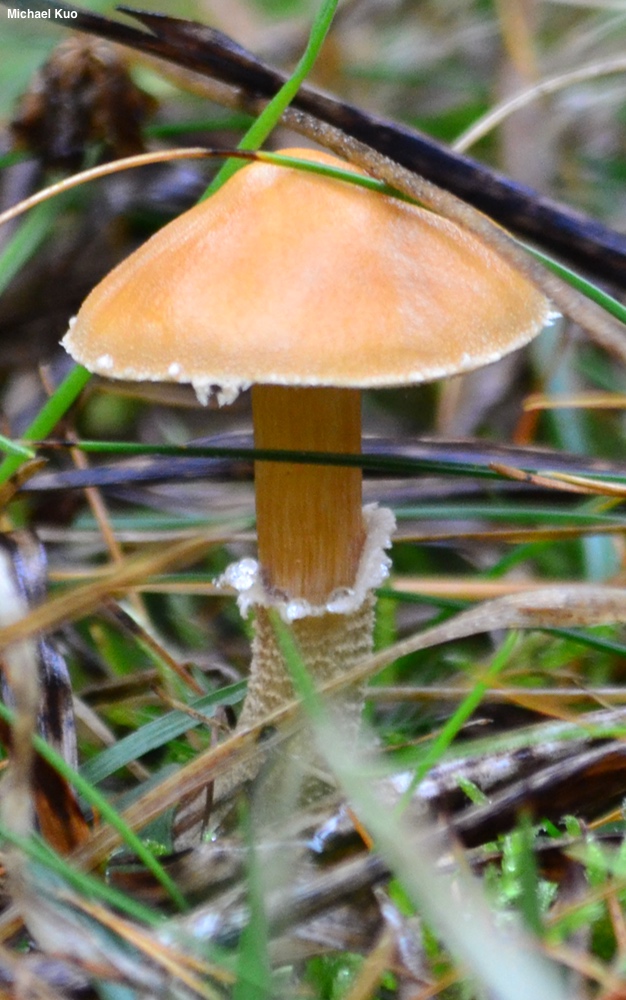
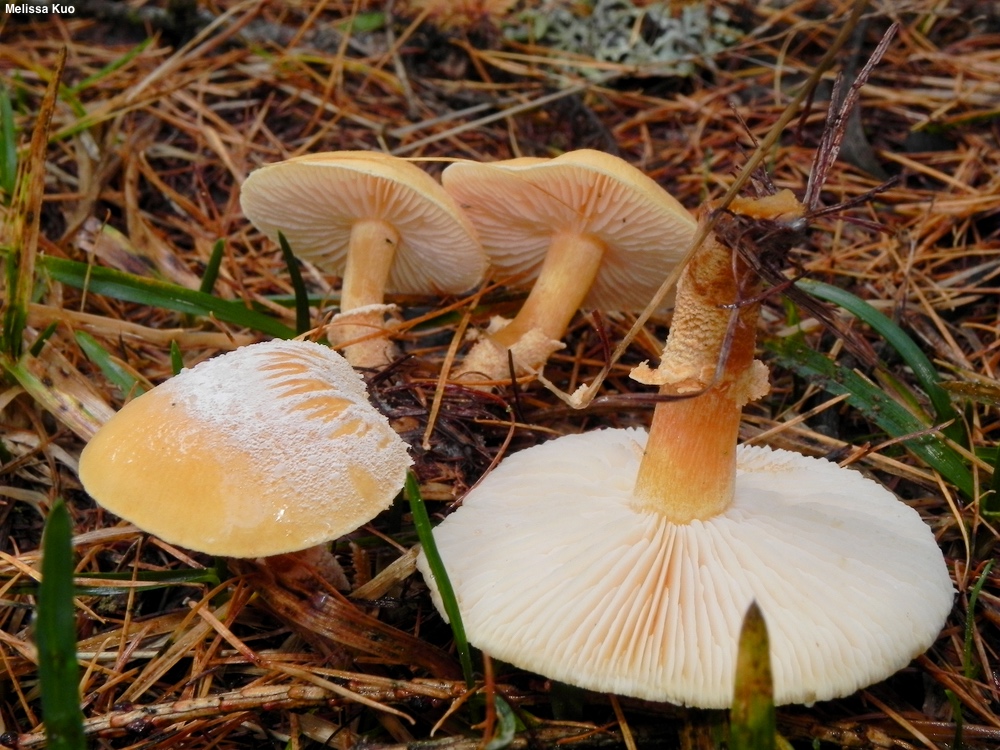
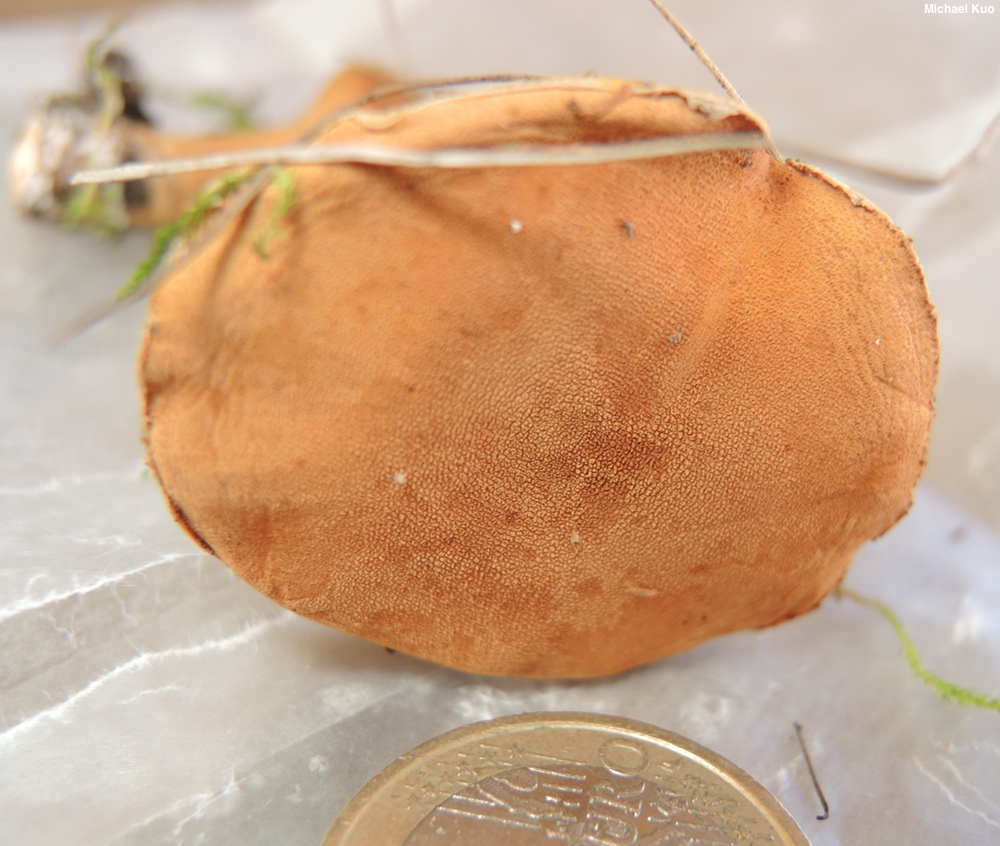
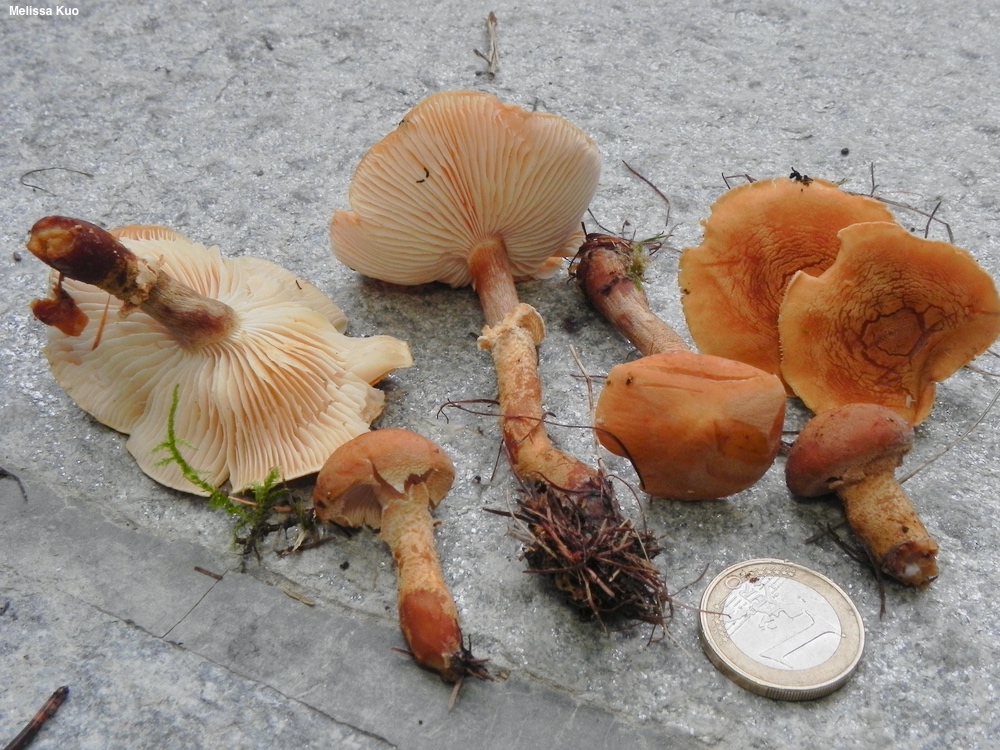
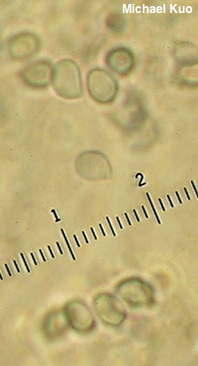
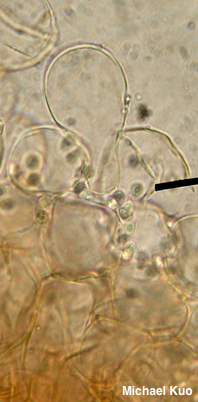
[Basidiomycota > Agaricales > Squamanitaceae > Cystoderma . . . ] Cystoderma carcharias by Michael Kuo, 20 December 2025 Also known as Cystoderma fallax, Cystoderma carcharias features a persistent, flaring ring on its stem, like a sheath that has been folded back at the top. The species is found in conifer woods in North America and Europe, primarily in northern and montane regions. Like other cystodermas it features a white spore print and gills that are attached to the stem. Since Cystoderma carcharias is often a northern species, boreal and near-boreal collections should be compared with Cystoderma tuomikoskii, also known as Cystoderma arcticum, which is very similar but limited to boreal areas; arcticum is best separated by its larger spores, which are 5–10 µm long. Description: Ecology: Saprobic; growing alone, scattered, or gregariously, under conifers; late summer and fall (over winter in California); originally described from Europe (Persoon 1797), with an epitype designated from Sweden (Saar et al. 2009); widely distributed in Europe; widely distributed in North America, primarily in northern and montane areas. The illustrated and described collections are from Italy and Colorado. Cap: 2–6 cm; convex at first, becoming broadly convex or nearly flat; dry; finely bumpy-granular or fairly bald; the margin adorned with granular veil tatters; yellow-orange, becoming brownish orange or orangish brown; the margin not lined. Gills: Narrowly attached to the stem; close; short-gills frequent; creamy whitish to pale orangish. Stem: 3–9 cm long; 4–10 mm thick; more or less equal; dry; pale and fairly smooth near the apex, but sheathed below with a felty, granular veil, with the sheath terminating in a prominent, folded-back ring with a white upper edge; orange to brownish; basal mycelium white. Flesh: Whitish; unchanging when sliced. Odor: Not distinctive. Spore Print: White. Microscopic Features: Spores 3–6 x 2.5–3.5 µm; ellipsoid to sublacrymoid; smooth; weakly amyloid, or inamyloid; hyaline in KOH. Basidia 26–28 x 4–5 µm; clavate; 4-sterigmate. Hymenial cystidia not found. Pileipellis a trichoderm of chained, subglobose to pyriform, smooth elements 15–40 µm wide, with orangish brown walls in KOH. REFERENCES: (C. H. Persoon, 1797) A. H. Smith & R. Singer, 1945. (Smith & Singer, 1945; Smith & Singer, 1948; Smith, 1949; Smith, 1975; Smith, Smith & Weber, 1979; Arora, 1986; Phillips, 1991/2005; Schalkwijk-Barendsen, 1991; Lincoff, 1992; Breitenbach & Kränzlin, 1995; Saar, 2003; McNeil, 2006; Boccardo et al., 2008; Laursen & Sepelt, 2009; Saar et al., 2009; Trudell & Ammirati, 2009; Buczacki et al., 2012; Saar, 2012; Desjardin, Wood & Stevens, 2015; Evenson, 2015; Siegel & Schwarz, 2016; Gminder & Böhning, 2017; Læssøe & Petersen, 2019; Kibby, 2020; MacKinnon & Luther, 2021.) Herb. Kuo 10141412, 09221805. This site contains no information about the edibility or toxicity of mushrooms. |
© MushroomExpert.Com |
|
Cite this page as: Kuo, M. (2025, December). Cystoderma carcharias. Retrieved from the MushroomExpert.Com Web site: http://www.mushroomexpert.com/cystoderma_carcharias.html |