| Major Groups > Gilled Mushrooms > Pale-Spored > Omphalinoid Mushrooms > Chromosera lilacifolia |

|
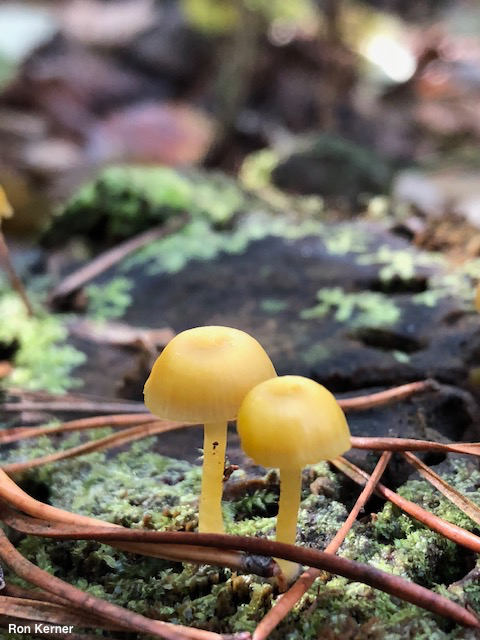
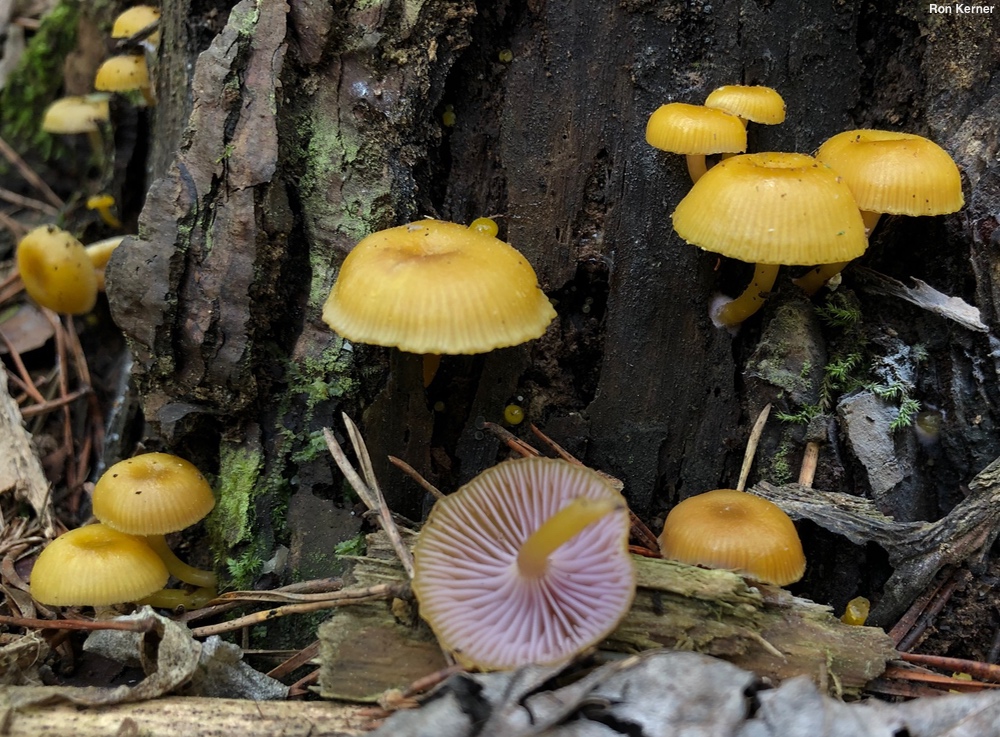
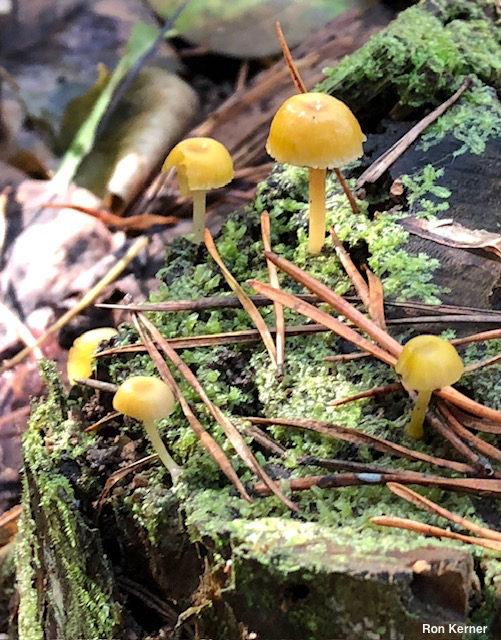
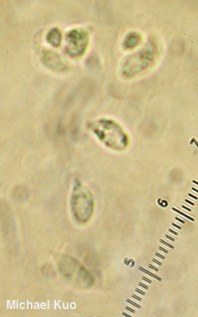
[ Basidiomycota > Agaricales > Hygrocybaceae > Chromosera . . . ] Chromosera lilacifolia by Michael Kuo, 26 December 2025 Rarely collected, this tiny omphalinoid mushroom appears on the well-rotted deadwood of conifers in eastern North America. Distinguishing features include its yellow cap and stem, contrasting nicely with its lilac gills, and its small size. Under the microscope Chromosera lilacifolia features smooth, inamyloid, flask-shaped spores, and lacks cystidia. Hygrocybe purpureofolia has similar colors but is larger (caps to 5 cm) and grows terrestrially, rather than from deadwood. The "Chromosera lilacifolia" appearing in western field guides (Arora 1986; Trudell & Ammirati, 2009; Desjardin, Wood & Stevens, 2014; Siegel & Schwarz, 2015) is a separate species, Chromosera loreleiae; it was named in 2025 (Grootmyers et al.). Eurasia's Chromosera cyanophila is also similar in appearance; it features bluish lilac gills. Chromosera lilacifolia totililacicolor is a variety with a lilac, rather than yellow, cap. Mycena lilacifolia is a former name. North American applications of the name Chromosera cyanophila refer to either Chromosera lilacifolia or Chromosera loreleiae (see above). Thanks to Ron Kerner for documenting, collecting, and preserving Chromosera lilacifolia for study; his collections are deposited in The Herbarium of Michael Kuo. Description: Ecology: Saprobic on the well-decayed wood of conifers (pines, spruces, and eastern hemlock); growing gregariously; spring through fall; originally described from New York (Peck 1878); fairly widely distributed in the Midwest and eastern North America; also recorded from Texas and Arizona. The illustrated and described collections are from Indiana. Cap: 5–20 mm across; broadly convex, developing a small central depression; sticky when fresh but soon dry; bald; dull brownish yellow; shallowly lined from the margin nearly to the center; the margin becoming slightly eroded with age. Gills: Beginning to run down the stem; nearly distant; short-gills frequent; pale purple. Stem: Up to 30 mm long and 2 mm thick; equal; dry or a little moist; bald; brownish yellow; basal mycelium whitish to pale lilac. Flesh: Insubstantial. Odor and Taste: Not distinctive. Spore Print: White. Microscopic Features: Spores 6–8 x 3–4 µm; amygdaliform or elongated-lacyrmoid; smooth; hyaline in KOH; inamyloid. Basidia 22–25 x 3–4 µm; 4-sterigmate. Hymenial cystidia not found. Pileipellis an ixocutis; elements 2–5 µm wide, smooth, thin-walled, hyaline in KOH; clamp connections present. REFERENCES: (C. H. Peck, 1878) D. Grootmyers, D. J. Lodge, S. A. Redhead, S.-T. Mullineux & S. D. Russell, 2025. (Murrill, 1916; Kauffman, 1918; Smith, 1947; Smith, Smith & Weber, 1979; Redhead et al., 1995; Lodge et al., 2013; Sturgeon, 2018; McKnight et al., 2012; Grootmyers et al., 2025.) Herb. Kuo 11031704, 04301901. This website contains no information about the edibility or toxicity of mushrooms. |
© MushroomExpert.Com |
|
Cite this page as: Kuo, M. (2025, December). Chromosera lilacifolia. Retrieved from the MushroomExpert.Com Web site: http://www.mushroomexpert.com/chromosera_lilacifolia.html |