| Major Groups > Puffballs > Calvatia gigantea |

|
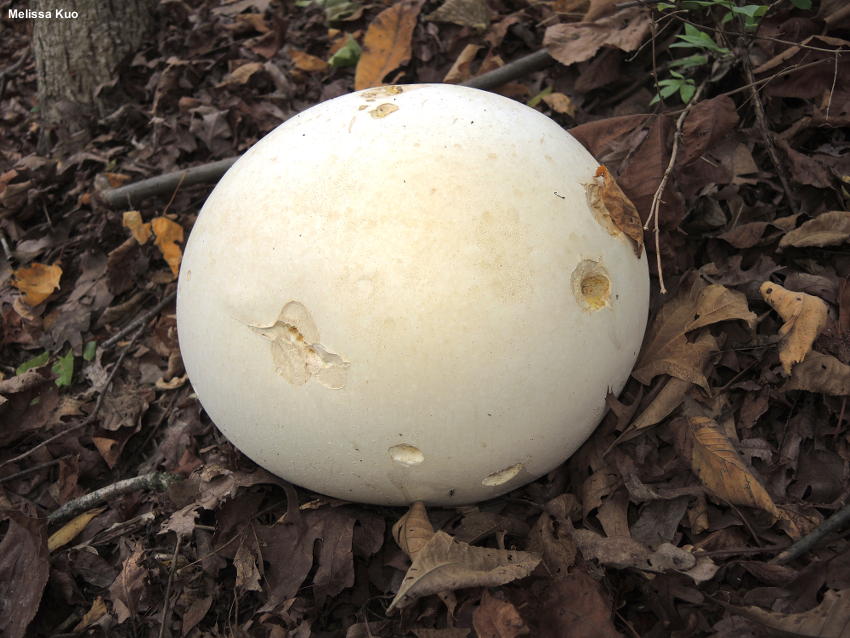
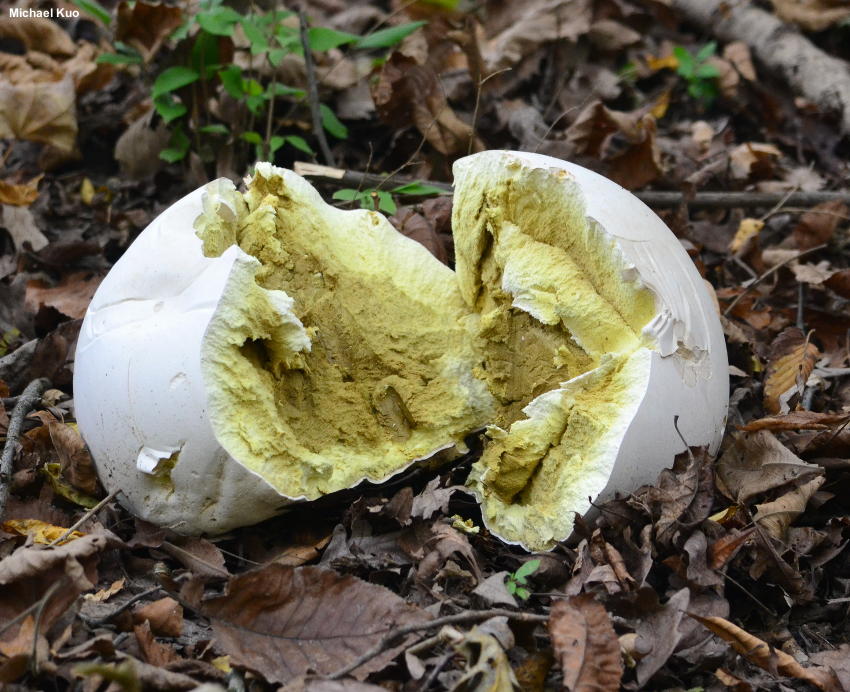
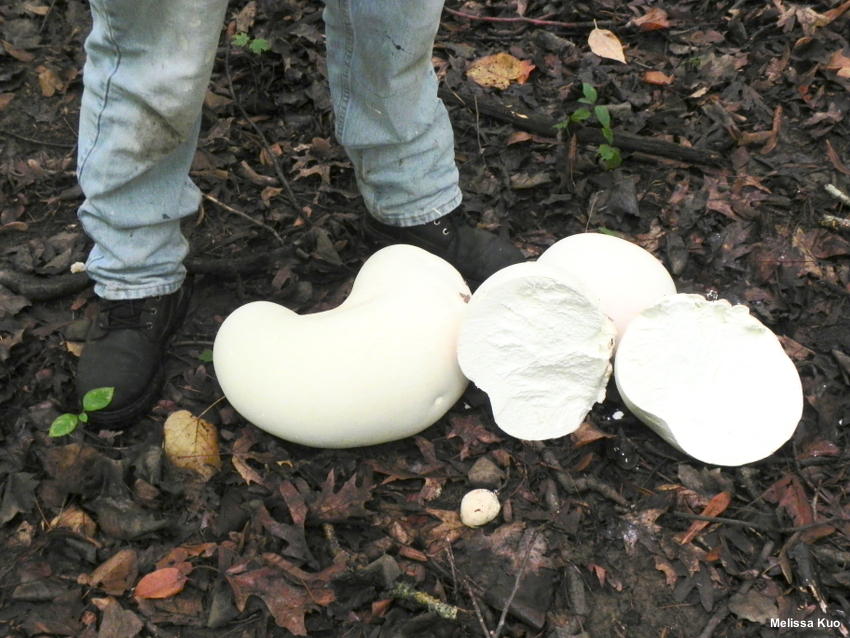
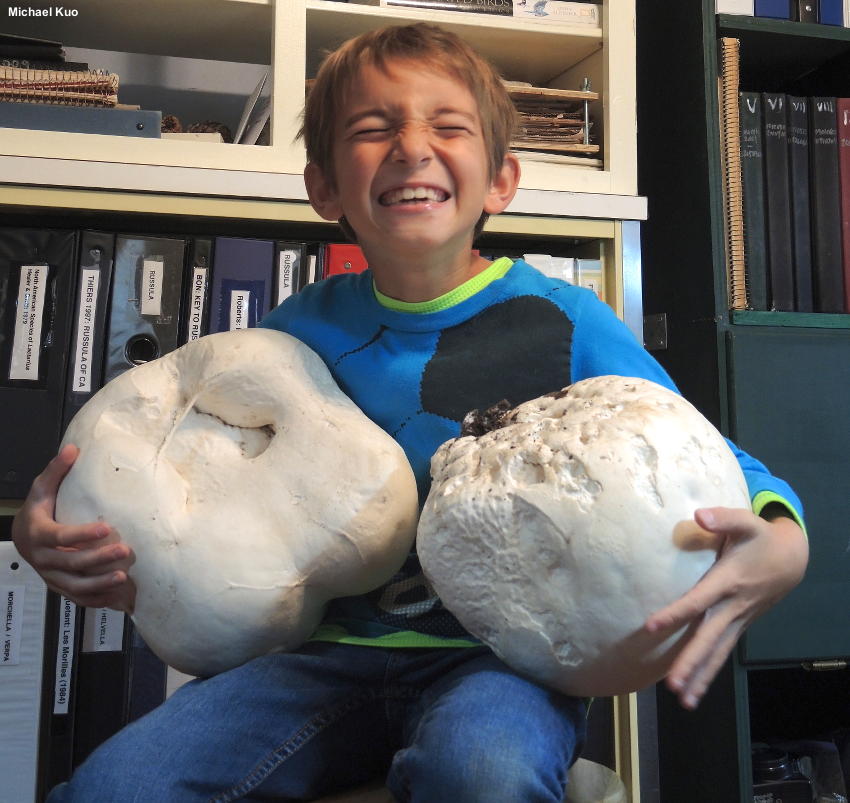
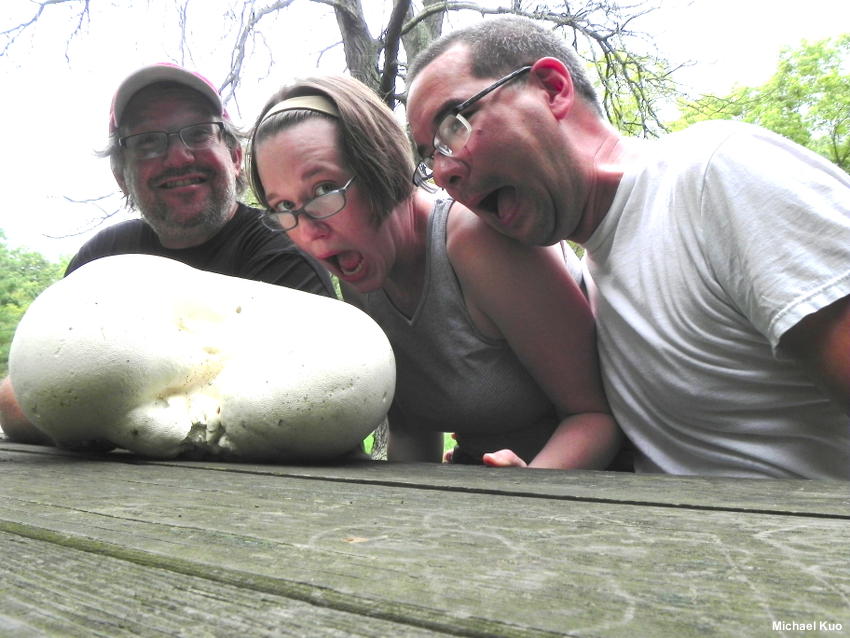
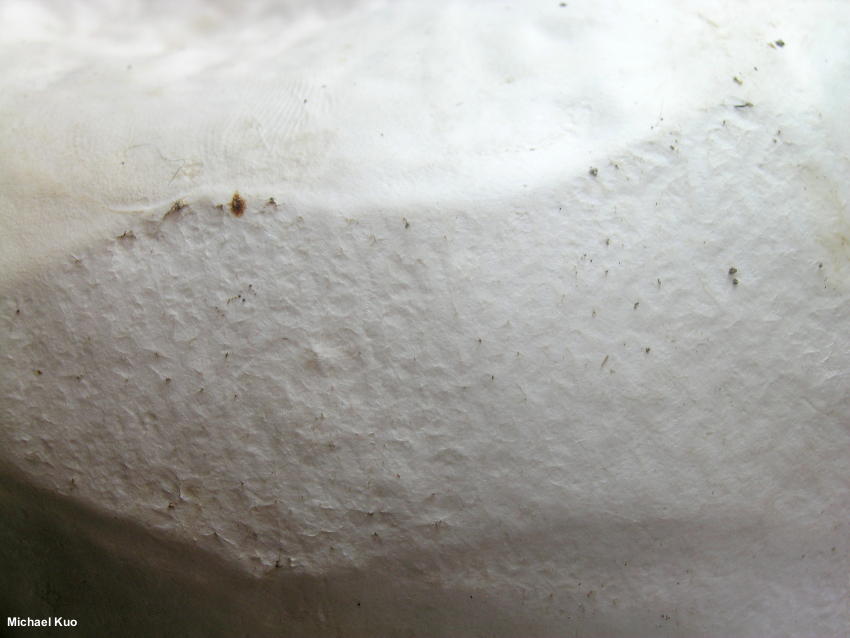
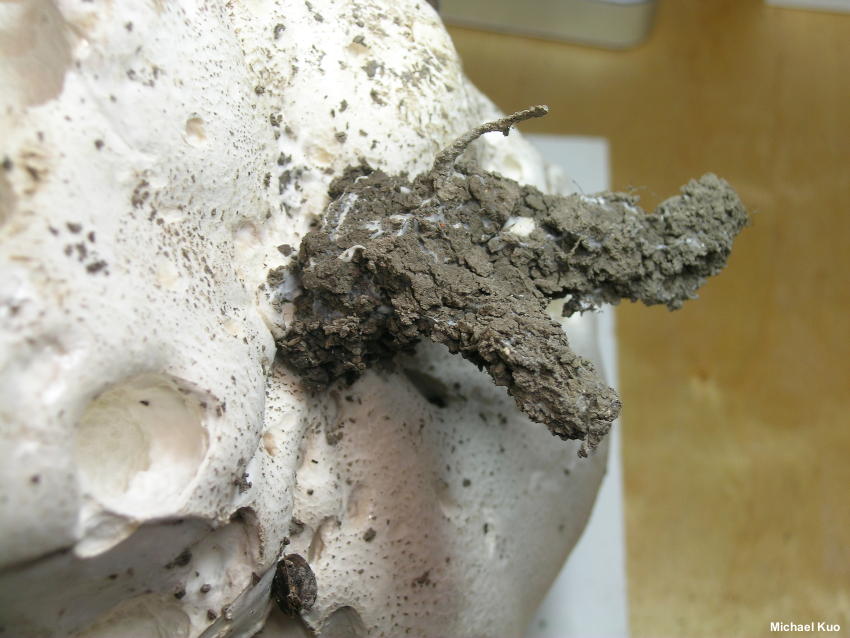
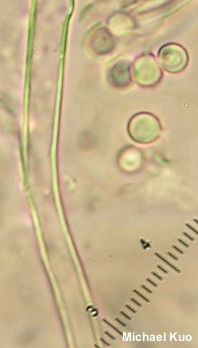
Calvatia gigantea [ Basidiomycota > Agaricales > Agaricaceae > Calvatia . . . ] by Michael Kuo Calvatia gigantea, sometimes called the "giant puffball," is easily recognized by its size and shape. Typical specimens are about the size of a soccer ball, and more or less round. However, it can be much larger (a 5-foot, 50-pound specimen has been reported!), and its shape can be more "blob-ish" than round, especially when it attains enormous sizes. But it is never shaped like an inverted pear, since it lacks the sterile base portion common to many other puffballs. The western species Calvatia booniana can also grow to 60 cm or more—but its surface is composed of polygonal scales, and it looks very different. In my area (central Illinois), Calvatia gigantea is a harbinger of fall, appearing in woods and at the edges of meadows as the leaves are beginning to turn. The large mushrooms can be seen from quite a distance, and I often mistake them for garbage (milk jugs, for example) until I get closer. Langermannia gigantea is a synonym, representing a taxonomic argument that does not look like it is going away any time soon, since DNA studies have yet to resolve the matter. Description: Ecology: Saprobic; terrestrial; growing alone or gregariously in woods or in grass—often at the edges of meadows, in drainage ditches, or under brush; late summer and early fall; fairly widely distributed from the Great Plains eastward, and occasionally reported (perhaps erroneously; most of the records are very old) in the Southwest and on the West Coast. Thorough studies of Calvatia in Arizona (Bates 2004, Bates et al. 2009) and in Florida (Morales & Kimbrough 1978) do not report Calvatia gigantea.The illustrated and described collections are from Illinois. Fruiting Body: Shaped like a ball, or nearly so; 20–30 cm or more across; 14–25 cm or more high; white when fresh, becoming yellowish or olive brownish; soft; finely velvety when young, becoming bald or developing very inconspicuous, fine scales in places; soft; outer skin less than 1 mm thick, sloughing away in very old specimens; interior white and soft when young and fresh, without a sterile basal area, becoming olive yellow and eventually turning to brownish spore dust; often with a short but thick cord (to 6 cm long and 2 cm wide) at the point of attachment to the ground. Odor and Taste: Not distinctive. Chemical Reactions: KOH negative on surface.Microscopic Features: Spores 2.5–4 µm; subglobose to globose, with or without a short pedicel; smooth; thick-walled; hyaline to yellowish in KOH. Capillitial threads 2.5–5 µm wide; walls 0.5–1 µm thick; occasionally septate; occasionally pitted; sometimes slightly constricted at septa; yellowish in KOH. REFERENCES: (Batsch, 1801) Lloyd, 1904. (Coker & Couch, 1928; Smith, 1951; Zeller & Smith, 1964; Morales 7 Kimbrough, 1978; Smith, Smith & Weber, 1981; Arora, 1986; Kreisel, 1992; Lincoff, 1992; Lange, 1993; Kreisel, 1994; Barron, 1999; Bates, 2004; McNeil, 2006; Miller & Miller, 2006; Gube, 2007; Bates et al., 2009; Kuo & Methven, 2014.) Herb. Kuo 10271701. This website contains no information about the edibility or toxicity of mushrooms. |
© MushroomExpert.Com |
|
Cite this page as: Kuo, M. (2017, November). Calvatia gigantea. Retrieved from the MushroomExpert.Com Web site: http://www.mushroomexpert.com/calvatia_gigantea.html |