| Major Groups > Gilled Mushrooms > Pale-Spored > Armillaria > Armillaria ostoyae |

|
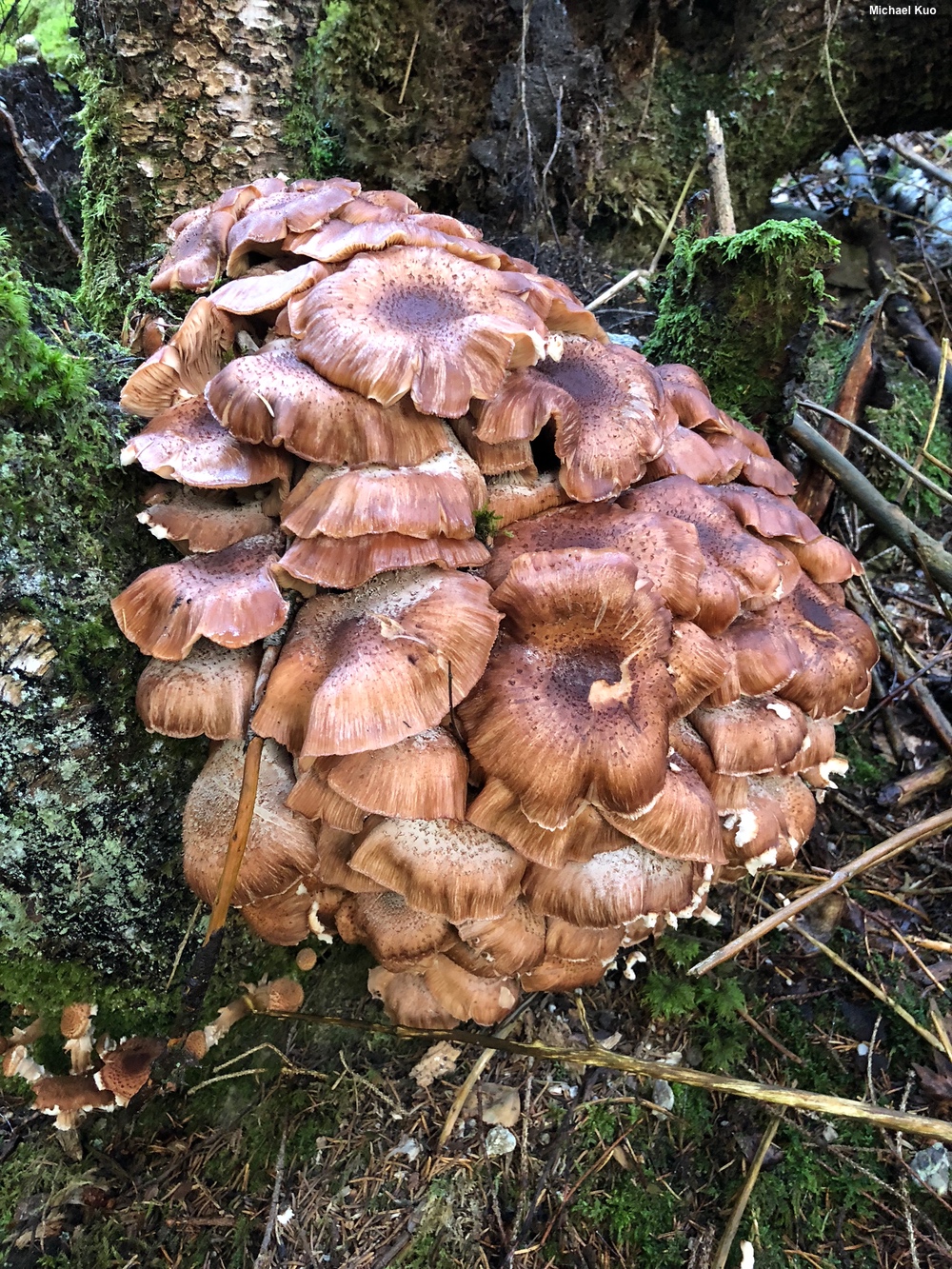
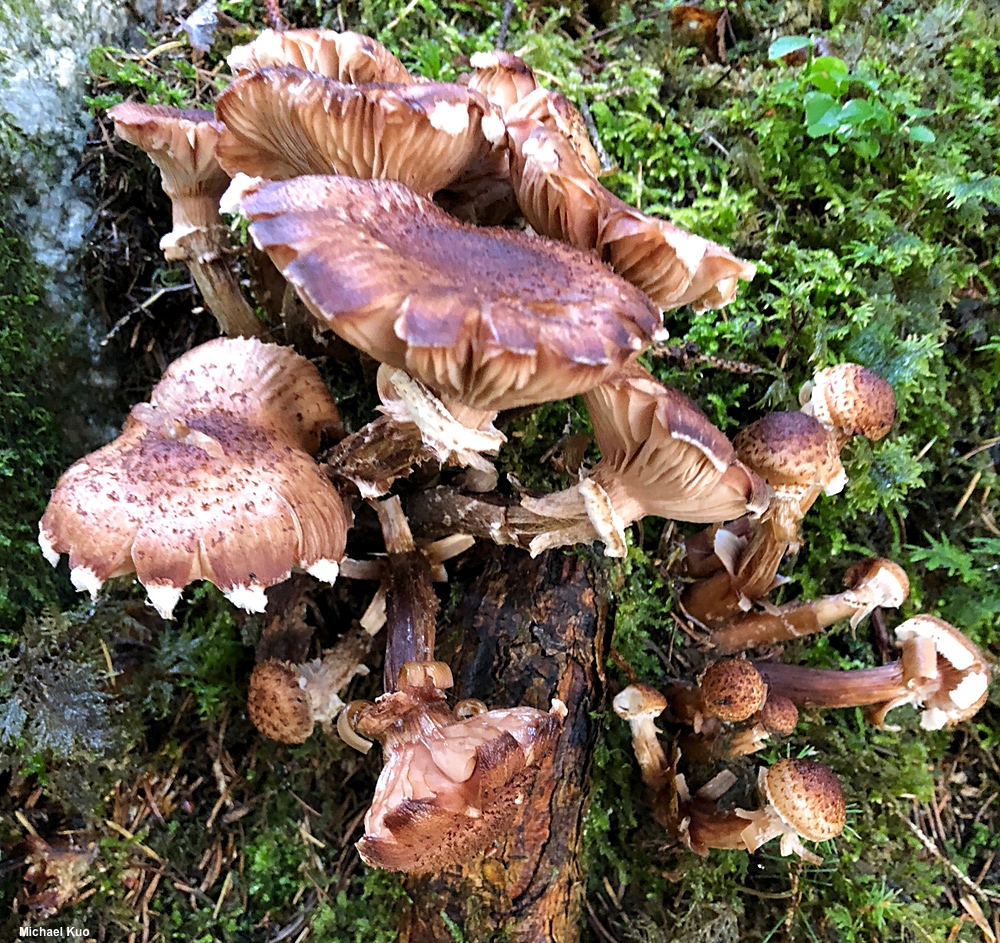
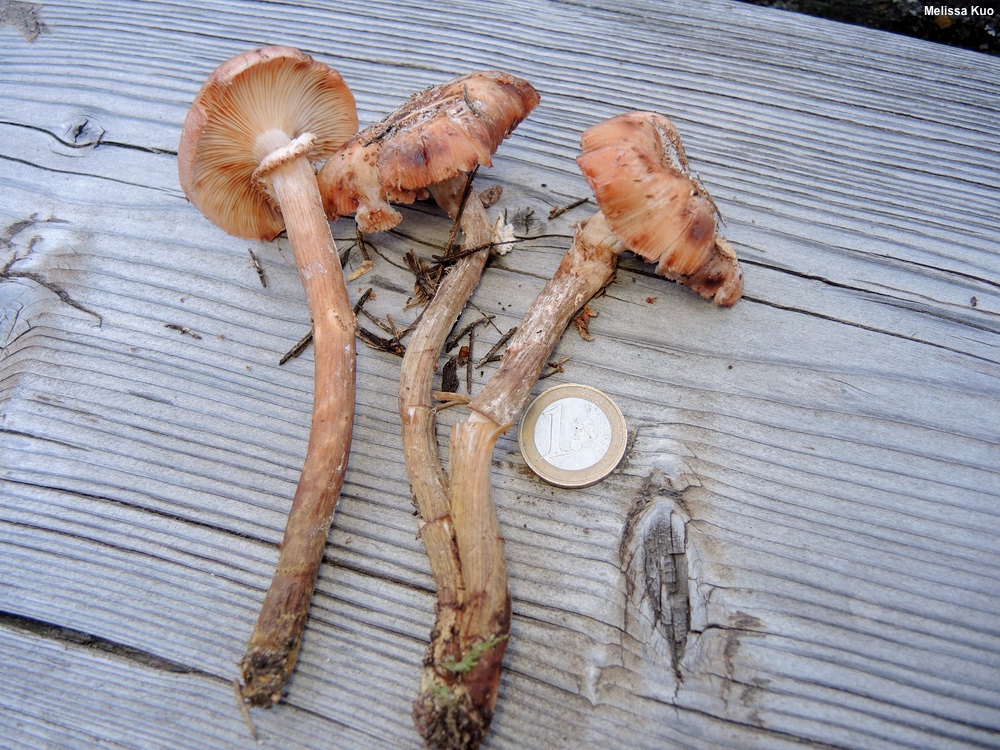
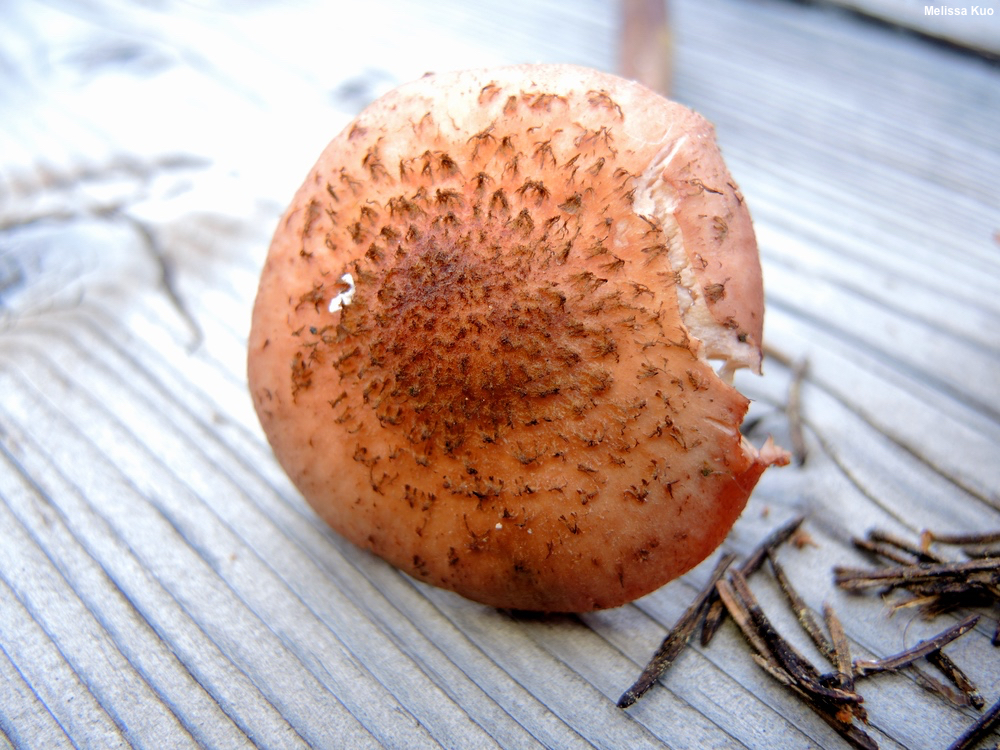
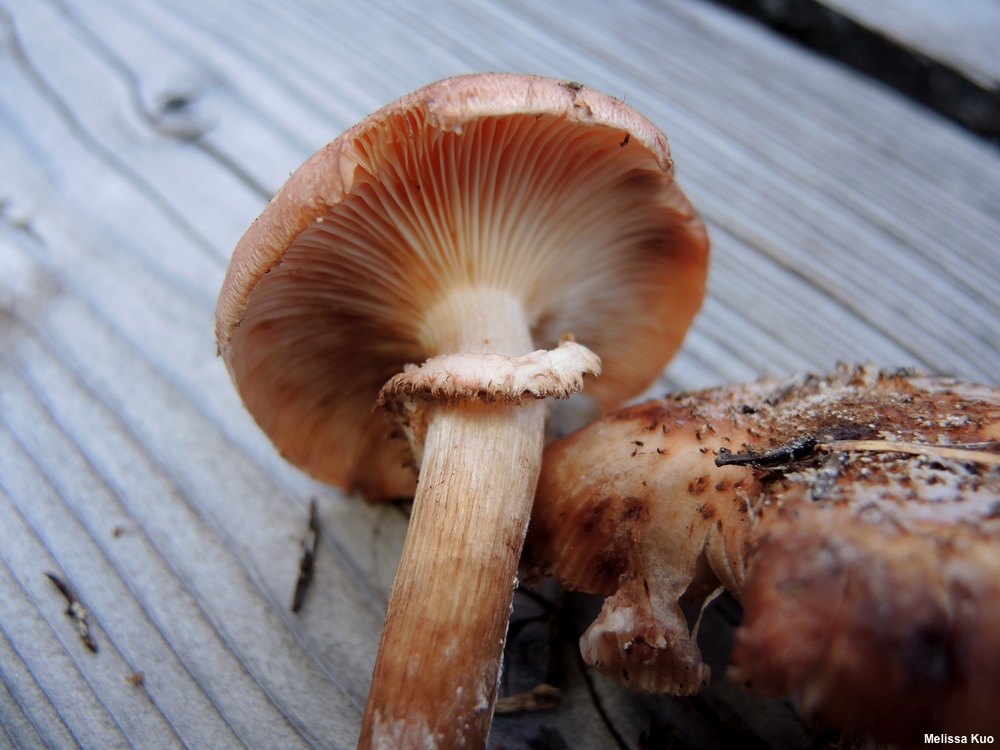
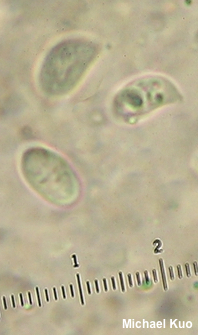
[ Basidiomycota > Agaricales > Physalaciaceae > Armillaria . . . ] Armillaria ostoyae by Michael Kuo, 3 December 2023 Armillaria ostoyae is a conifer-consuming species of Eurasia, recognized by its clustered habitat, the fairly sturdy ring on its stem, and the small, dark scales on its cap surface. Look-alikes include Armillaria borealis (a smaller, hardwood-associated species with paler scales) and Armillaria lutea (also hardwood-associated, with yellow shades and a flimsier ring). The name "ostoyae" was for decades applied to a similar North American species, Armillaria solidipes, but recent research (e.g. Klopfenstein et al., 2017) supports the idea that ostoyae and solidipes are distinct phylogenetic species. Description: Ecology: Parasitic and saprobic on the wood and roots of conifers and, less frequently, hardwoods (especially aspens and birches within conifer forests); causing a root rot; typically growing in dense clusters; summer and fall; originally described from France (Romagnesi 1970); widespread in Europe. The illustrated and described collection is from France. Cap: 4–8 cm; convex at first, becoming broadly convex; dry or slightly moist; orangish brown to pinkish brown underneath small, brown to dark brown scales; the margin sometimes becoming finely lined. Gills: Beginning to run down the stem; close; short-gills frequent; white or whitish when young and fresh, developing pinkish hues and/or reddish brown spots and discolorations. Stem: 6–15 cm long; 0.5–1 cm thick; tapered to base; whitish to brownish, becoming darker brown or olive toward the base; finely hairy with brownish fibrils; with a well-developed whitish ring that may feature a brown edge; with yellowish mycelium near the base; attached to long black rhizomorphs that run through the wood. Flesh: Whitish, becoming pinkish brown with maturity; unchanging when sliced. Odor and Taste: Odor not distinctive; taste mild to slightly bitter. Spore Print: White. Microscopic Features: Spores 8–10 x 4–6 µm; ellipsoid; smooth; hyaline in KOH; inamyloid. Basidia 33–35 x 6–8 µm; clavate; often basally clamped; 4-spored. Cheilocystidia lageniform; thin-walled; hyaline in KOH. Pleurocystidia not found. Pileipellis a cutis; brownish in KOH; elements 5–10 µm wide, smooth. REFERENCES: (H. C. L. Romagnesi, 1970) J. Herink, 1973. (Breitenbach & Kränzlin, 1991; Termorshuizen, 1995; Buczacki et al., 2013; Gminder & Böhning, 2017; Klopfenstein et al., 2017; Vesterholt, 2018; Læssøe & Petersen, 2019; Kibby, 2020; Caballero et al., 2023; Sahu et al., 2023.) Herb. Kuo 09241803. This site contains no information about the edibility or toxicity of mushrooms. |
© MushroomExpert.Com |
|
Cite this page as: Kuo, M. (2023, December). Armillaria ostoyae. Retrieved from the MushroomExpert.Com Web site: http://www.mushroomexpert.com/armillaria_ostoyae.html |