| Major Groups > Gilled Mushrooms > Pale-Spored > Amanita > Amanita phalloides |

|
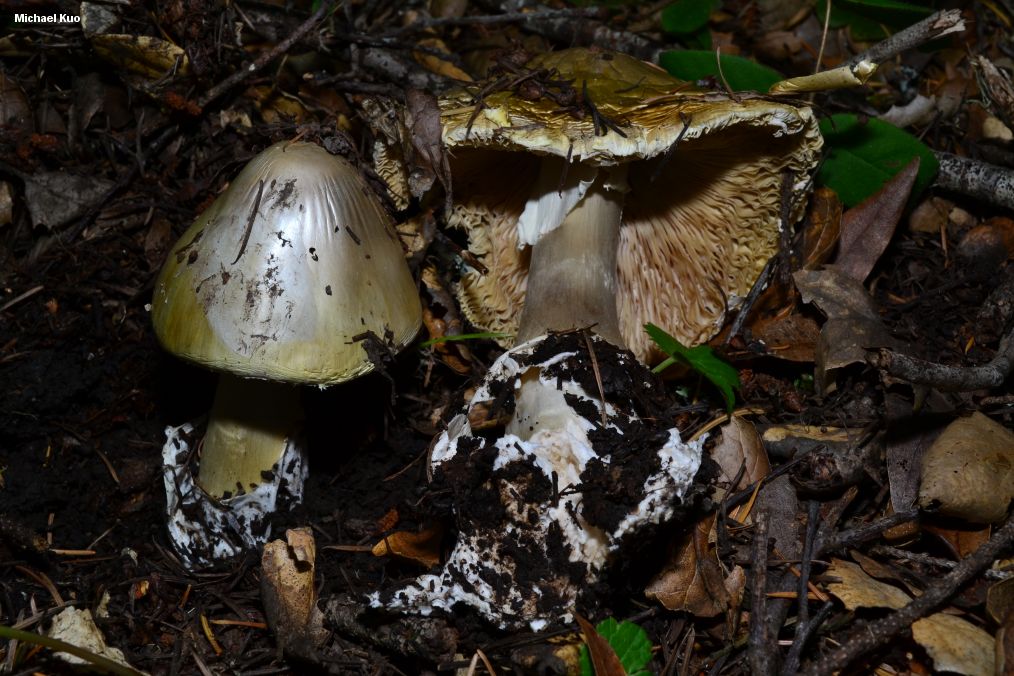
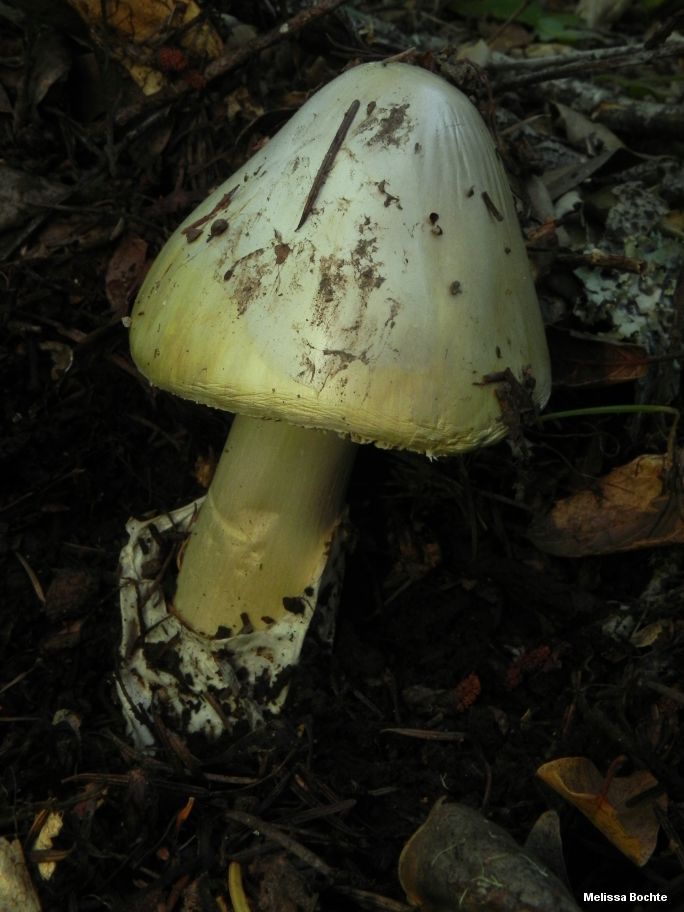
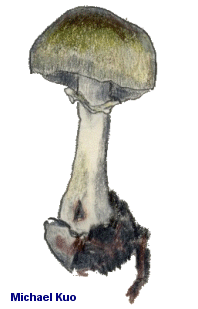
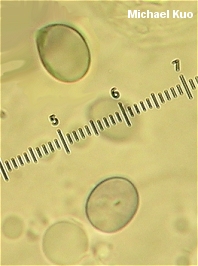
Amanita phalloides [ Basidiomycetes > Agaricales > Amanitaceae > Amanita . . . ] by Michael Kuo Defining features for this well known species, which is sometimes called the "death cap," include the sacklike white volva around its base, the ring, the white gills and spore print, and the non-lined cap margin. The cap is usually a shade of green or brown--although color is not the best thing to rely on when identifying this mushroom, since it is fairly variable--and it occasionally features a patch of white veil material. Readers who are familiar with the many pages at this site proclaiming that this or that North American species is likely not the same as the classic European species currently providing its name (for example, Amanita ceciliae or Amanita gemmata) will perhaps be surprised to hear that in the case of Amanita phalloides our North American version is apparently the same as the classic European Amanita phalloides first named in the early nineteenth century. Pringle and collaborators (2009) found ample evidence to support the idea that Amanita phalloides was introduced to our continent in California and in the New Jersey area, and is essentially an invasive species, expanding its range on the West Coast and in the Mid-Atlantic states. (Actually, as the collaborators note, the term "invasive" is a bit misleading, since Amanita phalloides is mycorrhizal and thus engages in beneficial mutualism with native trees). Description: Ecology: Mycorrhizal with oaks, including coast live oak on the West Coast and various oaks in the east; growing alone, scattered, or gregariously; currently distributed along the West Coast, and in the eastern United States from Pennsylvania and Virginia to Maine. Cap: 4-16 cm; nearly round or oval at first, becoming convex, then broadly convex to flat in age; bald; sticky when wet, shiny when dry; color ranging from dull green to olive to yellowish to brownish (rarely, white "albino" forms are collected alongside forms with pigmented caps); appearing finely and innately streaked; occasionally with one or a few patches of white veil material; the margin usually not lined. Gills: Free from the stem or nearly so; white (sometimes with a slight greenish tint); close or crowded. Stem: 5-18 cm long; 1-2.5 cm thick; more or less equal, or frequently tapering to apex and flaring to a swollen base; bald or finely hairy; white or with tints of the cap color; with a white, skirtlike ring that typically persists but is sometimes lost; with a sacklike white volva encasing the base (sometimes underground or broken up). Flesh: White throughout; unchanging when sliced. Spore Print: White. Microscopic Features: Spores 7-12 x 6-9 µ; smooth; ellipsoid; amyloid. Basidia 4-spored; without clamps. Pileipellis an ixocutis of hyphae 2- µ wide. Lamellar trama bilateral; subhymenium with inflated elements. REFERENCES: (Vaillant ex Fries, 1821) Link, 1833. (Saccardo, 1887; Smith, 1975; Ammirati et al., 1977; Smith, Smith & Weber, 1979; Thiers, 1982; Arora, 1986; Jenkins, 1986; Phillips, 1991/2005; Lincoff, 1992; Miller & Miller, 2006; Pringle et al., 2009; Trudell & Ammirati, 2009; Kuo & Methven, 2010; Tulloss, 2013.) Herb. Kuo 01191304. This site contains no information about the edibility or toxicity of mushrooms. |
© MushroomExpert.Com |
|
Cite this page as: Kuo, M. (2013, May). Amanita phalloides . Retrieved from the MushroomExpert.Com Web site: http://www.mushroomexpert.com/amanita_phalloides.html |