| Major Groups > Gilled Mushrooms > Pale-Spored > Amanita > Amanita jacksonii |

|
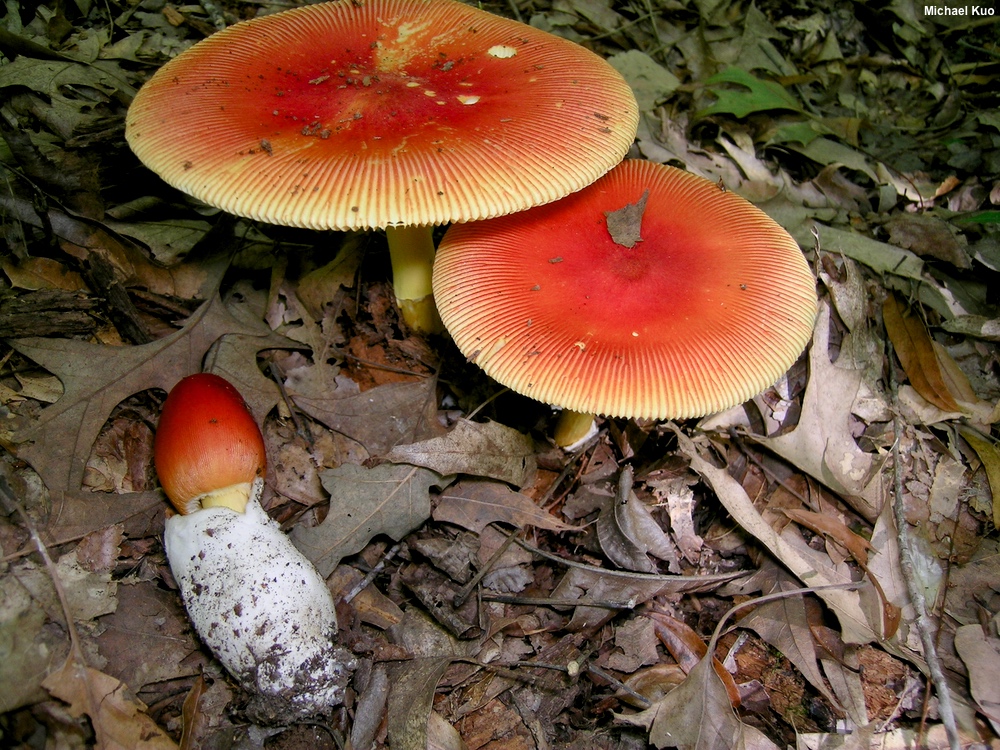
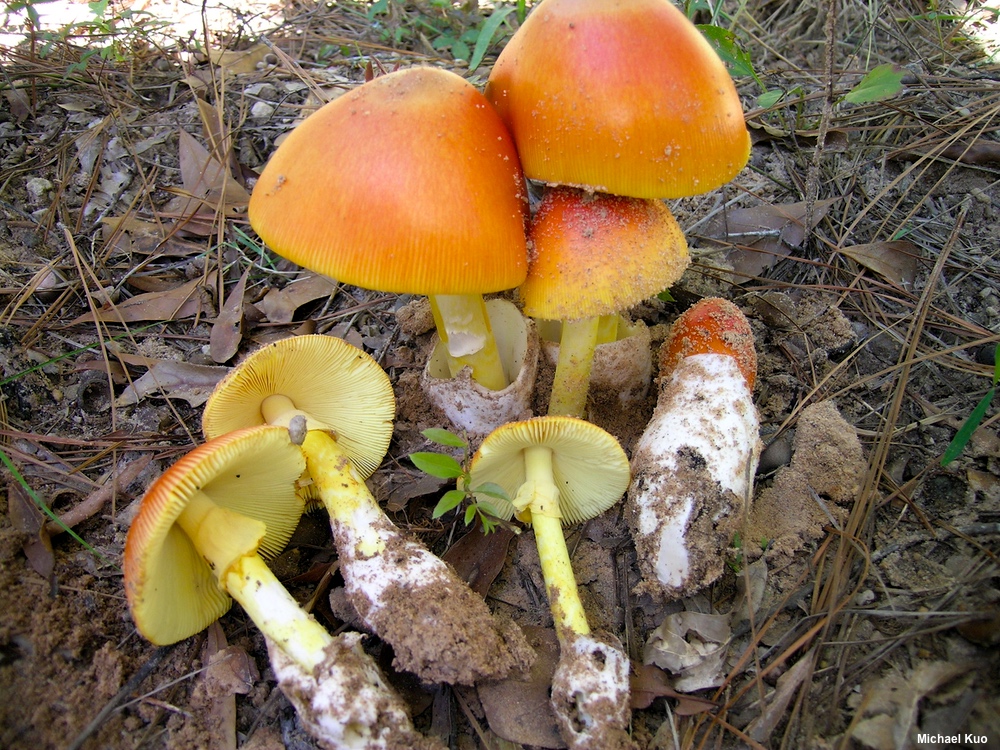
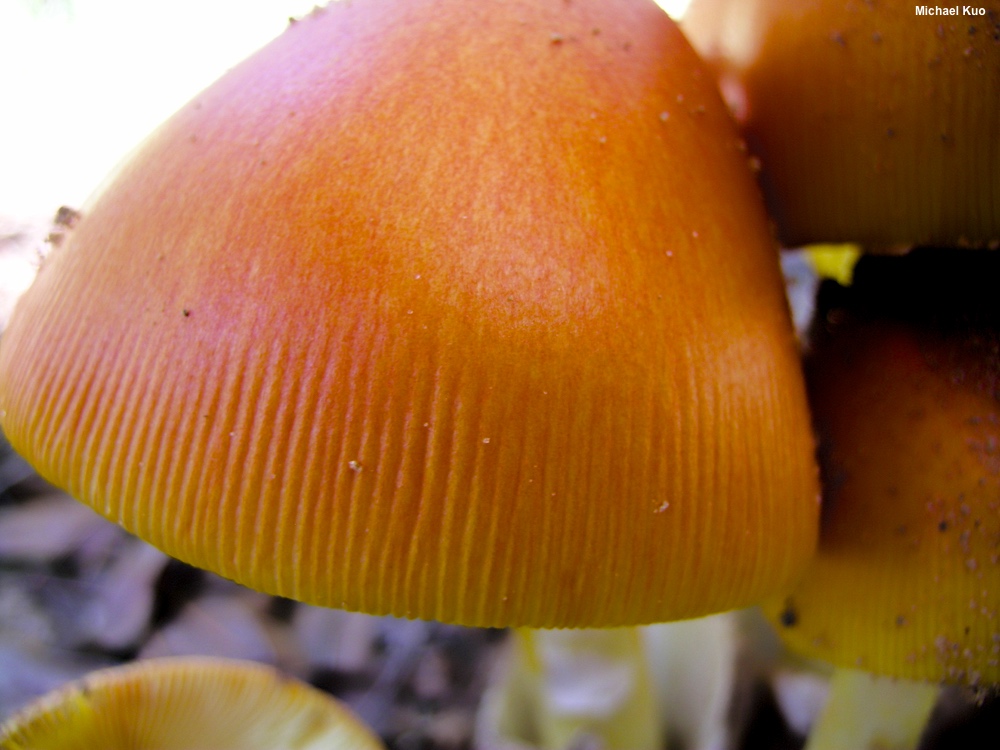
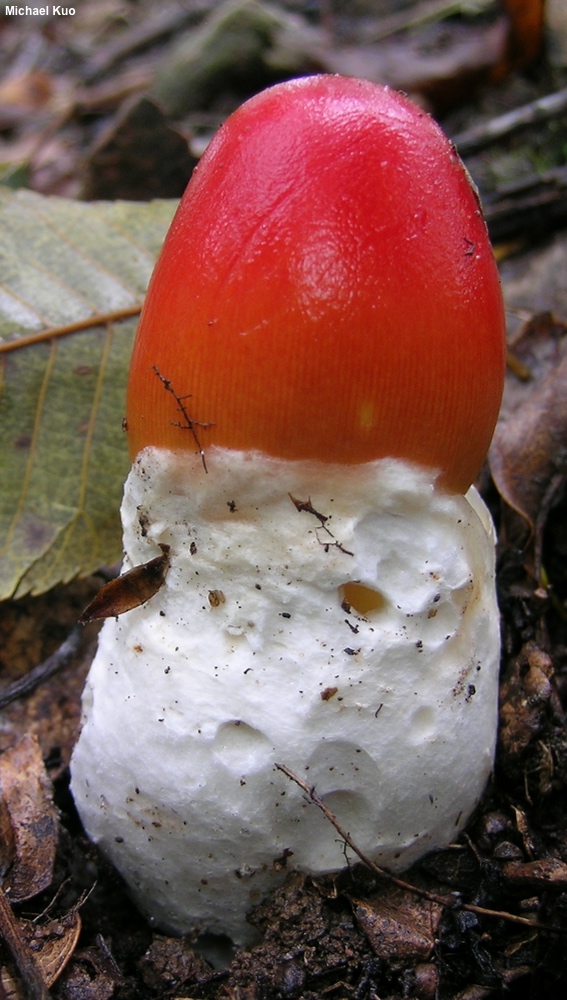
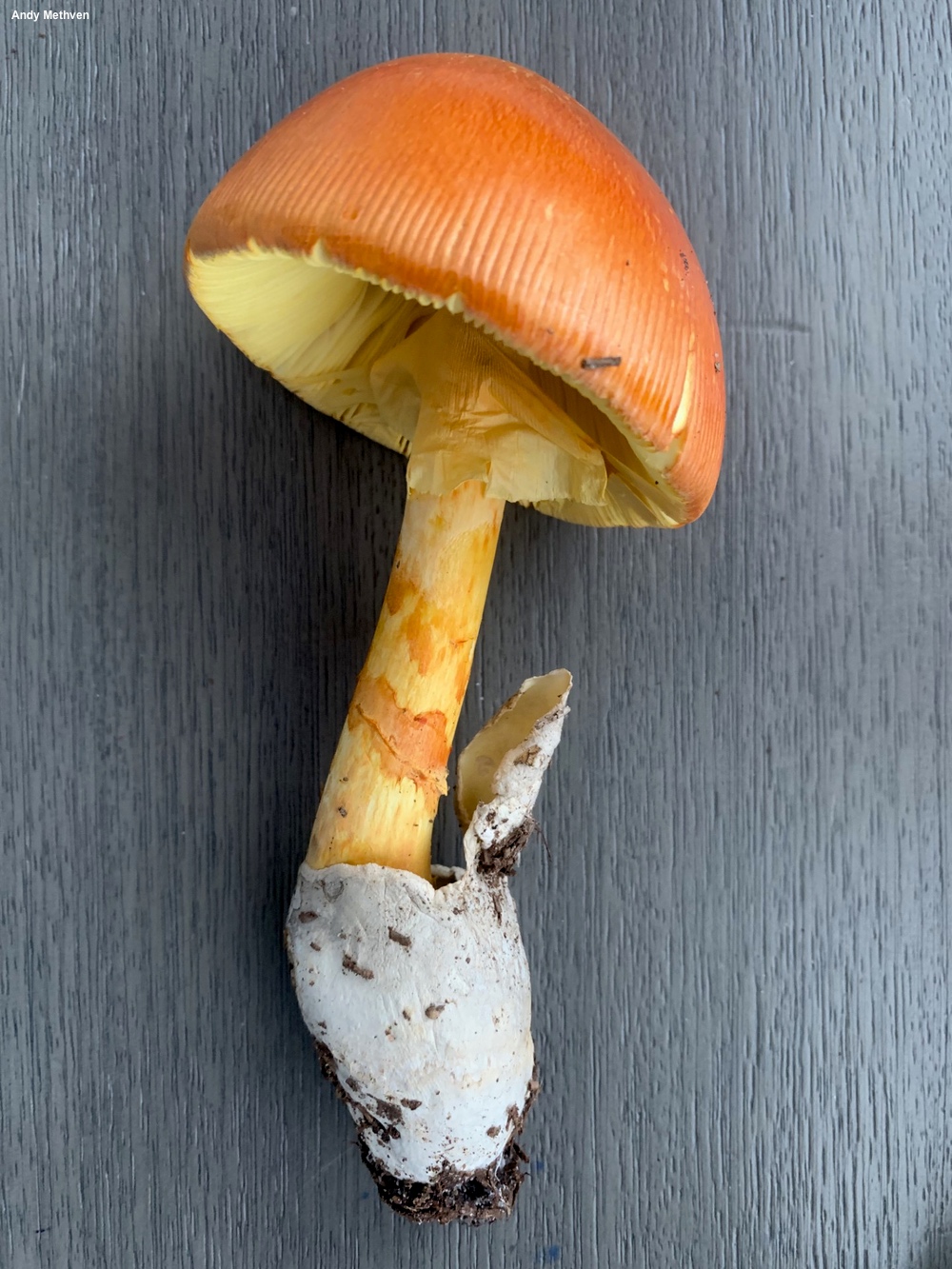
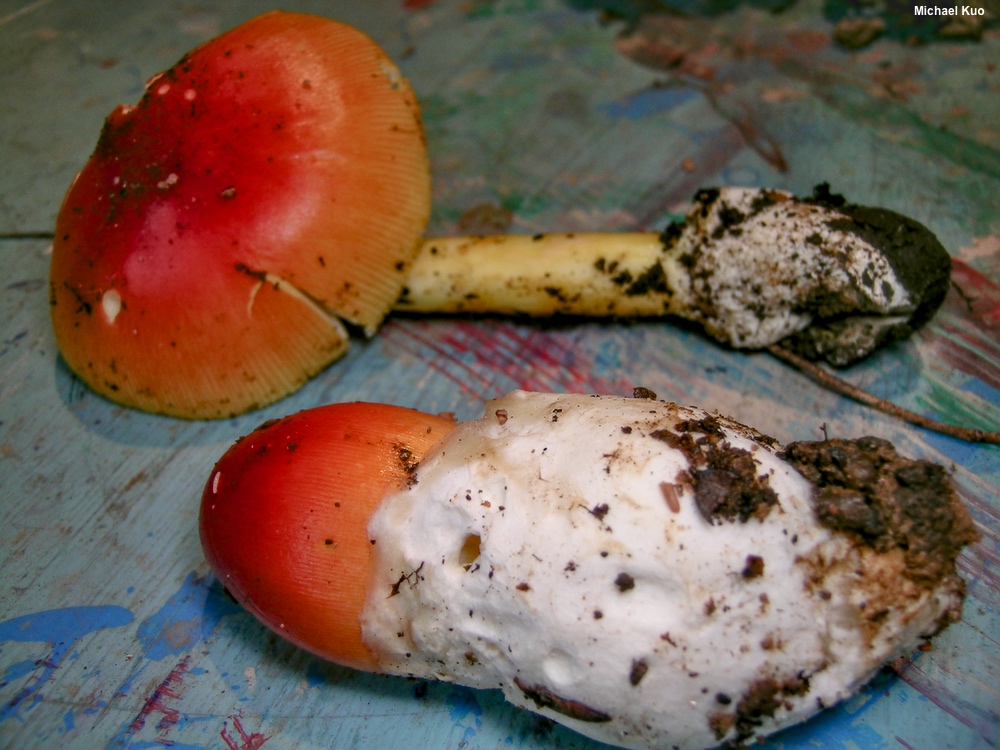
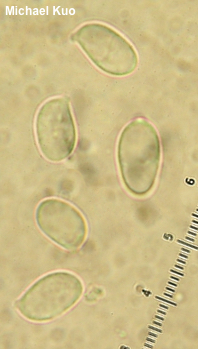
[ Basidiomycota > Agaricales > Amanitaceae > Amanita . . . ] Amanita jacksonii by Michael Kuo, 27 June 2024 The North American versions of the European species Amanita caesarea are numerous and confusing, and their taxonomy has not yet been completely established. The principal (mushroom) players in this drama are fairly easily recognized by their yellow gills, their large, white, sacklike volvas, and their bright orange or orange red caps, which have lined margins. Heading up the cast is Amanita jacksonii. It is an impressive northeastern actor, appearing in woodland theaters from Québec to the the Appalachians, recognized by its brilliant colors, the slender yellow stem with reddish to orange fibers and a large yellow ring, and the fact that the cap begins to fade to yellow from the margin inward. Virtually identical cryptic phylogenetic species appear in the lower Midwest, Texas, the Four Corners region, and Mexico; some of these have been officially named (Mexico's Amanita basii and Amanita yema), and others have been given temporary names like "jack5" and "cochiseana." Compare the red to orange members of the jacksonii group with their yellow-capped North American counterparts, including Amanita arkansasa and Amanita species 04. Thanks to Andy Methven for facilitating study of a collection of Amanita jacksonii. Amanita tullossii is a synonym, as is "Amanita caesarea" in the sense of North American authors prior to about the year 2000, at least in part. Description: Ecology: Mycorrhizal with oaks and pines; growing alone, scattered, or gregariously; summer and fall; originally described from Québec (Pomerleau 1980); widely distributed east of the Great Plains and in Mexico as a species group, from Québec to Hidalgo. The illustrated and described collections are from Missouri, North Carolina, and Texas. Cap: 5–12 cm; oval at first, becoming convex, typically with a central bump; sticky when fresh; brilliant red or orange, fading to orange, or yellow on the margin; bald; typically without warts or patches; the margin becoming lined for about 40–50% of the cap's radius. Gills: Free from the stem or slightly attached to it; close; short-gills frequent; yellow. Stem: 8–15 cm long; 1–2 cm thick; slightly tapering to apex; yellow; with orange to reddish fibers, often in zones or chevrons; with a yellow to orange, skirtlike ring; with a large (4–8 cm high and 4 mm thick), white, sacklike volva. Flesh: Whitish to pale yellow; not changing when sliced. Odor: Not distinctive. Chemical Reactions: KOH on cap surface erasing pigment to yellow. Spore Print: White. Microscopic Features: Spores 7–13 x 6–8 µm; ellipsoid to broadly ellipsoid or nearly subglobose, with an apiculus; smooth; hyaline and uniguttulate in KOH; inamyloid. Basidia 32–38 x 6–8 µm; 4-sterigmate; clamped. Hymenial cystidia not found. Subhymenium ramose-cellular. Pileipellis an ixocutis of smooth, hyaline elements 2–5 µm; wide. Veil elements 20–45 µm across; globose or irregularly subglobose; smooth; hyaline in KOH. REFERENCES: R. Pomerleau, 1984. (Smith, Smith & Weber, 1979; Arora, 1986; States, 1990; Phillips, 1991/2005; Lincoff, 1992; Metzler & Metzler, 1992; Jenkins, 1986; Roody, 2003; McNeil, 2006; Miller & Miller, 2006; Binion et al., 2008; Kuo & Methven, 2010; López & García, 2012; Tulloss, 2013; Kuo & Methven, 2014; Sánchez-Ramírez et al., 2015; Woehrel & Light, 2017; Baroni, 2017; Elliott & Stephenson, 2018; Sturgeon, 2018; McKnight et al., 2021.) Herb. Kuo 10200704, 09200806, 04302401. This site contains no information about the edibility or toxicity of mushrooms. |
|
|
Cite this page as: Kuo, M. (2024, June). Amanita jacksonii. Retrieved from the MushroomExpert.Com Web site: http://www.mushroomexpert.com/amanita_jacksonii.html © MushroomExpert.Com |