| Major Groups > Polypores > Stemmed, Pale-Fleshed > Albatrellus cristatus |

|
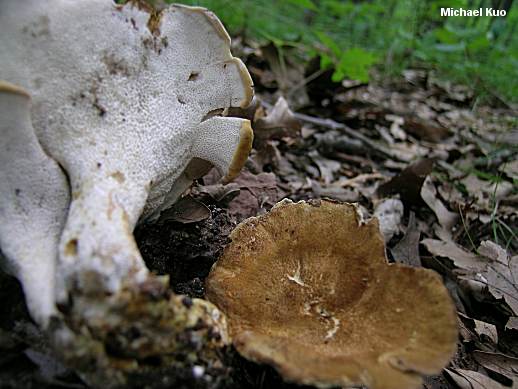
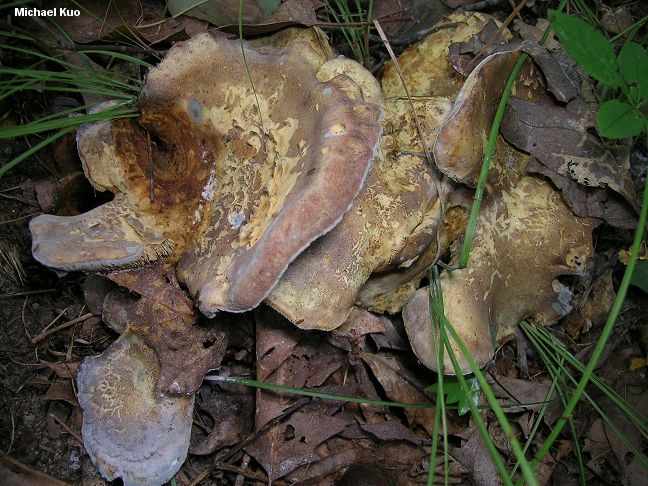
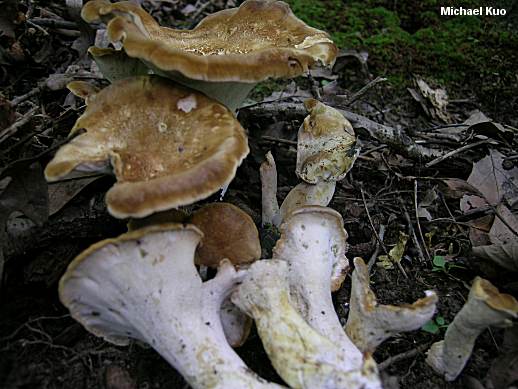
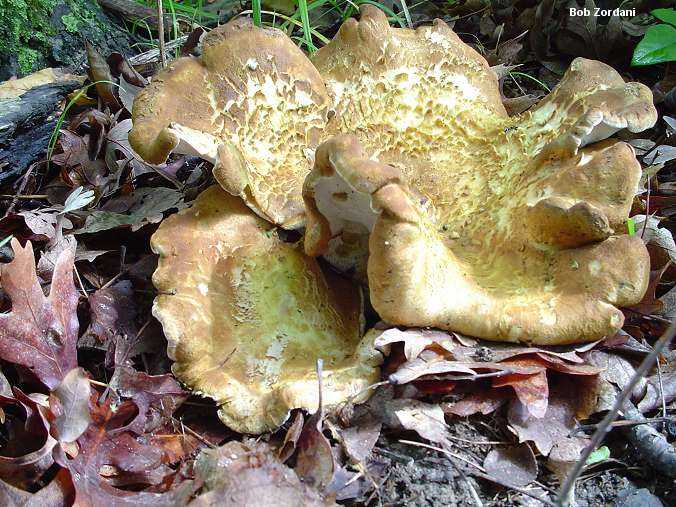
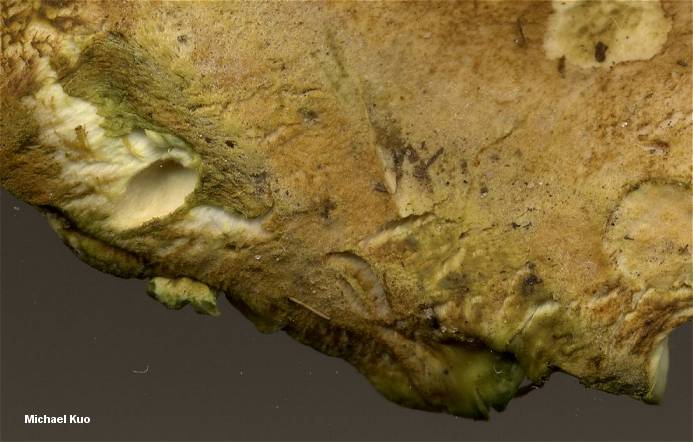
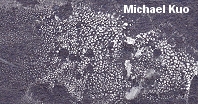
Albatrellus cristatus [ Basidiomycetes > Polyporales > Albatrellaceae > Albatrellus . . . ] by Michael Kuo Albatrellus cristatus is an attractive, large polypore found east of the Rocky Mountains under hardwoods. It grows terrestrially, rather than on wood, and can be recognized by its yellowish brown cap, its white to greenish yellow pore surface, its relatively central, single stem, and its nearly round spores. The similar Albatrellus ellisii grows under conifers, has a yellower cap that is truly scaly (not merely cracked in age), and bruises and stains green more strongly. Though it is widely distributed, it is more common west of the Rocky Mountains. Its spores are elliptical, measuring 8-9 x 5-7 µ. Albatrellus pes-caprae, also found under conifers, has a brown or pinkish brown cap that is finely hairy or scaly, and large (> 1 mm) pores; it is apparently limited to the southeastern United States and the West Coast. Its spores are elliptical, measuring 8-11 x 5-6 µ. Description: Ecology: Assumed to be mycorrhizal; growing alone or scattered; terrestrial under hardwoods and occasionally under conifers; summer and fall; widely distributed east of the Rocky Mountains. Cap: 5-20 cm across; circular or irregular in outline; loosely convex, flat, or irregular; dry; smooth or somewhat velvety or leathery, sometimes becoming cracked with age (but not scaly before this); yellowish to yellowish brown, sometimes with greenish shades; often bruising olive or greenish, especially near the margin. Pore Surface: Descending the stem; white, or eventually greenish to yellowish; pores small (1-3 per mm) and angular; tubes 1-5 mm deep. Stem: 3-6 cm long; 1-2.5 cm wide; central or somewhat off-center; yellowish; smooth; dry. Flesh: White; olive to greenish around larval tunnels; sometimes slowly staining olive to greenish or even bluish on exposure; thick. Chemical Reactions: Flesh slowly reddish with KOH. Spore Print: White. Microscopic Features: Spores 5-6 x 4-5 µ; smooth; round or nearly so. Clamp connections absent. REFERENCES: (Schaeffer, 1774) Kotlaba & Pouzar, 1957. (Persoon, 1801; Fries, 1821; Saccardo, 1888; Overholts, 1953; Smith, Smith & Weber, 1981; Arora, 1986; Gilbertson & Ryvarden, 1986; Lincoff, 1992; Roody, 2003; Binion et al., 2008.) Herb. Kuo 06120304, 07080704. This site contains no information about the edibility or toxicity of mushrooms. |
© MushroomExpert.Com |
|
Cite this page as: Kuo, M. (2004, November). Albatrellus cristatus. Retrieved from the MushroomExpert.Com Web site: http://www.mushroomexpert.com/albatrellus_cristatus.html |