| Major Groups > Gilled Mushrooms > Pink-Spored > Pluteus > Pluteus phlebophorus |

|
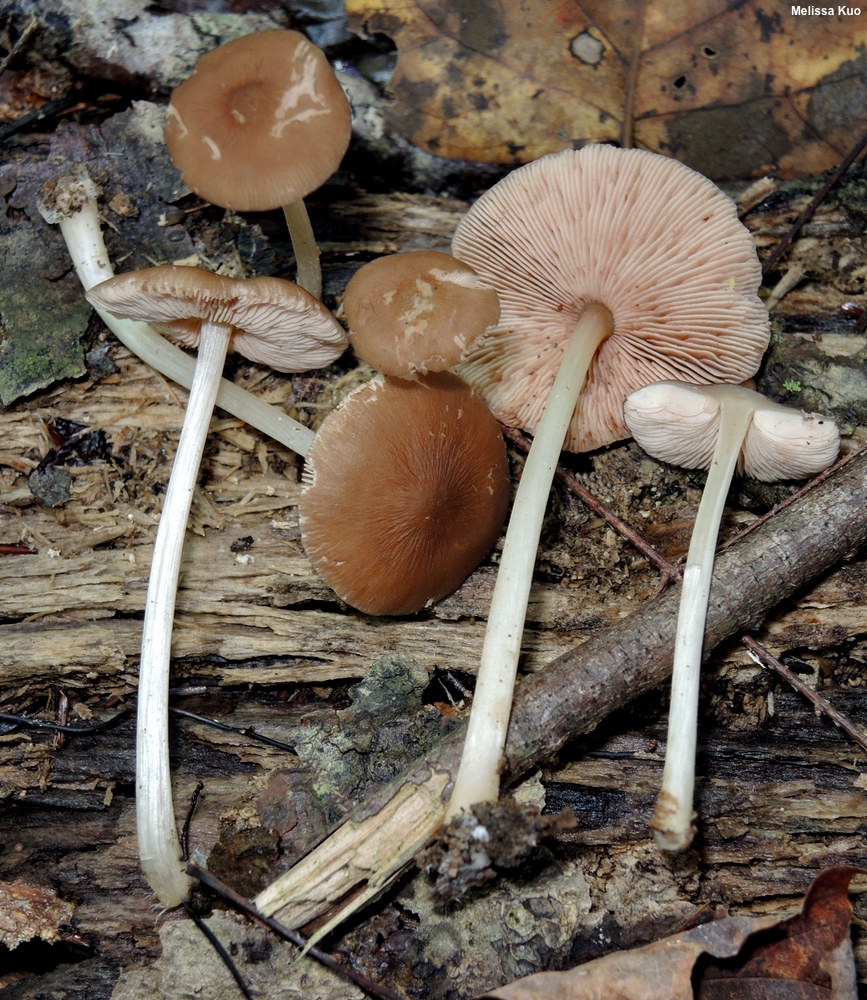
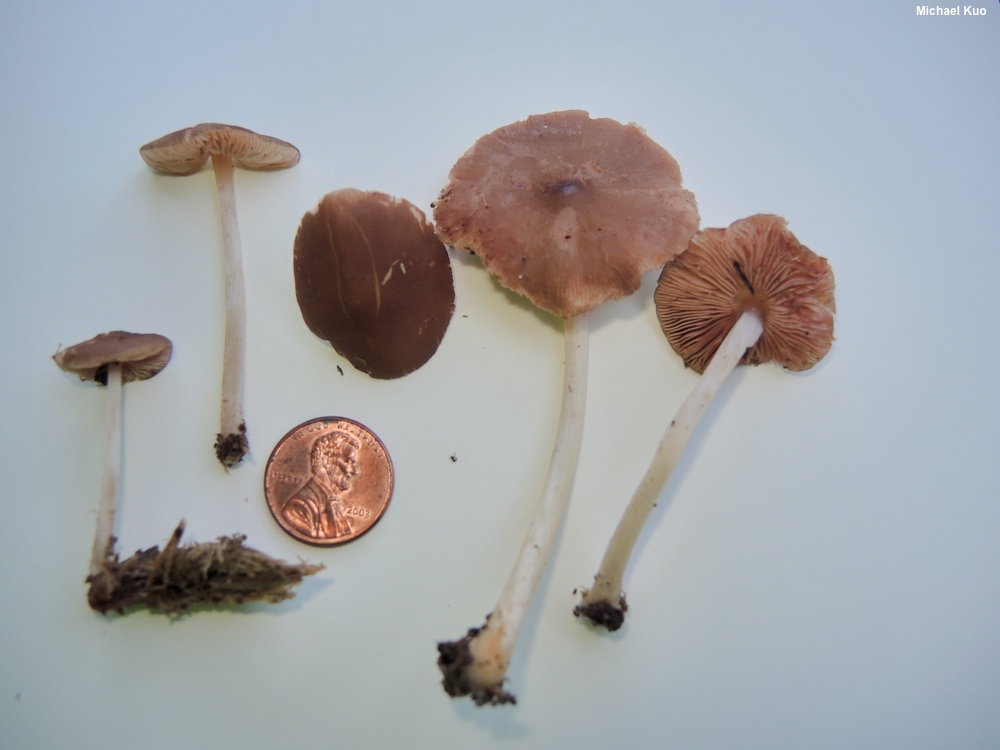
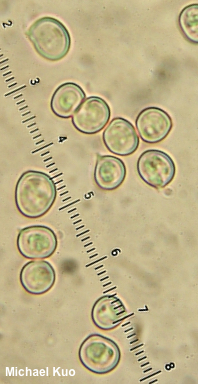
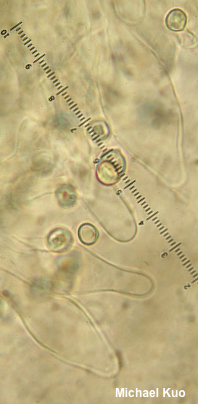
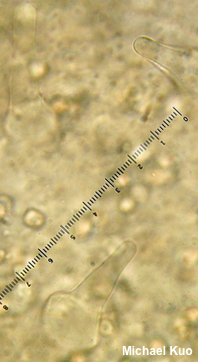
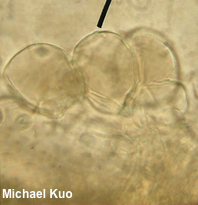
[ Basidiomycota > Agaricales > Pluteaceae > Pluteus . . . ] Pluteus phlebophorus by Michael Kuo, 2 July 2026 This is one of those little Pluteus species requiring microscopic examination for identification. Melissa and I found this one in Kentucky, more than 10 years ago, and I have only this month gotten around to taking a look at its microcharacters, which tells you something—either about Pluteus phlebophorus and its lack of charisma, or about my motivation. Before getting out the microscope for this mushroom, note the small size, the thin and fragile cap that sometimes features a veined center, the habitat on the deadwood of hardwoods, and the lack of a distinctive odor. Then make yourself a nice, clean Roman aqueduct section of a fresh or dried (10 years ago, perhaps) cap, and look for broadly ellipsoid spores, hymenial cystidia that are thin-walled and fairly long-necked, a "cellular" pileipellis, and a lack of clamp connections. If you can check all of these macro- and micro-boxes, go ahead and do a little phlebophorus dance . . . Or not. Description: Ecology: Saprobic on decaying hardwood logs; growing alone or gregariously; summer and fall in temperate climates; originally described from Germany (Ditmar 1813); widespread in Europe, and fairly widely distributed in North America, especially east of the Rocky Mountains. The illustrated and described collection is from Kentucky. Cap: 1.5–4 cm; planoconvex; thin and fragile; moist when fresh; bald; sometimes radially veined over the center; dark pinkish brown; hygrophanous; the margin becoming finely lined. Gills: Free from the stem; close; short-gills frequent; pink at maturity. Stem: 3.5–5.5 cm long; 2–3 mm thick; equal; fragile; bald; whitish; not bruising but discoloring brownish, especially near the base; basal mycelium white. Flesh: Insubstantial; watery brownish; not changing when sliced. Odor: Not distinctive. Chemical Reactions: KOH on cap surface negative. Microscopic Features: Spores 5–7.5 x 5–6 µm; broadly ellipsoid to subglobose; smooth; hyaline in KOH; inamyloid. Basidia 20–23 x 6–7 µm; subclavate; 4-sterigmate. Cheilocystidia 40–65 x 7–20 µm; widely cylindric to fusoid or lageniform, often with a long neck; smooth; thin-walled; hyaline in KOH. Pleurocystidia 50–70 x 15–18 µm; lageniform, with a fairly long neck; smooth; thin-walled; hyaline in KOH. Pileipellis hymeniform/cellular; elements 25–40 µm wide, subglobose or very broadly ellipsoid, smooth, hyaline in KOH; no pileocystidia found. Clamp connections not found. REFERENCES: (L. P. F. Ditmar, 1813) P. Kummer, 1871. (Singer, 1956; Homola, 1972; Vellinga, 1990; Breitenbach & Kränzlin, 1995; Minnis & Sundberg, 2010; Justo et al., 2011; Buczacki et al., 2012; Gminder & Böhning, 2017; Heilmann-Clausen, 2018; Læssøe & Petersen, 2019; Kibby, 2020.) Herb. Kuo 10041502. This site contains no information about the edibility or toxicity of mushrooms. |
© MushroomExpert.Com |
|
Cite this page as: Kuo, M. (2026, July). Pluteus phlebophorus. Retrieved from the MushroomExpert.Com Web site: http://www.mushroomexpert.com/pluteus_phlebophorus.html |