
|
Black Oak (Quercus velutina) [ Trees > Hardwoods > Oaks . . . ] Forest Type: Oak-Hickory
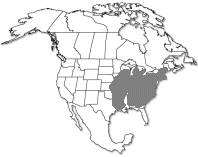
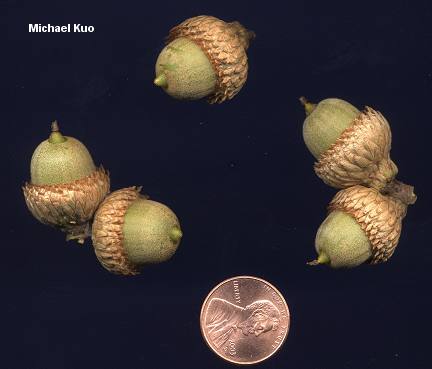
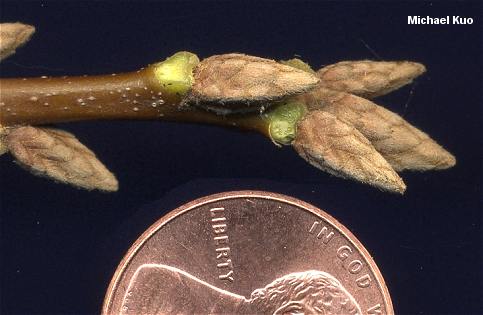
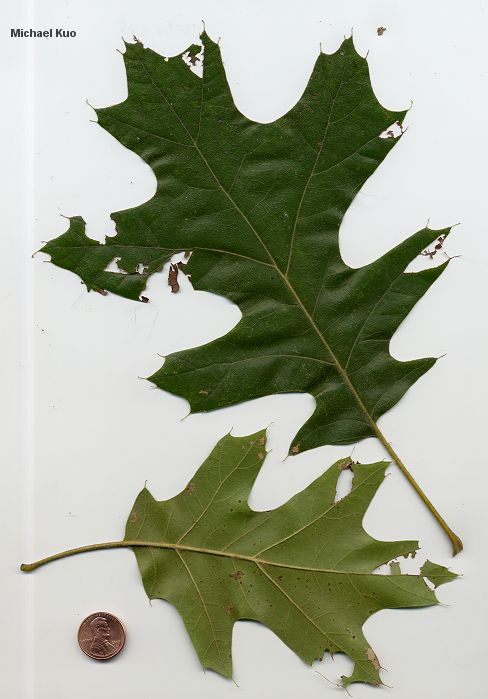
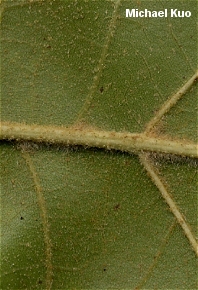
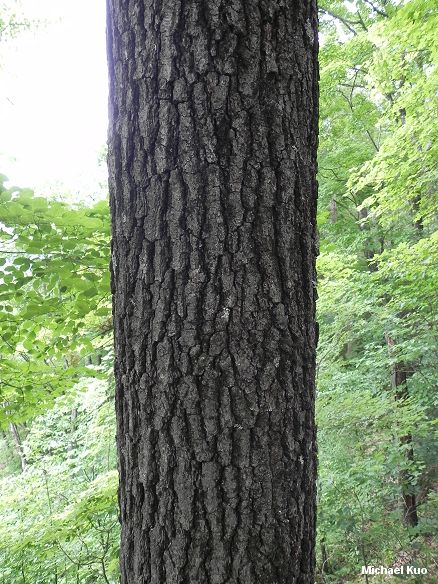
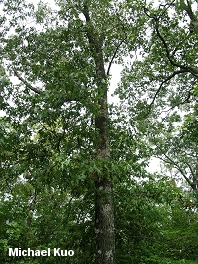
by Michael Kuo Note: The red oaks (those with bristle-tipped leaves) of eastern North America are notoriously difficult to separate--a task compounded by the fact that the trees often hybridize in nature. Habitat: Able to grow in dry or moist soil; often in mixed stands; east of the Great Plains. Stature: 50-100 feet high (or larger); to 3 feet in diameter; with an irregular, rounded crown. Leaves: With bristle tips; 5-9 inches long; with 5-7 lobes; one or more sinuses often extending more than halfway to the midrib; dark green and shiny above; pale green or, often, with a coppery orangish sheen below, with many hairs creating a fuzzy feel. Bark: Dark gray to black; thick; deeply furrowed; with narrow ridges in age, but not appearing "striped" from a distance. Acorns: Bitter; to 3/4 inch long; enclosed for 1/3 to 1/2 of the length, in a cup with free-tipped scales; appearing every two years. Buds: About 1/2 inch long; finely hairy or fuzzy; 4-sided; grayish brown. |
© MushroomExpert.Com |
|
Cite this page as: Kuo, M. (2005, September). Black oak (Quercus velutina). Retrieved from the MushroomExpert.Com Web site: http://www.mushroomexpert.com/trees/quercus_velutina.html |