| Major Groups > Gilled Mushrooms > Pale-Spored / Dark-Spored / Pink-Spored > Pleurotoid Mushrooms |

|
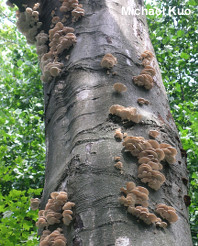
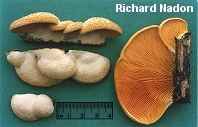
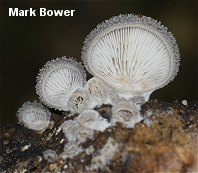
Pleurotoid Mushrooms by Michael Kuo Mushrooms with a "pleurotoid" habit grow on wood, have gills, and typically form semicircular or kidney-shaped caps that are either directly attached to the wood or are attached by means of a rudimentary, lateral stem. They often grow in loose or dense clusters, forming shelf-like groups. However, many pleurotoid mushrooms can develop more or less central stems, especially when they grow on the upper surface of a log—when the stemless, sideways fruiting strategy would not allow the mushroom to hold its gills so that the spores will catch air currents and be distributed. Pleurotoid mushrooms do not form a group of naturally related mushrooms; it is simply convenient, when identifying mushrooms, to narrow down the possibilities by lumping them together. Species of Crepidotus, for example, have brown spore prints and belong in the family Inocybaceae—while the "oyster mushroom," Pleurotus ostreatus has a lilac spore print and belongs in an entirely different family, the Pleurotaceae. Clitopilus hobsonii
|
© MushroomExpert.Com |
|
References Aime, M. C. (2001). Biosystematic studies in Crepidotus and the Crepidotaceae. Doctoral dissertation, Virginia Polytechnic and State University. Aime, M. C. & J. Ball (2002). The mating system in two species of Crepidotus. Mycotaxon 81: 191–194. Aime. M. C., R. Vilgalys & O. K. Miller (2005). The Crepidotaceae (Basidiomycota, Agaricales): Phylogeny and taxonomy of the genera and revision of the family based on molecular evidence. American Journal of Botany 92: 74–82. Alberto, E. et al. (1998). Reevaluation of Hohenbuehelia nigra and species with close affinities. Mycologia 90: 142–150. Bandala, V. M. & L. Montoya (2000a). A revision of some Crepidotus species related to Mexican taxa. Mycological Research 104: 495–506. Bandala, V. M. & Montova, L. (2000b). A taxonomic revision of some American Crepidotus. Mycologia 92: 341–353. Bandala, V. M. & L. Montoya (2008a). Type studies in the genus Crepidotus. Mycotaxon 103: 235–254. Bandala, V. M., L. Montoya & M. Mata (2008b). Crepidotus crocophyllus found in Costa Rica and Mexico and revision of related species in subsection Fulvifibrillosi. Mycologia 100: 335–346. Bao, D., S. Kinugasa & Y. Kitamoto (2004). The biological species of oyster mushrooms (Pleurotus spp.) from Asia based on mating compatibility tests. Journal of Wood Science 50: 162–168. Bresinsky, A., M. Fischer, B. Meixner & W. Paulus (1987). Speciation in Pleurotus. Mycologia 79: 234–245. Bruce, A. L. (2018). Population genomic insights into the establishment of non-native golden oyster mushrooms (Pleurotus citrinopileatus) in the United States. Master of Science thesis, University of Wisconsin-La Crosse. 40 pp. Bunyard, B. A., S. Chaichuchote, M. S. Nicholson & D. E. Royse (1996). Ribosomal DNA analysis for resolution of genotypic classes of Pleurotus. Mycological Research 100: 143–150. Buyck, B. & Horak, E. (1999). New taxa of pleurotoid Russulaceae. (1999). Mycologia 91: 532–537. Drechsler-Santos, E. R., F. Wartchow, V. R. M. Coimbra, T. B. Gibertomni & M. A. Q. Cavalcanti (2012). Studies on lentinoid fungi (Lentinus and Panus) from the semi-arid region of Brazil. Journal of the Torrey Botanical Society 139: 437–446. Grand, E. A. (2004). Systematics and species concepts in the genera Lentinus Fr. and Panus Fr., with emphasis on the Lentinus tigrinus, L. crinitus and Panus lecomtei complexes. Doctoral dissertation, University of Tennessee. Guzman, G., L. Montoya, G. Mata & D. Salmones (1994). Studies in the genus Pleurotus, III. The varieties of P. ostreatus-complex based in interbreeding strains and in the study of basidiomata obtained in culture. Mycotaxon 50: 365–378. Hesler, L. R. & Smith, A. H. (1965). North American species of Crepidotus. New York: Hafner. 187 pp. Jin, J., K. W. Hughes & R. H. Petersen (2001). Phylogenetic relationships of Panellus (Agaricales) and related species based on morphology and ribosomal large subunit DNA sequences. Mycotaxon 79: 7–21. Jin, J., K. W. Hughes & R. H. Petersen (2001). Biogeographical patterns in Panellus stypticus. Mycologia 93: 309–316. Luther, B. S. & Redhead, S. A. (1981). Crepidotus cinnabarinus in North America. Mycotaxon 12: 417–430. Mansur, M. et al. (2003). The white-rot fungus Pleurotus ostreatus secretes laccase isozymes with different substrate specificities. Mycologia 95: 1013–1020. Miller, O. K. Jr. (1969). A new species of Pleurotus with a coremioid imperfect stage. Mycologia 61: 887–893. Miller, O. K. Jr. (1970). The genus Panellus in North America. The Michigan Botanist 9: 17–30. Ohira, I. (1990). A revision of the taxonomic status of Pleurotus citrinopileatus. Reports of the Tottori Mycological Institute 28: 143–150. Pegler, D. N. (1983). The genus Lentinus: A world monograph. London: Her Majesty’s Stationery Office (Kew Bulletin Additional Series X). 281 pp. Penas, M. M. et al. (2004). Structure of gene coding for the fruit body-specific hydrophobin Fbh1 of the edible basidiomycete Pleurotus ostreatus. Mycologia 96: 75–82. Petersen, R. H. & K. W. Hughes (1993). Intercontinental interbreeding collections of Pleurotus pulmonarius, with notes on P. ostreatus and other species. Sydowia 45: 139–152. Petersen, R. H. & Krisai-Greilhuber, I. (1996). An epitype specimen for Pleurotus ostreatus. Mycological Research 100: 229–235. Petersen, R. H., K. W. Hughes & N. Psurtseva (no date). Biological species in Pleurotus. Retrieved February, 2005 from the University of Tennessee Web site: http://www.bio.utk.edu/mycology/Pleurotus/default.htm Putra, I. P., R. Hermawan & A. B. A. Salman (2023). Newly recorded Panus lecomtei (Fr.) Corner (Basidiomycota: Panaceae) for Indonesia. Makara Journal of Science 27: 165–171. Redhead, S. A. (1986). Mycological observations 15-16: On Omphalia and Pleurotus. Mycologia 78: 522–528. Rosnina, A. G., Y. S. Tan, N. Abdullah & S. Vikineswary (2016). Morphological and molecular characterization of yellow oyster mushroom, Pleurotus citrinopileatus, hybrids obtained by interspecies mating. Word Journal of Microbiology and Biotechnology 32: 18. Sousa-Guimarães, D. K., G. Alves-Sila, F. Bittencourt, O. Camacho, N. Menolli Jr., A. Góes-Neto, G. L. Robledo & E. R. Drechsler-Santos (20204). A comprehensive phylogeny of Panus (Panaceae, Polyporales) and revisited Brazilian diversity. Mycological Progress 23: 19. Thorn, R. G. & G. L. Barron (1984). Carnivorous mushrooms. Science 224: 76–78. Thorn, R. G. (1986). The "Pleurotus silvanus" complex. Mycotaxon 25: 27–66. Thorn, R. G. & G. L. Barron (1986). Nematoctonus and the tribe Resupinateae in Ontario, Canada. Mycotaxon 25: 321–453. Thorn, R. G., J.-M. Moncalvo, C. A. Reddy & R. Vilgalys (2000). Phylogenetic analyses and the distribution of nematophagy support a monophyletic Pleurotaceae within the polyphyletic pleurotoid-lentinoid fungi. Mycologia 92: 241–252. Vilgalys, R. & Sun, B. L. (1994). Ancient and recent patterns of geographic speciation in the oyster mushroom Pleurotus revealed by phylogenetic analysis of ribosomal DNA sequences. Proceedings of the National Academy of Sciences 91: 4599–4603. Vilgalys, R. & B. L. Sun (1994). Assessment of species distribution in Pleurotus based on trapping of airborne basidiospores. Mycologia 86: 270–274. Vilgalys, R., J. -M. Moncalvo, S. -R. Liou & M. Volovsek (1996). Recent advances in molecular systematics of the genus Pleurotus. In Royce, D. J., ed. Mushroom biology and mushroom products: proceedings of the second international conference, University Park, PA, June 9–12. 91–101. Yue, L., J. Chen, Y. Tuo, Z. Qi, Y. Liu, X. L. He, B. Zhang, J. Hu & Y. Li (2024). Taxonomy and phylogeny of Panus (Polyporales, Panaceae) in China and its relationship with allies. MycoKeys 105: 267–294. Zervakis, G. & Balis, C. (1996). A pluralistic approach in the study of Pleurotus species with emphasis on compatibility and physiology of the European morphotaxa. Mycological Research 100: 717–731. Zervakis, G. I., J. -M. Moncalvo & R. Vilgalys (2004). Molecular phylogeny, biogeography and speciation of the mushroom species Pleurotus cystidiosus and allied taxa. Microbiology 150: 715–726. This site contains no information about the edibility or toxicity of mushrooms. Cite this page as: Kuo, M. (2005, February). Oysters: Pleurotoid mushrooms. Retrieved from the MushroomExpert.Com Web site: http://www.mushroomexpert.com/pleurotoid.html |