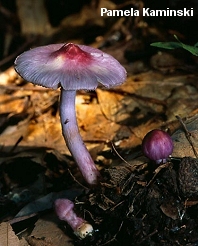
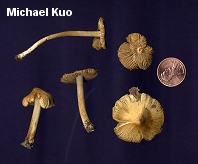
(Partial) Key to Morphology-Defined Inocybe Taxa in North America
Unlike most keys at MushroomExpert.Com, this key is frequently microscope-based. There is just no escaping the need for microscopic analysis with Inocybe. Source abbreviations refer to the references list below the key.
| 1. | Lilac or purplish shades present somewhere on the mushroom. | 2 |
| 1. | Lilac or purplish shades absent. | 20 |
| 2. | Spores with nodules, warts, or spiny structures. | 3 |
| 3. | Cystidia absent from gill faces. | 4 |
| 3. | Cystidia present on gill faces. | 5 |
| 4. | Sterile cells on gill edges present but not projecting as cheilocystidia. (Note: Usually described as a brown species, but "frequenter purpureo tincto" according to Atkinson's original description.) | |
| 4. | True cheilocystidia present, 35-50 µ. (According to Atkinson, "pileo brunneo, purpureo-tincto.") | |
| 5. | Mature cap to 1 cm across, reddish brown; spores 8-10 µ long. | Inocybe fulvella
GS5 672 |
| 5. | Mature cap larger than above, variously colored; spores shorter than above. | 6 |
| 6. | Cystidia with thin walls; cap pinkish brown but fading markedly as it dries out (hygrophanous). | Inocybe tubarioides
SSW 299; ATK 217 |
| 6. | Cystidia with thick walls; cap whitish over the center, pale purplish gray elsewhere. | |
| 7. | Cystidia absent from gill faces. | 8 |
| 7. | Cystidia present on gill faces. | 9 |
| 8. | Cap with a dark purplish brown central bump, purplish brown elsewhere; gills and stem discoloring pinkish. | |
| 8. | Cap with a whitish or pale central bump, whitish to pale greenish or pinkish elsewhere; neither gills nor stem discoloring pinkish. | Inocybe vinosistipitata
GS7 269 |
| 9. | Cap with lilac shades. | 10 |
| 9. | Cap without lilac shades. | 11 |
| 10. | Cap lilac to grayish lilac, fading to whitish; cystidia 40-60 µ long, fusoid-ventricose, with encrustations. | |
| 10. | Cap brownish, sometimes with lilac hues; cystidia 50-80 µ long, almost capitate (with swollen ends), without encrustations. | |
| 11. | Cystidia with thin walls; stem with a grayish sheath and a purplish apex; cap grayish. | Inocybe fuscicothurnata
GS3 27 |
| 11. | Cystidia with thick walls; stem variously colored but not sheathed; cap variously colored. | 12 |
| 12. | Stem with conspicuously contrasting brown or rusty red hairs. | 13 |
| 12. | Stem without hairs, or with pale hairs that do not contrast conspicuously. | 14 |
| 13. | Cap rusty red; spores 7-10 µ long; cystidia 60-80 µ long. | Inocybe pyrotricha
SSW 296; SS50 106 |
| 13. | Cap brown; spores 9-11 µ long; cystidia 60-100 µ long. | |
| 14. | Cap creamy yellow to creamy buff, sometimes with a pale cinnamon center. | Inocybe picrosmaS78; SS50 102 |
| 14. | Cap differently colored. | 15 |
| 15. | Most spores with length in the range 10-16 µ. | 16 |
| 15. | Most spores with length in the range 7-11 µ. | 17 |
| 16. | Cap maroon becoming brownish; flesh with a pinkish tinge; cheilocystidia projecting prominently. | Inocybe obscura var. rubens
S47 42 |
| 16. | Cap brown to dark brown, becoming tawny; flesh not pinkish; cheilocystidia not projecting prominently. | |
| 17. | Cap with a reddish brown center, pale brown elsewhere; cystidia 63 µ long or shorter; odor distinctive but not spermatic. | |
| 17. | Cap otherwise colored; some cystidia regularly longer than 63 µ; odor spermatic (or not recorded). | 18 |
| 18. | "Gregarious or subcaespitose, 4-4.5 cm high; cap pale ochraceous-fulvous, convex then expanded, nearly gibbous, prominently squamulose and irregularly rimose, marginally smoothly radiating-rimulose, 2-2.5 cm wide; gills broadly sinuate-adnexed, ventricose, isabelline becoming rusty-fulvous; cystidia cylindric or ventricose, thick-walled, 50-70 x 10-16 µ; spores oval or subreniform, inequilateral, smooth, 8-10 x 5-6 µ; stem 4-5 mm thick, white below, violaceous above, minutely white-velutinous, not squamose, with a basal bulb whose membranous volva sometimes becomes free; flesh white above, violaceous below" (Atkinson, 1918; my translation from Latin, my emphasis). | Inocybe violaceoalbipes
ATK 217 |
| 18. | Not completely as above. | 19 |
| 19. | Cystidia with apical, cystalized encrustations; stem base slightly enlarged. | |
| 19. | Cystidia without crystalized encrustations; stem base not enlarged. | |
| 20. | Fresh, unfaded cap white, whitish, or slightly pinkish. | 21 |
| 21. | Cap with pinkish hues, and/or surfaces and flesh staining pinkish to reddish. | 22 |
| 21. | Cap not pinkish; pinkish to reddish staining absent. | 25 |
| 22. | Cap (and sometimes the stem) with pinkish coloration rather than pinkish staining or bruising; gills and flesh not staining pinkish; spores 10-12.5 x 5.5-6.5 µ, not nodulose, warty, or spiny; originally described under spruce and hemlock in Nova Scotia. | 23 |
| 22. | Pinkish to reddish hues on surfaces and flesh resulting from staining or bruising; spores variously sized and shaped; ecology and range various. | 24 |
| 23. | Odor fragrant, complex. | Inocybe aurora
GS3 24 |
| 23. | Odor not distinctive. | Inocybe aurora var. inodorata
GS7 257 |
| 24. | Odor spermatic. | Inocybe whitei= Inocybe pudica
= I. geophylla var. lateritia
= Inocybe godeyi
C 683; GS6 661; K2 250;
S47 33; SSW 296 |
| 25. | Spores nodulose or angular. | 26 |
| 25. | Spores not as above. | 30 |
| 26. | Cap 4-10 cm; in North America growing in low, wet, hardwood-based ecosystems. | |
| 26. | Cap substantially smaller than above; in various ecosystems. | 27 |
| 28. | Stem terminating in a marginate bulb; cap 1-3.5 cm across; fairly well documented; probably widely distributed in North America. | Inocybe umbratica
GS4 397; K2 241 |
| 28. | Stem not terminating in a marginate bulb; cap .5-2 cm across; poorly documented; known from New York. | Inocybe palludinella
K2 242 |
| 29. | Stem hollow, not terminating in a marginate bulb; odor not recorded. | Inocybe fallax
K2 240 |
| 29. | Stem not hollow, terminating in a marginate bulb; odor sweet. | Inocybe suaveolensS78; SSW 299 |
| 30. | Pleurocystidia absent; spores (9) 11-14 µ long. | Inocybe fastigiata f. subcandida? = pale form of Inocybe rimosa
GS6 662 |
| 30. | Pleurocystidia present; spore length various. | 31 |
| 31. | Cap tiny (4-8 mm across); growing from decaying wood. | Inocybe comatella
K2 251 |
| 31. | Cap larger than above; terrestrial. | 32 |
| 32. | Most spores over 10 µ long. | 33 |
| 32. | Most spores shorter than 10 µ. | 34 |
| 33. | Cap densely fibrillose. | Inocybe bakeri
K2 245 |
| 33. | Cap silky, or with a slightly fibrillose margin--becoming slightly fibrillose with maturity. | Inocybe serotina
K2 250 |
| 34. | Cap 1.5-4 cm across. | 35 |
| 35. | Pleurocystidia 54-72 µ long; widely distributed; common; well documented species. | |
| 35. | Pleurocystidia under 50 µ long; ranges apparently limited to northeastern North America; not common; documentation sparse. | 36 |
| 36. | Stem 4-6 mm thick, equal, not hollow; buttons with a "profuse" cortina; odor not recorded; recorded from New York (possibly only by the type collection). | Inocybe sambucella
K2 252; ATK 215 |
| 36. | Stem 2-4 mm thick, with a basal bulb, usually hollow; cortina not mentioned by Grund & Stuntz; odor spermatic; recorded from Nova Scotia. | Inocybe pallidicremea
GS4 399 |
| 37. | Pleurocystidia under 55 µ long; stem 4-8 cm long. | Inocybe kauffmanii= Inocybe longipes
K2 248; S78 |
| 37. | Pleurocystidia longer than 55 µ; stem 2.5-6 cm long. | 38 |
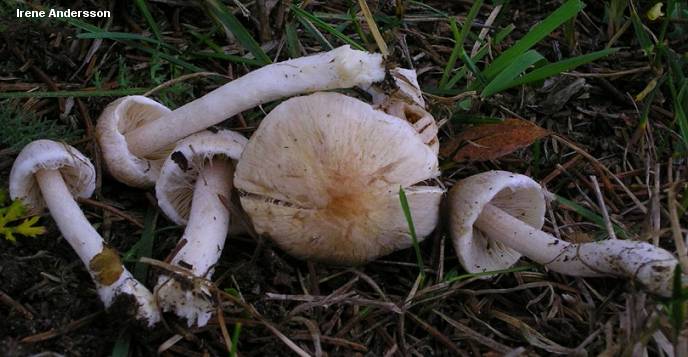
| 38. | Pleurocystidia abundant, thick-walled. | Inocybe sindoniaphoto by Irene Andersson
C 681; K1 464; K2 251
Roody, 2003 |
| 38. | Pleurocystidia scattered, thin-walled. | Inocybe insinuata
K2 252 |
References
Abbreviations correspond to those in the key above.
[A] Arora, D. (1986). Mushrooms demystified: A comprehensive guide to the fleshy fungi. Berkeley: Ten Speed Press. 959 pp.
[ATK] Atkinson, G. F. (1918). Some new species of Inocybe. American Journal of Botany 5: 210-218.
[C] Cripps, C. L. (1997). The genus Inocybe in Montana aspen stands. Mycologia 89: 670-688.
[GS1] Grund, D. W. & Stuntz, D. E. (1968). Nova Scotian Inocybes. I. Mycologia 60: 406-425.
[GS2] Grund, D. W. & Stuntz, D. E. (1970). Nova Scotian Inocybes. II. Mycologia 62: 925-939.
[GS3] Grund, D. W. & Stuntz, D. E. (1975). Nova Scotian Inocybes. III. Mycologia 67: 19-31.
[GS4] Grund, D. W. & Stuntz, D. E. (1977). Nova Scotian Inocybes. IV. Mycologia 69: 392-408.
[GS5] Grund, D. W. & Stuntz, D. E. (1980). Nova Scotian Inocybes. V. Mycologia 72: 670-688.
[GS6] Grund, D. W. & Stuntz, D. E. (1981). Nova Scotian Inocybes. VI. Mycologia 73: 655-674.
[GS7] Grund, D. W. & Stuntz, D. E. (1983). Nova Scotian Inocybes. VII. Mycologia 75: 257-270.
[GS8] Grund, D. W. & Stuntz, D. E. (1984). Nova Scotian Inocybes. VIII. Mycologia 76: 733-740.
Hansen, L. & Knudsen, H., eds. (1992). Nordic macromycetes Vol. 2: Polyporales, Boletales, Agaricales, Russulales. Copenhagen: Nordsvamp. 474 pp.
Jacobsson, S. & E. Larsson (2018). Inocybe (Fr.) Fr. in Knudsen, H. & J. Vesterholt, eds. Funga Nordica: Agaricoid, boletoid, clavarioid, cyphelloid and gastroid genera. Copenhagen: Nordsvamp. 981–1021.
[K1] Kauffman, C.H. (1918). The gilled mushrooms (Agaricaceae) of Michigan and the Great Lakes region, Volumes I and II. New York: Dover. 924 pp. (1971 Reprint.)
Kauffman, C. H. (1920). Studies in the genus Inocybe. The species of Inocybe in Peck's collections. Bulletin of the New York State Museum 233-234: 43-60.
[K2] Kauffman, C. H. (1924). Inocybe. North American Flora 10: 227-260.
[MK] Matheny, P. B. & Kropp, B. R. (2001). A revision of the Inocybe lanuginosa group and allied species in North America. Sydowia 53: 93-139.
Matheny, P. B., Liu, Y. J., Ammirati, J. F. & Hall, B. D. (2002). Using RPB1 sequences to improve phylogenetic inference among mushrooms (Inocybe, Agaricales). American Journal of Botany 89: 688-698.
Matheny, P. B. (2005). Improving phylogenetic inference of mushrooms with RPB1 and RPB2 nucleotide sequences (Inocybe; Agaricales). Molecular Phylogenetics and Evolution 35: 1-20.
Matheny, P. B. (2017). Key to species of Inocybe from eastern North America--v03. Retrieved December 8, 2017 from the University of Tennessee website: http://mathenylab.utk.edu/Site/The_Inocybaceae_Post_files/Key_Inocybe_easternNA_v03.pdf
Matheny, P. B. & R. A. Swenie (2018). The Inocybe geophylla group in North America: a revision of the lilac species surrounding I. lilacina. Mycologia 110: 618–634.
Matheny, P. B. & L. V. Kudzma (2019). New species of Inocybe (Inocybaceae) from eastern North America. Journal of the Torrey Botanical Society 146: 213–235.
Matheny, P. B., A. M. Hobbs & F. Esteve-Raventós (2020). Genera of Inocybaceae: New skin for the old ceremony. Mycologia 112: 83–120.
Matheny, P. B. & 15 coauthors (2023). A phylogeny for North American Mallocybe (Inocybaceae) and taxonomic revision of eastern North American taxa. Fungal Systematics and Evolution 12: 153–201.
Nishida, F. H. (1989). Key to the species of Inocybe in California. Mycotaxon 34: 191-196.
[SS] Smith, A. H. & Stuntz, D. E. (1950). New or noteworthy fungi from Mt. Rainier National Park. Mycologia 42: 80-134.
[SSW] Smith, A. H., Smith, H. V. & Weber, N. S. (1979). How to know the gilled mushrooms. Dubuque, Iowa: Wm. C. Brown. 334 pp.
[S47] Stuntz, D. E. (1947). Studies in the genus Inocybe I. New and noteworthy species from Washington. Mycologia 39: 21-55.
Stuntz, D. E. (1954). Studies in the genus Inocybe II. New and noteworthy species from Michigan. Papers of the Michigan Academy of Science, Arts, and Letters 21: 163-197.
[S78] Stuntz, D. E. (1978). Interim skeleton key to some common species of Inocybe in the Pacific Northwest. Notes and species descriptions by Gibson, I. (2004). Retrieved December 8, 2017 from the Pacific Northwest Key Council Web site: http://www.svims.ca/council/Inocyb.rtf
Index to Taxa Described by Grund & Stuntz in Nova Scotian Inocybe Papers (I-VIII)
This website contains no information about the edibility or toxicity of mushrooms.
Cite this page as:
Kuo, M. (2007, April). The genus Inocybe. Retrieved from the MushroomExpert.Com Web site: http://www.mushroomexpert.com/inocybe.html