| Major Groups > Toothed Mushrooms > Hericium |

|
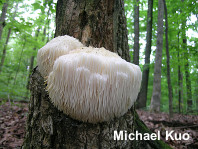
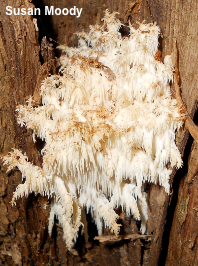
The Genus Hericium [ Basidiomycota > Russulales > Hericiaceae . . . ] by Michael Kuo These wood-loving mushrooms are easily identified to genus by their drooping spines, which hang like little icicles. They have no caps; some of the species hang their spines from branched structures, while one species simply forms a large clump of spines. Recent molecular biology studies have placed Hericium within the Russulales (it was previously variously disposed in the "Aphyllophorales"), in the family Hericiaceae (see Mushroom Taxonomy for the complete hierarchy). Obviously, there is no traditional morphological distinction one can make that would place Hericium erinaceus and Russula foetentula in the same order while another gilled mushroom—say, Pluteus cervinus—belongs in a different order. To confuse things further, the order Russulales also contains the polypore Bondarzewia berkeleyi and other morphologically diverse mushrooms. Ain't convergent evolution grand? To my knowledge no thorough contemporary study of North American Hericium collections has been done—which means that the species currently recognized are based on morphological and biological species concepts and may be subject to revision once DNA studies apply the phylogenetic species concept. One global DNA-based study (Hallenberg and collaborators, 2013) opened Pandora's Box for North America, supporting some groupings of collections but also discovering misidentifications in previous studies, as well as multiple misidentifications and inconsistent name applications in the American material studied. In short, mycology grad student, have at it. |
|

|
Key to 4 Species of Hericium in North America
References Ginns, J. (1985). Hericium in North America: cultural characteristics and mating behavior. Canadian Journal of Botany 63: 1551–1563. Hall, D. & D. E. Stuntz (1971). Pileate Hydnaceae of the Puget Sound area. I. White-spored genera: Auriscalpium, Hericium, Dentinum and Phellodon. Mycologia 63: 1099–1128. Hallenberg, N., R. H. Nilsson & G. Robledo (2013). Species complexes in Hericium (Russulales, Agaricomycota) and a new species—Hericium rajchenbergii—from southern South America. Mycological Progress 12: 413–420. Harrison, K. A. (1973). The genus Hericium in North America. Michigan Botanist 12: 177–194. Stalpers, J. A. (1996). The aphyllophoraceous fungi—II. Keys to the species of Hericiales. Studies in Mycology 40: 1–185 Cite this page as: Kuo, M. (2022, July). The genus Hericium. Retrieved from the MushroomExpert.Com Web site: http://www.mushroomexpert.com/hericium.html © MushroomExpert.Com |