| Major Groups > Gilled Mushrooms > Dark-Spored > Agrocybe & Cyclocybe |

|
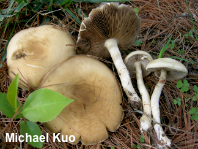
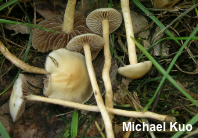
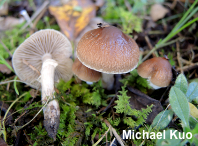
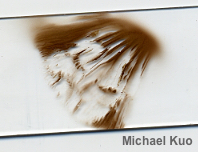
[ Basidiomycota > Agaricales > Strophariaceae . . . ] Agrocybe and Cyclocybe by Michael Kuo, December 2021 The mushrooms in Agrocybe and Cyclocybe have brown spore prints and are small to medium-sized, saprobic species that grow in grass, wood chips, dung, garden mulch, or in woods—either terrestrially, or from deadwood. They are not subject to rapid decay (in contrast to the mushrooms in Bolbitius), and the caps, with a few exceptions, are dry. Unlike species of Conocybe and Pholiotina, which have "cone heads," Agrocybe species have convex to bell-shaped or nearly flat caps. In my area (central Illinois) May and June are the months for most Agrocybe species, and the little mushrooms proliferate in urban settings and along country roads in ditches and fields. There's no stopping them—but, after the first or second excited Agrocybe stop of the year, my eager slides to meager. The truth is, they're kind of boring, and many of them look very similar. Field characters used to identify Agrocybe and Cyclocybe species include overall dimensions, the presence or absence of a partial veil (leaving remnants on the edge of the cap, or a ring on the stem), and information about where the mushrooms were growing: in grass, in woodchips, in the woods, or in urban settings. However, identification in Agrocybe and Cyclocybe often hinges on microscopic examination. Observation of spores—their dimensions, and the size of the pore at one end of the spore, if present—can settle several identification quandaries in this group of mushrooms. Occasionally, observation of cystidia is also important. Traditionally, Cyclocybe erebia and Cyclocybe cylindracea (AKA cylindrica and aegerita) were treated as species of Agrocybe, since the mushrooms share so many morphological features. But recent research (Vizzini, Angelini & Ercole 2014) demonstrates that erebia and cylindracea are actually not very closely related to Agrocybe species, using phylogenetic species concepts.
|
|

|
Key to 16 Species of Agrocybe and Cyclocybe in North America
References Caciali, G., V. Caroti & F. Doveri (1997). Note su alcune Bolbitiaceae Singer. Rivista di Micologia 2: 109–123. Calaça, F. J. S., V. G. Cortez & S. Xavier-Santos (2020). Dung fungi from Brazil: Agrocybe pediades (Fr.) Fayod (Basidiomycota) in Cerrado. Scientia Plena 16: 1–6. Cortez, V. G. & R. M. B. da Silveria (2005). First report of Agrocybe retigera (Speg.) Singer (Bolbitiaceae, Agaricales) from Brazil. Biosciências 13: 227–229. Flynn, T. & Miller, O. K. Jr. (1990). Biosystematics of Agrocybe molesta and sibling species allied to Agrocybe praecox in North America and Europe. Mycological Research 94: 1103–1110. González, P. & LaBarere, J. (1998). Sequence and secondary structure of the mitochondrial small-subunit rRNA V4, V6, and V9 domains reveal highly species-specific variations within the genus Agrocybe. Applied and Environmental Microbiology 64: 4149–4160. Halama, M. (2016). Agrocybe putaminum (Agaricales, Basidiomycota), new for Poland. Polish Botanical Journal 61: 293–299. Lechner, B. E. (2015). Especies de Agaricales (Basidiomycota) halladas por primera vez en la Argentina: Agrocybe molesta, Coprinopsis romagnesiana y Gymnopus villosipes. Boletín de la Sociedad Argentina de Botánica 50: 303–307. Malysheva, E. F. & A. A. Kiyashko (2011). Contribution to the study of Agrocybe pediades complex (Agaricales) in Russia based on nrITS sequences. Mycologia Balcanica 8: 115–124. Nauta, M. M. (2003). A new Agrocybe on woodchips in northwestern Europe. Persoonia 18: 271–274. Nauta, M. M. (2004). Notulae ad floram agaricinam Neerlandicam--XLIII. Notes on Agrocybe. Persoonia 18: 429–433. Nauta, M. M. (2005). Agrocybe. In Noordeloos, M. E., Th. W. Kuyper & E. C. Vellinga, eds. Flora Agaricina Neerlandica: Critical monographs on families of agarics and boleti occurring in the Netherlands. Volume 6. Boca Raton: Taylor & Francis. 204–221. Niveiro, N., M. Uhart & E. Albertó (2020). Revision of the genera Agrocybe and Cyclocybe (Strophariaceae, Agaricales, Basidiomycota) in Argentina. Rodriguésia 71: e02272018. Ryman, S. (2018). Agrocybe Fayod. In Knudsen, H. & J. Vesterholt, eds. Funga Nordica: Agaricoid, boletoid, clavarioid, cyphelloid and gastroid genera. Copenhagen: Nordsvamp. 928–931. Singer, R. (1977). Agrocybe. In: Keys for the identification of the species of Agaricales I. Sydowia 30: 194–206. Uhart, M. & E. Albertó (2007). Morphologic characterization of Agrocybe cylindracea (Basidiomycetes, Agaricales) from America, Europe and Asia. Revista Mexicana de Micología 24: 9–18. Vizzini, A., C. Angelini & E. Ercole (2014). Le sezioni Velatae e Aporus di Agrocybe sottogenere Aporus: rivalutazione del genere Cyclocybe Velen. ed una nuova specie. Bollettino della Associazione Micologica ed Ecologica Romana 92: 21–38. Watling, R. (1982). British Fungus Flora, Agarics and Boleti, 3: Bolbitiaceae: Agrocybe, Bolbitius & Conocybe. Edinburgh: Her Majesty's Stationery Office. 139 pp. Watling, R. & H. E. Bigelow (1983). Observations on the Bolbitiaceae—22. Mycotaxon 17: 377–397. This site contains no information about the edibility or toxicity of mushrooms. Cite this page as: Kuo, M. (2021, December). Agrocybe and Cyclocybe. Retrieved from the MushroomExpert.Com Web site: http://www.mushroomexpert.com/agrocybe.html © MushroomExpert.Com |